PESHAWAR, Pakistan: Ten-year-old Aman wants to become a teacher.
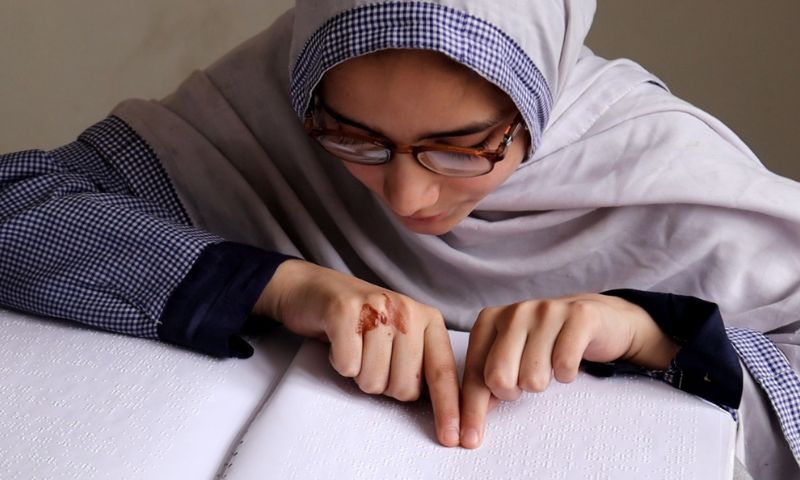
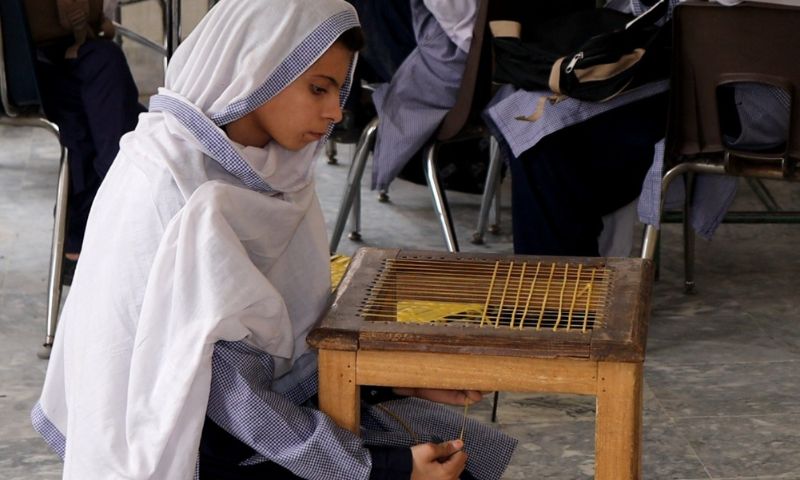
Each morning, Aman — a visually impaired girl from Upper Dir whose name means “peace” in Urdu — sits in a classroom at the Government Institute for the Visually Impaired Children in Peshawar, carefully pressing a stylus against thick Braille paper as her fingers trace raised dots across the page.
More than 290 kilometres away from home, she lives in the school’s hostel, carrying with her not only the hopes of her family but also a fear she struggles to ignore. “I want to become a teacher in the future. But I feel that my dream will never come true because our school only goes up to Grade-5.”
The total enrollment at the institution is 45. Among them, three are studying in Grade-5, five in Grade-4, seven in Grade-3, 12 in Grade-2, and 10 in Grade-1. Additionally, eight students are enrolled in Kindergarten (KG).
A single lifeline school
The Government Institute for the Visually Impaired Children is the only government-run school for girls with sight loss in Pakistan’s northwestern Khyber Pakhtunkhwa province.
“I want to become a teacher in the future. But I feel that my dream will never come true because our school only goes up to Grade-5.” – Aman, a student
In addition, there are four private schools in Khyber Pakhtunkhwa that provide education to children with special needs, including visually impaired students.
By comparison, there are 19 government schools for visually impaired students in Punjab, while Sindh has nine such institutions.
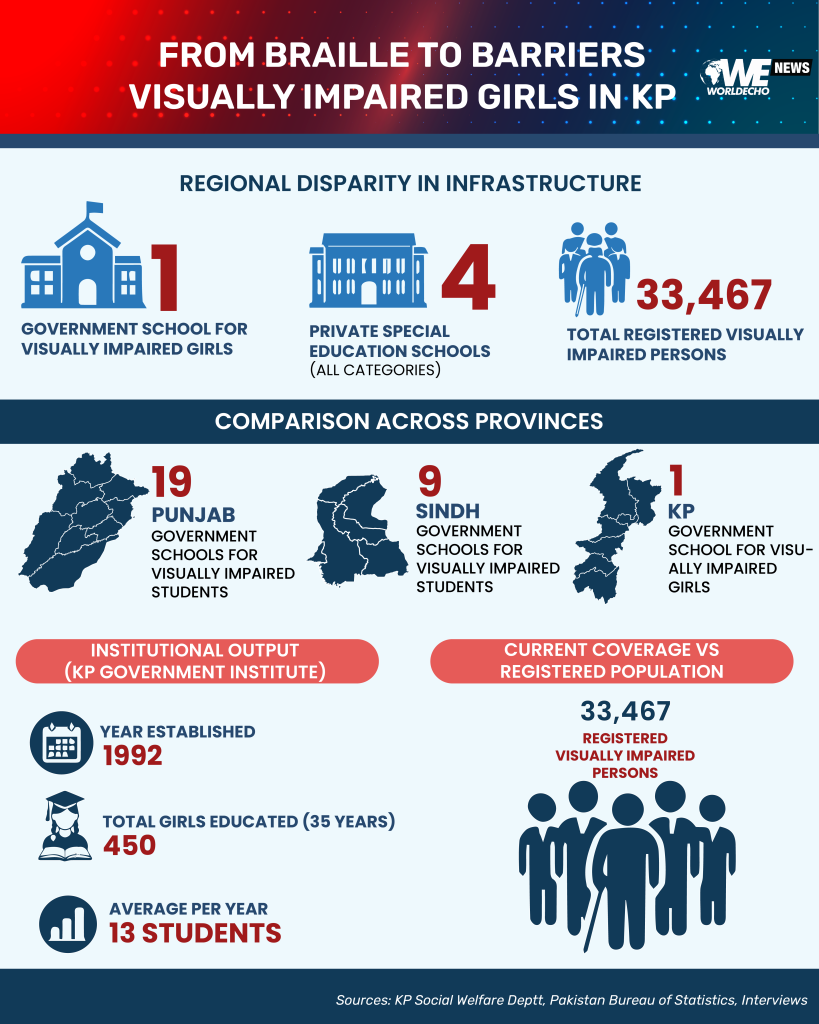
Established in 1992, the institution has educated approximately 450 girls over the past 35 years. That averages nearly 13 students per year out of 33,467 registered visually impaired persons in the province, according to the institution’s management.
Students have come from remote districts including Dir, Chitral, Swat and Bajaur. However, more than three decades later, it still offers education only up to primary level.
Meanwhile, official Khyber Pakhtunkhwa government data indicates that 33,467 visually impaired persons are registered across the province, underscoring the limited reach of the institution relative to the scale of need.
Government Institute for the Visually Impaired Children Principal Nadia Shah believes that all of these girls are capable enough to study up to PhD level because when Allah gives them a disability, He also gives them a different level of intelligence and ability if they are provided with opportunities.
“Nadia Shah says only about three to four per cent of parents choose to send their visually impaired daughters outside the province to continue their education.” Nadia Shah, Principal, Government Institute for the Visually Impaired Children, Peshawar
For many girls here, Grade-5 is not just the end of school — it is often where dreams meet a brick wall.
“Like the other girls, we have been hearing for many years that this school will be upgraded. But nothing has happened yet. After completing Grade-5, I will have to return home, and that will be very painful for our future,” Aman says.
Underreported disability crisis
Across Pakistan, persons with disabilities continue to face major barriers to education, particularly girls living in conservative and underdeveloped regions.
Pakistan’s latest official findings from the 2023 Population and Housing Census, conducted by the Pakistan Bureau of Statistics (PBS), reflect a significant shift in the country’s understanding and measurement of disability.
The data shows that approximately 9.64 per cent of the population lives with functional limitations, marking the first time that internationally recognised methodologies have been applied in a national census.
Data from the Khyber Pakhtunkhwa Social Welfare Department suggest that there are 251,668 registered persons with disabilities in the province. Of them, 33,467 are registered as visually impaired, including 8,819 children, 9,436 women and 15,212 men.
“Since I also work for persons with disabilities, around 16,000 disabled individuals are registered with me alone [in Mardan district], but official data reflects only 7,000.” – Sajjad Ahmed, rights activist
Rights activists say the actual number is likely much higher, as many families in rural areas never register disabled children because of poverty and lack of awareness.
Sajjad Ahmed — a 45-year-old rights activist from Mardan who is living with a physical disability caused by polio affecting both of his legs — works for the welfare and rehabilitation of persons with disabilities.
He says the official data significantly underrepresents the actual number of disabled people in the province. “Since I also work for persons with disabilities, around 16,000 disabled individuals are registered with me alone [in Mardan district], but official data reflects only 7,000.”
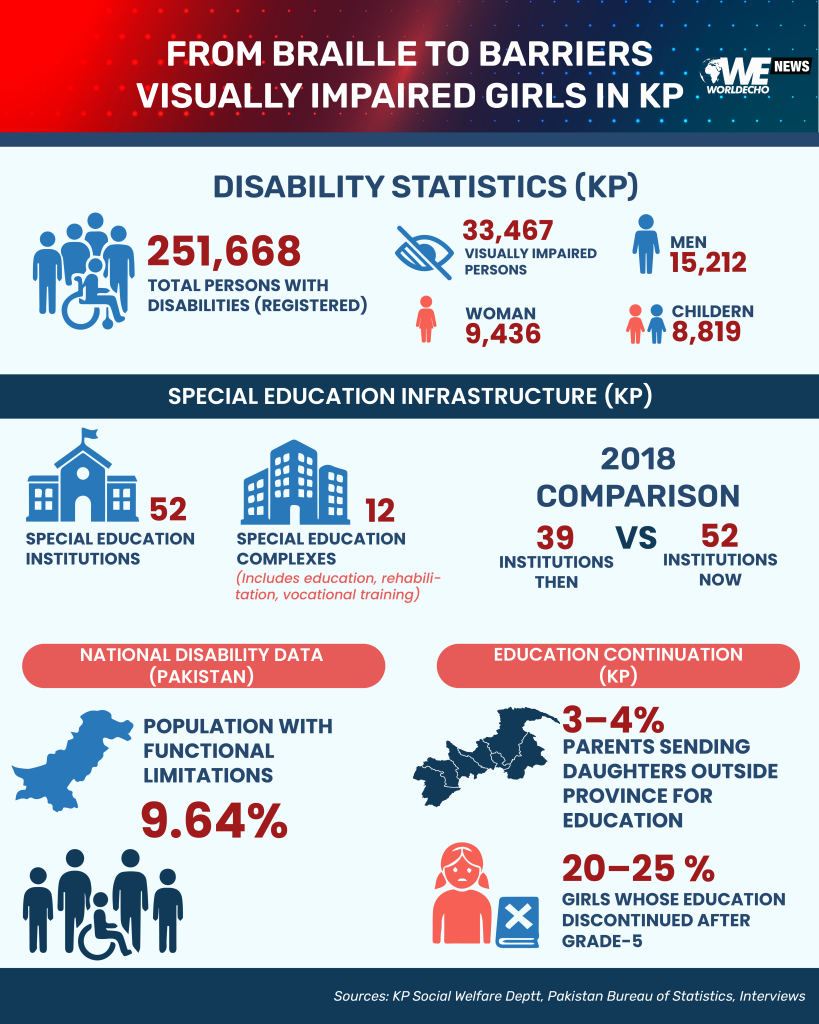
Khyber Pakhtunkhwa Social Welfare Department data show that the province currently has 52 institutions for children with special needs, including 12 special education complexes that provide education, rehabilitation and vocational training services. This represents a significant increase from 2018, when the province reported 39 special education institutions for children with visual, hearing, physical and intellectual disabilities.
Between rights and reality
Pakistan is a signatory to the United Nations Convention on the Rights of Persons with Disabilities (CRPD), which guarantees equal access to education for persons with disabilities.
In addition, under Article 25-A of Pakistan’s Constitution, education is a fundamental right for all children aged five to 16. Yet for visually impaired girls in Khyber Pakhtunkhwa, access to education remains deeply unequal.
“We belong to a Pashtun family. As a citizen, I pay my taxes in full, so it is the government’s responsibility to provide facilities for my visually impaired daughter. I cannot send my daughter far away from home to pursue further education.” – Hazrat Jan, father of a visually impaired student
Zahid Abdullah — an Islamabad-based visually impaired researcher and author of Disabled by Society — says that although there is a need to work for blind girls across all provinces of Pakistan, those living in rural areas require much greater support, especially from their parents.
“Unfortunately, this support is often lacking. That is why the challenges faced in Khyber Pakhtunkhwa are far greater compared to Punjab or Sindh.”
Government Institute for the Visually Impaired Children Principal Nadia Shah says the absence of middle and secondary classes has left many students caught in a tug of war between ambition and reality.
“There is only one school for visually impaired girls in the whole of Khyber Pakhtunkhwa, and it only provides education up to the primary level,” she complains.
Beyond institutional limitations, family support often determines how far visually impaired girls are able to pursue their aspirations.
Zahid Abdullah remarks that people with any type of disability face different kinds of challenges, but if families provide support, blind girls can achieve a great deal. There are many visually impaired girls in Pakistan who are excelling in various fields, largely because their families stand by them and support them.
Learning stops at five
For girls in Khyber Pakhtunkhwa who want to continue their studies after Grade-5, the nearest option is often in Punjab or Islamabad. But sending blind daughters away from home is a difficult decision for many families in the deeply conservative Pashtun belt.
Although some parents from remote districts of Khyber Pakhtunkhwa are willing to send their daughters to Peshawar for primary education, only a small number agree to send them to other provinces for further studies.
“Unfortunately, this support is often lacking. That is why the challenges faced in Khyber Pakhtunkhwa are far greater compared to Punjab or Sindh.” – Zahid Abdullah, visually impaired researcher and author
Nadia Shah says only about three to four per cent of parents choose to send their visually impaired daughters outside the province to continue their education.
The principal says she has been lobbying authorities since 2022 to upgrade the school to middle and secondary level. “Even now, there are around 20 to 25 girls whose education has been discontinued,” she says.
The price of education
Four years ago, Naila completed Grade-5 from the Government Institute for the Visually Impaired Children. Like many other students, her education came to an abrupt halt because there were no higher classes available.
Her father initially refused to send her outside the province. But Naila and her sister, who is also visually impaired, persisted, urging him repeatedly to let them continue studying.
Eventually, he agreed.
Today, Naila studies in Grade-8 at a government school for visually impaired students in Islamabad, where she lives in a hostel alongside her sister.
For many families, however, sending visually impaired daughters outside the province for education remains out of the question.
Peshawar-based Hazrat Jan, the father of visually impaired student Muskan Jan, says concerns about safety, distance and cultural norms prevent many parents from making that decision.
“We belong to a Pashtun family. As a citizen, I pay my taxes in full, so it is the government’s responsibility to provide facilities for my visually impaired daughter. I cannot send my daughter far away from home to pursue further education.”
The missing framework
Despite the challenges, the classrooms inside the Government Institute for the Visually Impaired Children remain filled with resilience and ambition.
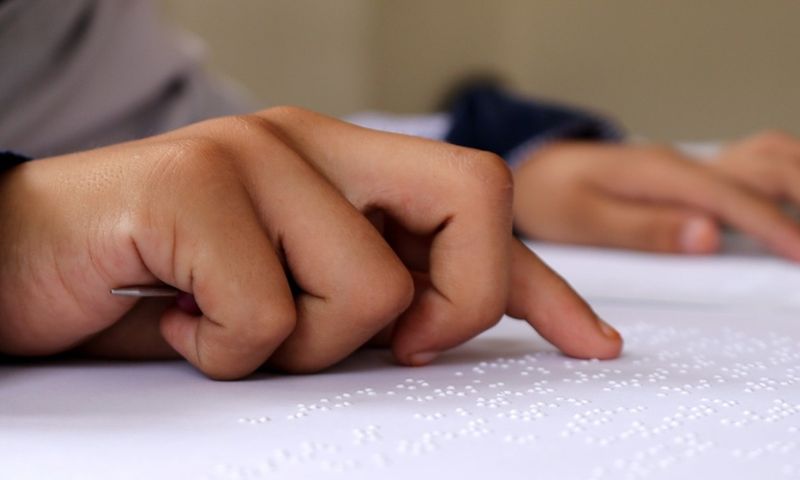
Girls recite lessons in Braille, memorise poetry and learn skills that they hope will help them live independently. Teachers say visually impaired students often excel academically when given opportunities and support — a quiet testament to their untapped potential.
Khyber Pakhtunkhwa Social Welfare Department Director Khalid Zaman claims there are 52 special education institutes operating in Khyber Pakhtunkhwa, while around 4,000 persons with disabilities are receiving education in special schools.
However, when it comes to policy, the province does not appear to have a single, comprehensive and fully updated standalone disability-inclusive education framework that is uniformly implemented across the system.
Though special education structures and inclusion-related initiatives do exist, a fully integrated and province-wide disability-inclusive education policy has not yet been clearly consolidated or consistently implemented across all educational institutions.