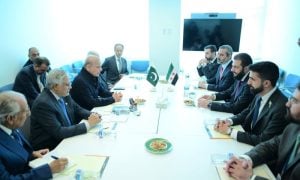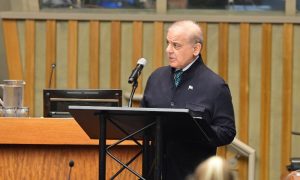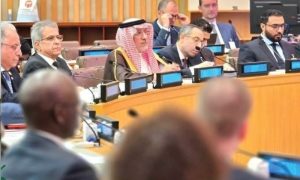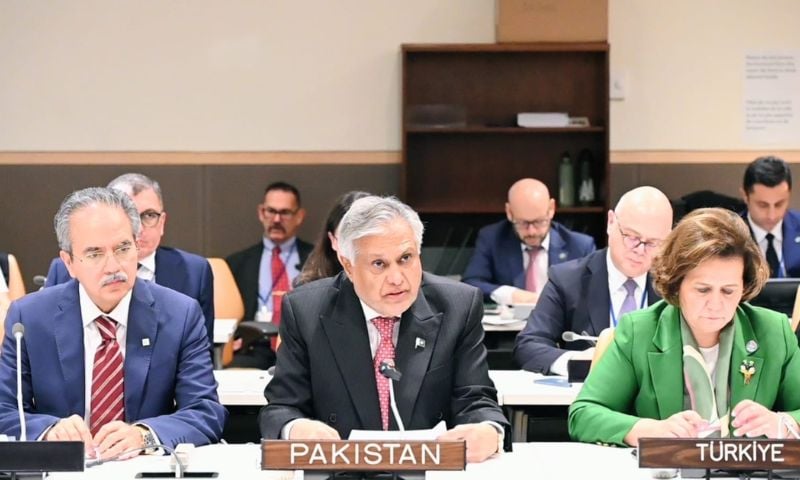
NEW YORK: Pakistan’s Deputy Prime Minister and Foreign Minister Ishaq Dar on Wednesday warned that India’s unilateral move to suspend the Indus Waters Treaty has created a “dangerous dimension”, stressing that the binding agreement contains no provision for unilateral suspension.
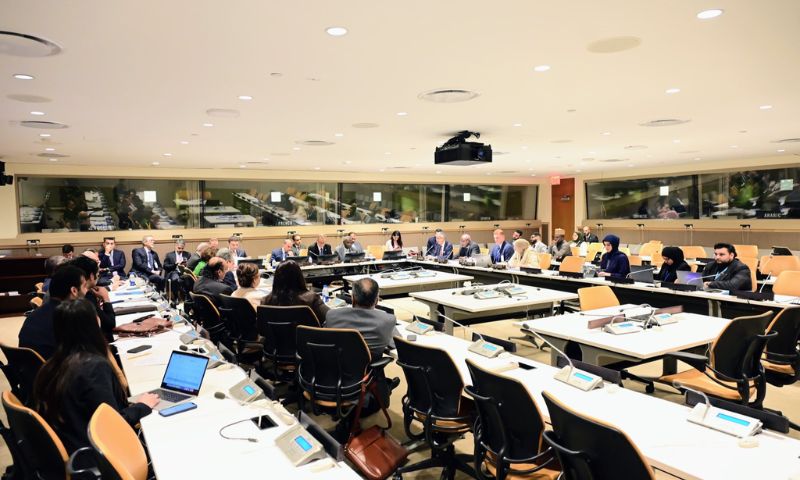
Addressing the ministerial meeting of the Organisation of Islamic Cooperation (OIC) Contact Group on Jammu and Kashmir on the sidelines of the 81st session of the UN General Assembly in New York, Deputy PM Dar said the status of the Indus Waters Treaty (IWT) had been reaffirmed by the Permanent Court of Arbitration (PCA).
In August, the Permanent Court of Arbitration ruled that the Indus Waters Treaty between Pakistan and India remained fully in force, finding that India had no legal basis to terminate or suspend the agreement.
Deputy Prime Minister/Foreign Minister Senator Mohammad Ishaq Dar @MIshaqDar50 addressed the Ministerial Meeting of the OIC Contact Group on Jammu and Kashmir on the sidelines of the 81st session of the UN General Assembly in New York.
The DPM/FM thanked the OIC… pic.twitter.com/PMiTkH06aT
— Ministry of Foreign Affairs – Pakistan (@ForeignOfficePk) September 23, 2026
“India cannot invoke domestic law to negate Security Council resolutions on Jammu and Kashmir, any more than it can resort to unilateral measures to evade its binding obligations under the Indus Waters Treaty. Treaties and international commitments must be respected in good faith,” Ishaq Dar added.
“International obligations can’t be set aside when they become inconvenient,” he said.
Right to self-determination
He said for almost eight decades, the people of Jammu and Kashmir have waited for the international community to honour a solemn promise: their right to determine their own future through a free and impartial plebiscite under United Nations auspices,” he said.
He mentioned a series of illegal and unilateral measures taken by India since Aug 5, 2019, saying New Delhi’s “unmistakable intention is to unlawfully change the demographic, critical and cultural character” of Indian Illegally Occupied Jammu and Kashmir (IIOJK).
The foreign minister noted that India had systematically “dismantled political and civic space” in the region.
Arbitrary detentions
Ishaq Dar said Kashmiri leaders, activists, journalists and youth continue to face arbitrary detentions, torture and persecution under draconian laws, including the Public Safety Act and Unlawful Activities (Prevention) Act. Political organisations have been outlawed and legitimate dissent criminalised.
Deputy Prime Minister and Foreign Minister Ishaq Dar says Kashmiri leaders, activists, journalists and youth continue to face arbitrary detentions, torture and persecution under draconian laws. He says India’s measures since Aug 5, 2019, are aimed at unlawfully changing the… pic.twitter.com/Kr6dLVvDcs
— Pakistan TV (@PakTVGlobal) September 23, 2026
He added: “New domicile and laws, manipulation of electoral constituencies, addition of non-Kashmiris to electoral roles, confiscation and demolition of properties and measures undermining Kashmiri Muslim’s cultural and religious heritage are used to change realities on the ground.”
Meanwhile, India has “simultaneously sought to shut the window through which the world can see these violations”, Dar highlighted.
“Media freedom has been systematically curtailed; journalists face intimidation, surveillance and detention; Kashmir Press Club was forcibly closed; social media accounts have been blocked; and international media and independent observers continue to be denied unhindered access.”
International community concerns
Ishaq Dar pointed out that the international community had independently corroborated these concerns, including in a joint communication by the UN Special Procedures issued on Oct 16, 2025.
That report mentioned the “arrest and detention of around 2,800 individuals, including journalists and human rights defenders; demolition of homes, blocking of around 8,000 social media accounts; and incidents of hate speech, intimidation and dehumanisation targeting Kashmiris and Muslims”.
Dar stressed that the incidents were not isolated violations. “Taken together, they reveal a sustained effort to silence people, transform the identity of their homeland and foreclose their right to self-determination and their own future,” he said.
🔈 PR No. 2️⃣5️⃣6️⃣/2️⃣0️⃣2️⃣6️⃣
Remarks by the Deputy Prime Minister/Foreign Minister Senator Mohammad Ishaq Dar @MIshaqDar50 at the Ministerial Meeting of the OIC Contact Group on Jammu and Kashmir, on the sidelines of the 81st Session of the UN General Assembly, New York
🔗⬇️ pic.twitter.com/LcT2Uf5eU1
— Ministry of Foreign Affairs – Pakistan (@ForeignOfficePk) September 23, 2026
In his address, he also mentioned multiple laws promulgated by India for the annexation of Jammu and Kashmir.
Pakistan-India conflict
Recalling the conflict between Pakistan and India in May last year following a deadly attack in Indian Illegally Occupied Jammu and Kashmir’s Pahalgam, Dar said it “provided a stark reminder of the consequences of leaving the Jammu and Kashmir dispute unresolved”.
The Foreign Minister said India, after the incident, levelled baseless allegations against Pakistan without credible investigation and embarked upon military aggression. “Pakistan exercised its inherent right to self-defence under Article 51 of the United Nations Charter in a measured and proportionate manner while acting responsibly to prevent further escalation,” he stated.
Deputy Prime Minister emphasised that the “lessons from [the] dangerous confrontation in May 2025 must not be lost”.
“Two nuclear-armed states came into a direct military conflict over a dispute that has remained unresolved for almost eight decades,” he noted.
Military force can’t resolve longstanding political disputes
“Whether in South Asia or the Middle East, military force can’t resolve longstanding political disputes. Dialogue, diplomacy and just resolution of the root causes in accordance with international law remain the only sustainable way forward,” he added.
Ishaq Dar said Jammu and Kashmir remains an internationally recognised dispute on the agenda of the United Nations Security Council.
“No domestic legislation, judicial verdict, electoral exercise, or demographic manipulation can substitute for the Kashmiri people’s inalienable right to self-determination. Pakistan remains committed to a just and peaceful settlement of the dispute in accordance with the relevant Security Council resolutions and the wishes of the Kashmiri people,” said the foreign Minister.
Dar urged the OIC and its member states to “maintain a unified and visible position at the United Nations and other international fora and intensify efforts for implementation” of the relevant UNSC resolutions.
OIC urged to call upon India to reverse all illegal measures
He further urged the OIC to “call upon India to reverse all illegal measures taken since Aug 5, 2019; halt demographic engineering and attacks on Kashmiri political, religious and cultural identities; and release all political prisoners and those arbitrarily detained”.
Third, Dar called on the OIC to demand unrestricted access to IoK for the OIC special envoy and fact-finding mission, the Office of the United Nations High Commissioner for Human Rights (OHCHR), UN Special Procedures, international media and independent observers.
ALSO READ: Pakistan Calls for End to Palestinian Suffering, Unhindered Humanitarian Aid
He also sought OIC members’ support for “international accountability for serious human rights violations” in the region.
Coordinated diplomacy
Fourth, Dar urged the forum to strengthen coordinated OIC diplomacy in New York and Geneva and support the OIC’s call for an updated OHCHR report on Kashmir.
“Kashmiri people are only asking the international community to deliver what was provided to them decades ago. Their right to self-determination is already recognised, and the mechanism for its exercise has already been prescribed by the Security Council,” he said.
“What remains is the fulfilment of the solemn international commitment,” he concluded.