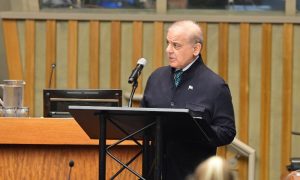
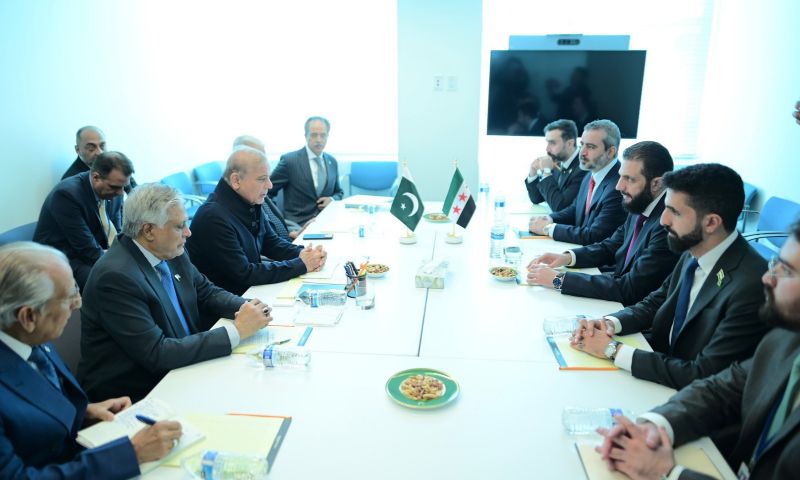
NEW YORK: Pakistan’s Prime Minister Shehbaz Sharif and Syrian President Ahmed al-Sharaa on Wednesday discussed ways to further strengthen bilateral relations, including through enhanced high-level exchanges and cooperation in trade, investment, education and information technology.
The two leaders met on the sidelines of the 81st session of the United Nations General Assembly in New York and agreed on the need to activate institutional mechanisms to deepen cooperation in areas of mutual interest, the Prime Minister’s Office said in a statement.
Prime Minister Muhammad Shehbaz Sharif met today with President of the Syrian Arab Republic, H.E. Mr. Ahmed al-Sharaa, on sidelines of the 81st Session of the United Nations General Assembly in New York.
The Prime Minister reaffirmed Pakistan’s strong commitment to its historic… pic.twitter.com/pTaqhXCbcW
— Prime Minister’s Office (@PakPMO) September 23, 2026
During the meeting, Prime Minister Sharif reaffirmed Pakistan’s strong commitment to its historic and fraternal relations with Syria.
He reiterated Pakistan’s support for Syria’s sovereignty, unity, territorial integrity and political independence, and expressed good wishes for the Syrian people in their efforts towards national stabilisation, cohesion, peace and economic recovery.
“The two leaders discussed ways to further strengthen bilateral relations, including through enhanced high-level exchanges, activation of institutional mechanisms, and cooperation in trade and investment, education, information technology and other areas of mutual interest,” the Prime Minister’s Office statement read.
Prime Minister Muhammad Shehbaz Sharif meets President of Syrian Arab Republic H.E. Ahmed al-Sharaa in New York. pic.twitter.com/3r0mUdqb0w
— Prime Minister's Office (@PakPMO) September 23, 2026
The Prime Minister also reaffirmed Pakistan’s readiness to contribute to Syria’s reconstruction and economic recovery.
Prime Minister Sharif reiterated Pakistan’s principled support for Syria’s sovereignty and territorial integrity. He underscored the importance of dialogue, diplomacy and respect for the principles of the UN Charter for promoting peace and stability in the region.
PM Sharif and President Sharaa also exchanged views on the regional situation. The Prime Minister reaffirmed Pakistan’s steadfast support for the Palestinian people’s right to self-determination and for a just and lasting resolution of the Palestine issue in accordance with relevant United Nations resolutions and international law.
The meeting provided an opportunity to reaffirm the longstanding bonds of friendship between Pakistan and Syria and to further strengthen bilateral cooperation in the years ahead, the Prime Minister’s Office statement concluded.
During Syrian Foreign Minister Asaad Hassan Al-Shaibani’s visit to Pakistan on August 19-20, the two sides agreed to strengthen institutional engagement and expand cooperation in areas of mutual interest. This was the first visit by a Syrian Foreign Minister to Pakistan following the formation of the new Syrian Government.
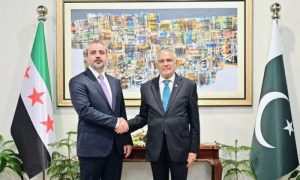
Pakistan’s Deputy Prime Minister and Foreign Minister Ishaq Dar held bilateral consultations with his Syrian counterpart, during which the two sides reaffirmed the longstanding brotherly ties between Pakistan and Syria.
Underscoring the importance of regular institutional engagement between the two countries, the two sides agreed to the early convening of the established institutional mechanisms. They also agreed to expand cooperation across areas of mutual interest and strengthen people-to-people contacts.
The Syrian Foreign Minister also called on Prime Minister Muhammad Shehbaz Sharif. He also met with the Minister for Interior and Narcotics Control, the Minister for Commerce, and the Chief of Army Staff and Chief of Defence Forces Field Marshal Syed Asim Munir.
During Al-Shaibani’s visit, Pakistan’s Commerce Ministry identified sectors including textiles and apparel, pharmaceuticals, leather, sports goods, food processing, agriculture, light engineering and information technology as areas with potential for expanded economic cooperation.