
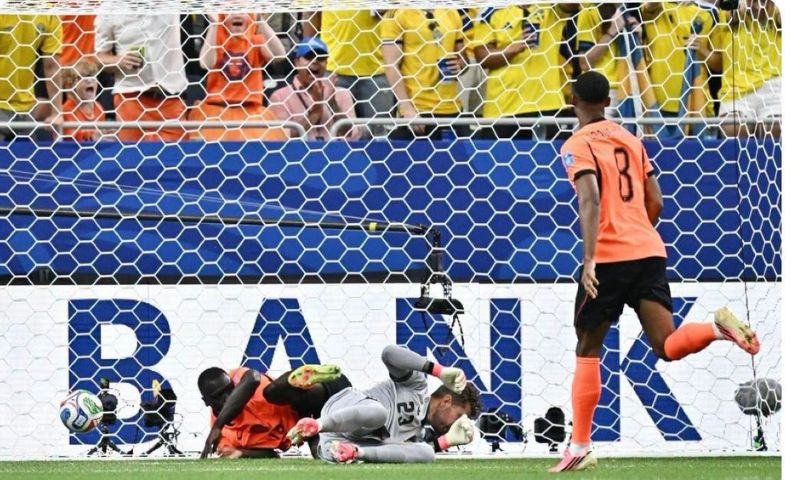
ISLAMABAD: The 2026 World Cup has delivered a goal-scoring spectacle like no other in nearly seven decades, shattering records and leaving fans breathless as the 100-goal milestone was reached in just the 33rd match of the tournament.
Liverpool forward Cody Gakpo etched his name into history books by scoring the Netherlands’ fourth goal in a resounding 5-1 victory over Sweden, bringing up the century and sparking celebrations across the globe.
⚽️ HISTORIC GOAL FEST! The 2026 #FIFAWorldCup has officially become the fastest edition to hit the 100-goal mark since 1958, reaching the milestone in just 33 matches! Cody Gakpo’s strike for the Netherlands sealed the record. 🤯🔥
What a historic day for football! 🙌
1️⃣ The 2026… pic.twitter.com/zXHb5rkUtS— Pragativadi (@PragativadiNews) June 21, 2026
This is the first time in 68 years that the 100-goal mark has been reached in just 33 matches. Only the 1954 World Cup in Switzerland, won by West Germany, was faster, achieving the feat in just 20 games. By comparison, the 2014 finals in Brazil took 36 matches to reach 100 goals, matching the total of the 1982 tournament, while the 1978 edition in Argentina and the 1994 tournament in the United States both required 38 matches.
Also Read: Lionel Messi Makes History with Record-Breaking 17th World Cup Goal
The tournament, co-hosted by the United States, Mexico, and Canada, has transformed into a goal-scoring carnival from the very first whistle. Mexico’s Julian Quinones opened the account on June 11, and the floodgates have remained wide open ever since. Germany’s ruthless 7-1 dismantling of debutants Curacao in Houston and Canada’s 6-0 demolition of Qatar in Vancouver are just two highlights of a tournament that is rewriting the record books.
⚽ FIFA World Cup 2026 Is Making History!
The tournament has officially become the fastest World Cup in 68 years to reach the 100-goal mark, achieving the milestone in just 33 matches. 🔥
🇳🇱 Cody Gakpo scored the 100th goal of the tournament during the Netherlands’ 5-1 victory… pic.twitter.com/fyThIFE4RB
— Nationscope.in (@NationScopeIn) June 21, 2026
The Netherlands’ victory over Sweden was particularly significant, as it made the Dutch the eighth team in World Cup history to score 100 goals. The all-time list is led by Brazil with 241 goals, followed by Germany (239), Argentina (155), France (139), Italy (128), Spain (108), England (108), and now the Netherlands (100). Gakpo also surpassed the legendary Johan Cruyff in the Dutch goal-scoring charts with his decisive strike.
What’s Behind the Goal Rush?
One of the main reasons for the avalanche of goals could be the Adidas ‘Trionda’ ball being used in the tournament. Several goalkeepers have already been caught out by its unpredictable flight, leading to a stunning array of long-range strikes.
More than 10 goals have been scored from outside the penalty area, not to mention tap-ins after keepers have fumbled swerving shots. France captain Kylian Mbappe scored a stunning second goal against Senegal from 30 yards out, beating goalkeeper Edouard Mendy with a strike that swerved unexpectedly.
Former England goalkeeper Paul Robinson, working for BBC Sport at the World Cup, said: “There are one or two occasions where this football has not necessarily behaved as you would expect it to. It is something to keep an eye on.”
This isn’t the first time World Cup balls have caused problems. During the 2010 tournament in South Africa, the infamous ‘Jabulani’ ball became well known for its swerve, dip, and drift, which contributed to several long-range goals. England’s David James criticized it at the time, saying: “The ball is dreadful. It’s horrible, but it’s horrible for everyone.”
The FIFA World Cup 2026 has already rewritten history by smashing the 100-goal mark in just 33 matches — the fastest in 68 years. But will this goal surge mean more flair or just a statistical anomaly as the tournament progresses? pic.twitter.com/xYdBEYYUiC
— Gully Point (@gullypoint_) June 21, 2026
Is the Expanded Format Behind the Goal Surge?
Another factor could be the fact that many new teams or non-regulars are playing this time around. It’s a 48-team tournament – the biggest to date – and many debutant nations are still getting their bearings, leading to high-scoring contests against seasoned sides.
Germany’s 7-1 demolition of Curacao, the smallest nation ever by size and population to participate in a World Cup, and Canada’s 6-0 thrashing of Qatar are prime examples of the gap in experience and quality.
Former Brentford and Tottenham boss Thomas Frank said: “Of course, having more teams and lower-ranked sides has had a small impact in terms of quality. But aside from a few matches, like Germany against Curacao where the game eventually got away from them, not that many sides have been blown away so far.”
England’s Euro 2022 winner Ellen White captured the sentiment perfectly: “Probably the most compact and tactically tight game I’ve seen so far was Netherlands versus Japan, and even that had four goals.”
The FIFA World Cup 2026 is already rewriting history. With 100 goals scored in just 33 matches, the tournament has recorded its highest scoring rate at this stage since 1958.
Read Here: https://t.co/jayXz1glvi#DNAUpdates #FIFAWorldCup2026 #GoalFifa2026 pic.twitter.com/i6UIDetzQC
— DNA (@dna) June 21, 2026
A Tournament for the Ages
The 2026 World Cup is currently averaging a breathtaking 3.09 goals per match and remains firmly on course to surpass the 300-goal barrier before the tournament concludes. With an average of over three goals per game, this edition is on track to become the highest-scoring World Cup in history.
The combination of a controversial match ball, an expanded format, and the emergence of new teams has created the perfect storm for goals. Fans around the world are being treated to a tournament that is delivering entertainment, drama, and records in equal measure.
The only question that remains is just how many goals will be scored by the time the final whistle blows. If the current rate continues, the 300-goal mark is well within reach, cementing this tournament’s place in football folklore forever.