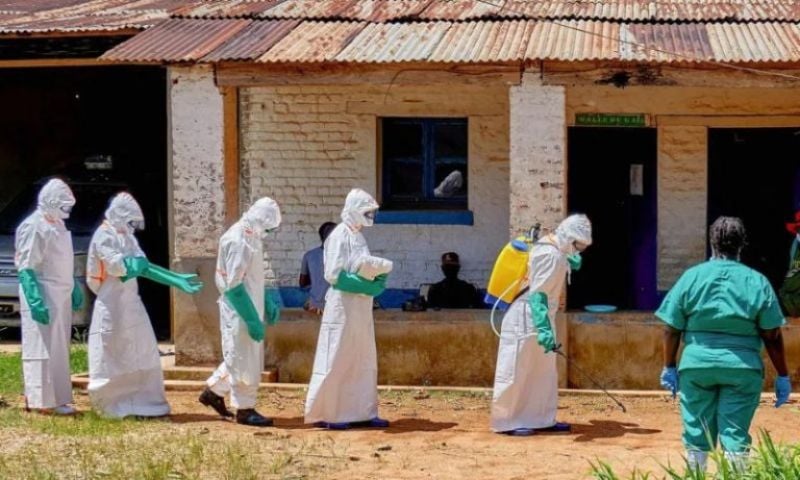
KINSHASA: The Democratic Republic of Congo has reported a further rise in confirmed Ebola infections, with the number of cases reaching 956 and the death toll increasing to 247, according to official figures released on Saturday.
The latest update marked an increase from Friday’s tally of 933 cases and 245 fatalities, underscoring the continuing severity of the outbreak.
Health experts are increasingly concerned about the situation in Kigonze camp near Bunia in Ituri Province, where at least 30 people have died since the beginning of May. Camp authorities and aid organisations say the unusually high number of deaths suggests the virus could be spreading rapidly among displaced populations.
Kigonze, home to more than 15,000 people, normally records only a handful of deaths each month. However, local officials said 10 burials were carried out during the past week alone.
Fears of undetected spread
Camp spokesperson Desire Grodya Bapi said residents and families had initially resisted requests by medical teams to test both sick individuals and the bodies of those who had died, making it difficult to establish the exact cause of all the fatalities.
Several victims reportedly exhibited symptoms commonly associated with Ebola, including fever, headaches and vomiting. Samples collected from some of the deceased later tested positive for the virus, according to camp officials and humanitarian sources.
The outbreak was officially declared by Congolese authorities on 15 May, although officials acknowledged that infections and deaths had begun earlier in the month.
Humanitarian workers fear that the disease may be circulating unnoticed among eastern Congo’s more than five million internally displaced people, where overcrowding and limited access to sanitation facilities create conditions favourable for the spread of infection.
Aid workers raise alarm
Justin Zanamuzi, head of the Catholic charity Caritas in the area, said aid workers had witnessed several bodies awaiting burial, including those of children and a pregnant woman.
Attempts to convince families to allow health officials to examine the deceased were initially rejected, complicating efforts to contain the outbreak.
Residents described increasingly desperate conditions. Kato Lonu, who lost two children, including a six-month-old infant, said people in the camp were dying in quick succession and living in circumstances no one should have to endure.
Poor sanitation adds to risks
Humanitarian organisations say deteriorating sanitation and reductions in international aid have heightened the vulnerability of displaced communities to infectious diseases.
United Nations data indicate that funding for water, hygiene and sanitation programmes in Congo fell by more than half between 2024 and 2025 to around $38 million. This year’s appeal for $80 million has received only about 21 per cent of the required funding.
Conditions inside Kigonze camp remain particularly challenging, with large families living in cramped shelters less than a metre apart. Aid workers reported that toilets are insufficient and frequently overflow, forcing residents to empty them manually.
Ituri Province accounts for more than 90 per cent of the country’s nearly 900 confirmed Ebola infections, and fatalities have also been reported in another displacement camp in the region.
Impact of funding cuts
Humanitarian groups say reductions in US-backed water and sanitation projects have significantly affected services available to displaced populations.
According to aid agencies, several programmes supported by American funding in the three Ebola-affected provinces have either been scaled back or discontinued. Mercy Corps said that while it had provided more than 400 public toilets and 82 water points serving over 125,000 displaced people in 2024, current funding constraints mean fewer than 19,000 people are now receiving support and no public toilets are being maintained.
Although Washington has pledged more than $375 million in direct Ebola assistance, aid organisations warn that cuts to sanitation programmes are undermining efforts to contain the outbreak and prevent further loss of life.
The worsening situation has raised fresh concerns that the virus could spread more widely unless access to testing, healthcare and sanitation services is urgently strengthened.