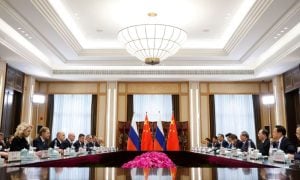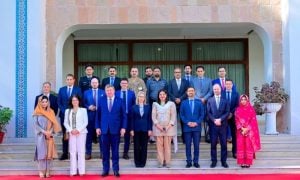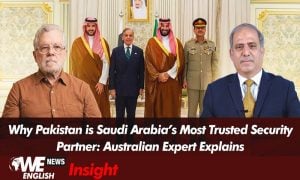
What appeared to be a diplomatic dead end was, in reality, the beginning of a quieter and more determined effort led by Pakistan.
Through sustained engagement, back-channel diplomacy and relentless outreach to regional and international stakeholders, Islamabad helped keep dialogue alive when few believed it could survive.
For much of the past year, the prospect of meaningful engagement between Iran and the United States appeared remote.
Deep mistrust, regional rivalries, Israeli military actions, and shifting political calculations in Washington and Tehran had pushed the possibility of dialogue into the realm of the impossible.
Yet against this backdrop, Pakistan quietly emerged as one of the most active diplomatic actors working to prevent a wider regional conflagration.
While global attention remained focused on military developments and political rhetoric, Islamabad pursued a sustained campaign of diplomacy that combined public engagement with intensive back-channel communication.
The result was not a dramatic breakthrough announced from a grand international summit, but something arguably more significant: the preservation of dialogue at a time when war appeared increasingly likely.
A Diplomatic Opening Few Expected
The very idea of Islamabad serving as a venue for contacts between Iran and the United States would have seemed improbable only months earlier.
Pakistan’s unique position, however, allowed it to maintain communication channels with all sides. It enjoys a long border and deep historical ties with Iran, maintains strategic relations with the United States, and has increasingly strengthened its standing across the Muslim world.
Rather than seeking the spotlight, Pakistani diplomacy focused on creating space for dialogue.
What began as efforts to reduce tensions gradually evolved into a broader diplomatic initiative aimed at preventing military escalation and encouraging negotiations.
The Leadership Factor
A defining feature of Pakistan’s diplomatic effort was the unusual degree of coordination among the country’s civilian and military leadership.
Prime Minister Shehbaz Sharif remained actively engaged with regional and international leaders, using bilateral contacts to advocate restraint and dialogue.
His conversations with world leaders helped reinforce Pakistan’s message that a wider conflict would carry consequences far beyond the Middle East.
At the same time, Field Marshal Syed Asim Munir played a critical role in maintaining strategic communication with regional partners and military counterparts.
At several pivotal junctures, when the risk of escalation threatened to overshadow diplomacy, Field Marshal Syed Asim Munir complemented traditional diplomatic efforts through direct engagement with heads of state, senior political leaders and military counterparts, helping to preserve dialogue and maintain momentum towards de-escalation.
Deputy Prime Minister and Foreign Minister Ishaq Dar maintained a steady pace of diplomatic engagement, holding meetings and consultations with counterparts across the region.
These efforts ensured that communication channels remained open even during periods of heightened tension.
Interior Minister Mohsin Naqvi’s repeated visits to Tehran further demonstrated Islamabad’s commitment to direct engagement rather than diplomacy from a distance.
The cumulative effect was the creation of a diplomatic architecture capable of responding quickly whenever crises emerged.
The Importance of Back-Channel Diplomacy
History shows that major diplomatic breakthroughs rarely occur in front of television cameras.
Pakistan’s contribution appears to have rested significantly on quiet diplomacy conducted away from public scrutiny.
While official statements emphasised dialogue and peace, a parallel effort focused on maintaining communication between stakeholders who often found direct contact politically difficult.
Such diplomacy is difficult to quantify and rarely receives public recognition. Yet it frequently determines whether tensions escalate or de-escalate.
In the Iran-US context, where mistrust has accumulated over decades, these unofficial channels were particularly valuable.
Managing Repeated Setbacks
The path toward de-escalation was far from smooth.
Ceasefire understandings faced repeated challenges. Regional tensions continued to flare. Israeli military actions complicated diplomatic calculations and generated fresh uncertainty.
Meanwhile, political signals from Washington often appeared inconsistent, with changing priorities and evolving strategies creating additional obstacles for negotiators.
Yet Pakistan maintained a consistent approach.
Rather than reacting to each setback as a failure, Islamabad continued to advocate dialogue, facilitate communication, and encourage restraint.
Whenever tensions rose, Pakistani representatives remained engaged with regional capitals, particularly Tehran.
This persistence may ultimately prove to be one of the most important aspects of Pakistan’s diplomatic contribution.
Why the World Had a Stake in Success
The significance of these efforts extended well beyond Iran and the United States.
A wider regional conflict carries the potential to disrupt global energy markets, threaten maritime security, and undermine economic stability worldwide.
Few issues illustrated these risks more clearly than the possibility of disruptions in the Strait of Hormuz.
As one of the world’s most critical energy corridors, the waterway serves as a lifeline for international trade and energy supplies.
Any prolonged closure or disruption would have triggered consequences for economies across Asia, Europe, and beyond.
Markets reacted repeatedly to fears of escalation. Energy prices came under pressure. Governments and businesses prepared contingency plans.
The gradual stabilisation of the situation and the prospect of uninterrupted maritime traffic therefore represent more than a regional achievement; they are a matter of global economic importance.
A New Diplomatic Identity for Pakistan
For decades, Pakistan’s international image has often been shaped by security challenges and geopolitical competition.
Recent developments suggest a different narrative is emerging.
Instead of being viewed solely through the lens of regional conflicts, Pakistan increasingly presents itself as a facilitator of dialogue and a bridge between competing powers.
The country’s diplomatic engagement in the Iran-US context demonstrates that middle powers can still play meaningful roles in resolving international crises.
This is particularly significant at a time when traditional diplomatic mechanisms often appear strained and major powers struggle to find common ground.
Recognition Beyond Awards
Whether or not Pakistan’s efforts receive international recognition is ultimately secondary.
What matters is that sustained diplomacy helped preserve the possibility of peace when conflict appeared increasingly inevitable.
In an era dominated by military headlines, Pakistan chose a different path. It invested political capital in dialogue, maintained engagement during moments of crisis, and continued pushing for de-escalation even when success seemed unlikely.
The lesson is clear: diplomacy remains most effective when it is persistent, patient, and often invisible.
If the current trajectory toward stability continues, Pakistan’s role in helping prevent a wider regional conflict may well be remembered as one of the most consequential diplomatic achievements in recent South Asian history.
As tensions recede and diplomacy gains ground, Pakistan’s role is drawing increasing recognition across the international community. The United Nations, Western governments, European partners and countries throughout the Muslim world have all acknowledged the importance of sustained engagement in preventing a wider conflict.
What once appeared an improbable diplomatic undertaking has evolved into a widely recognised example of effective statecraft, demonstrating how persistence, credibility and dialogue can still shape outcomes in an increasingly turbulent world.
Bridging Rivals Through Diplomacy
One of the most remarkable aspects of the crisis was that, even as the United States and Iran exchanged military strikes and tensions threatened to spiral into a wider regional conflict, both sides continued to acknowledge Pakistan’s constructive role.
President Donald Trump publicly praised Pakistan’s leadership and diplomatic efforts, including his engagement with Prime Minister Shehbaz Sharif and Field Marshal Syed Asim Munir, while Tehran also maintained close coordination with Islamabad throughout the crisis.
Such simultaneous recognition from two adversaries locked in a dangerous confrontation is exceptionally rare in international diplomacy. It reflected not only Pakistan’s ability to maintain open channels with all parties but also the growing confidence in Islamabad’s role as a credible facilitator of dialogue at a time when diplomacy appeared to be losing ground to conflict.
Pakistan’s diplomatic intervention offers a compelling example of how middle powers can influence major international crises through credibility, access and sustained engagement.
In helping steer a dangerous confrontation towards dialogue, Islamabad demonstrated that effective diplomacy remains one of the most valuable currencies in international relations.