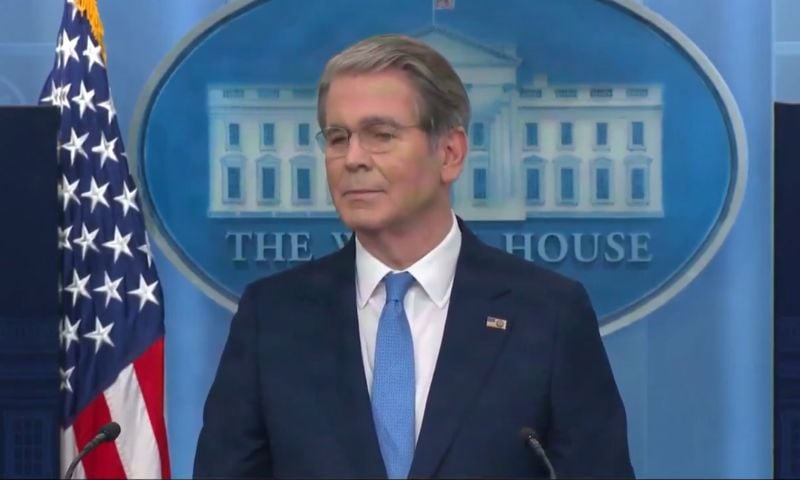



WASHINGTON: US Treasury Secretary Scott Bessent said on Thursday that a tentative agreement between Washington and Tehran on a 60-day ceasefire extension hinges on President Donald Trump’s decision.
“It’s always a mistake to get out ahead of the president, so it’s all going to be the president’s decision. I think we can see that the president very clearly stated his three [conditions]: open the Strait, no highly-enriched uranium, no nuclear programme,” he told a White House press briefing.
The Strait of Hormuz, through which roughly one-fifth of global oil and liquefied natural gas shipments normally pass, has remained a key flashpoint since the United States and Israel launched the war against Iran in late February.
“If there can be no deal without those, why would there be a deal without those?” Secretary Bessent asked.
He termed state-owned Iranian airlines “outlaws”, and warned that anyone accommodating those airlines could be sanctioned.
“One thing that we’re not going to do is restrict movement for religious reasons, so Iranians who want to make the pilgrimage to Makkah and Madina will be allowed. We will also allow valid humanitarian reasons,” he explained.
“But the other thing we can do is that when these airlines fly, they have to be refuelled, they sell tickets, they pay landing fees — anyone who accepts those, we will sanction,” he stated.
“They should be very clear that the state-owned Iranian airlines are outlaws and they cannot do this.”
When asked about the US position on sanctions on Iran, the US treasury secretary declined to “preview the deal” but said he thought “things would go very slowly in terms of that, so we’ll see.”
“It is a multifaceted agreement and nothing is going to be on the table until we see the Strait of Hormuz open, and the Iranians agree that they have to turn over the highly enriched Uranium, and that they can’t have a nuclear programme,” he said.
“President Trump has done something that no other administration has been able to do: we have gotten the Iranians to talk about their nuclear programme and to perhaps commit to not having one. That has never happened before.”
“If you look at the results of our kinetic action, of our economic pressure, it has worked to bring them to the table and have a discussion on this.”
“President Trump has made it very clear, he talked about it at the Cabinet meeting, that he has several red lines, and Iran has to turn over their highly enriched uranium, they cannot pursue a nuclear weapon and the Strait of Hormuz … has to free transit.”
“Navigation of the seas has to be free and open as it was before, so he’s not going to take a bad deal, he’s going to make a great deal for the American people.
He added that Oman has no plans to impose a toll on the Strait of Hormuz.
“I had a call with the Omani ambassador this morning and he assured me that there were no plans for tolling the Strait,” he told reporters.
“As he said, our countries have had 200 years of good relations, he wants to have another 200 more, and I told him that this was a non-starter and he did not want to risk either Omani individuals or Omani financial institutions getting sanctioned,” he added.