Key Points
- Deal seen as first concrete step in wider US-China trade reset following Trump-Xi summit
- Washington to guarantee supply of aircraft engine parts and aviation components
- Both sides pursuing reciprocal tariff reductions on more than $30 billion in goods
ISLAMABAD: China on Wednesday officially confirmed its purchase of 200 aircraft from Boeing, giving fresh momentum to an emerging trade reset between Beijing and Washington after months of economic friction and tariff uncertainty.
The confirmation by China’s Commerce Ministry marks the first formal acknowledgement from Beijing of the aircraft agreement.
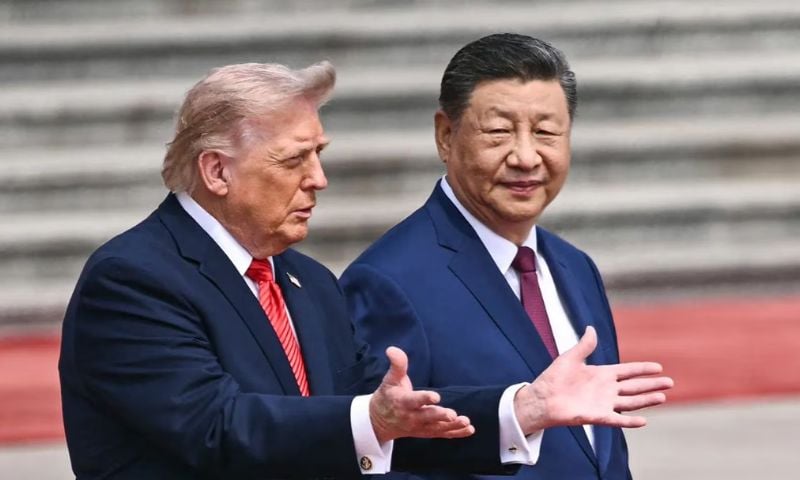
The announcement initially came during last week’s summit between Chinese President Xi Jinping and US President Donald Trump in Beijing.
Chinese officials said both countries were also seeking reciprocal tariff cuts covering at least $30 billion worth of goods.
Beijing has agreed to work with Washington on reducing levies affecting tens of billions of dollars in goods, a commerce ministry statement said Wednesday, days after US President Donald Trump visited China.
Under the auspices of a newly established trade council, “both sides agreed in principle to discuss a framework arrangement for reciprocal tariff reductions on products of equivalent scale”, covering “$30 billion or more on each side”, the online statement said.
Beijing added that US tariffs on Chinese exports should remain within the limits agreed under the Kuala Lumpur trade arrangement reached last year.
The ministry linked the Boeing purchase to an overall framework aimed at stabilising bilateral trade relations, including reciprocal tariff reductions and renewed supply-chain cooperation.
Under the arrangement, the United States will provide China with supply guarantees for aircraft engine parts and aviation-related components.
That was an issue that had become increasingly sensitive amid technology restrictions and export controls.
The Boeing deal first surfaced publicly during Trump’s visit to China last week, when the US president said Beijing had agreed to purchase American aircraft as part of broader economic understandings reached during talks with Xi.
On May 16, Boeing issued a statement welcoming the agreement after Trump publicly disclosed the purchase plans.
Trump also suggested the order could eventually rise to as many as 750 aircraft equipped with engines produced by GE Aerospace.
Until Wednesday, however, Beijing had not formally confirmed the purchase.
The analysts view the latest announcement as the clearest indication yet that both sides are seeking to move beyond the prolonged tariff confrontation that disrupted global supply chains and strained commercial ties in recent years.
The US-China trade framework dates back to the Kuala Lumpur understanding reached ahead of a Trump-Xi meeting in South Korea last October.
That arrangement extended the existing tariff truce for another year and included reductions in some US tariffs, alongside a pause in China’s planned restrictions on rare earth minerals and magnet exports.
The Boeing confirmation now provides the first major commercial pillar underpinning that evolving trade détente.