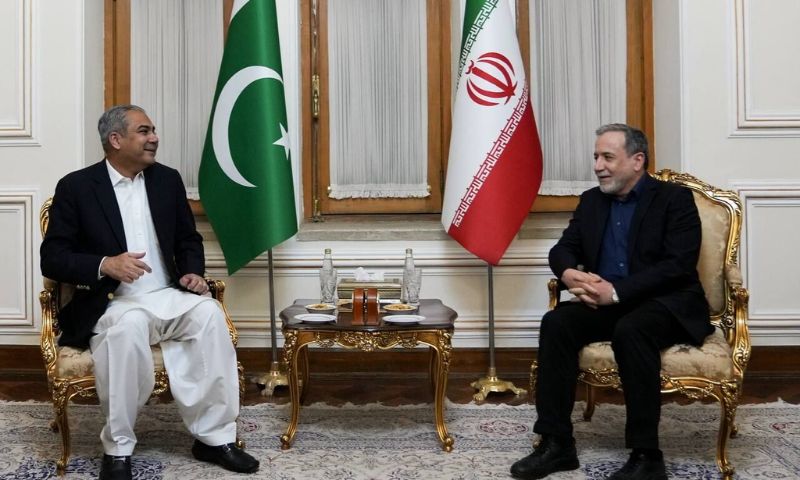
ISLAMABAD: Pakistan’s Interior Minister Mohsin Naqvi on Monday met with Iranian Foreign Minister Abbas Araghchi in Tehran where the two leaders discussed regional developments.
The discussions focused on the rapidly evolving situation in the Middle East, security challenges, and changing geopolitical dynamics in detail, Iranian media reported.
According to Iranian media, the talks were extensive and significant. The two ministers exchanged views on regional stability and explored ways to strengthen cooperation between Pakistan and Iran.
Pakistani Interior Minister Mohsin Naqvi met with Iran’s Foreign Minister Araghchi in Tehran.
Follow: https://t.co/7Dg3b41hTx pic.twitter.com/hpMdY8BUI5
— PressTV Extra (@PresstvExtra) May 18, 2026
Earlier on Sunday, the Pakistani Interior Minister also met Iranian President Masoud Pezeshkian in Tehran.
The meeting at the Presidential Palace lasted around 90 minutes and focused on bilateral relations as well as Pakistan’s mediation efforts aimed at promoting regional peace and stability, Iran’s state news agency IRNA reported.
Iranian Foreign Minister Abbas Araghchi and Interior Minister Eskandar Momeni were also present during the meeting, IRNA reported.
The Pakistani minister also met Iranian Parliament Speaker Mohammad Bagher Ghalibaf. Iranian media said the two sides exchanged views on regional peace and stability.
Pakistan’s Interior Minister Naqvi arrived in Tehran on Saturday on an unannounced visit linked to Pakistan’s mediation efforts to facilitate dialogue between Washington and Tehran.
Iran’s Tasnim News Agency reported that Naqvi’s visit formed part of Pakistan’s “ongoing efforts to facilitate talks and promote regional peace”.
Pakistan has continued diplomatic efforts to facilitate dialogue between Tehran and Washington and to de-escalate the ongoing conflict through diplomacy and dialogue.
Pakistan brokered a ceasefire between Tehran and Washington on April 8 that halted the war involving the United States, Israel, and Iran.
On April 11, Pakistan hosted high-stakes direct talks between the US and Iranian negotiators in Islamabad.
The Islamabad Talks concluded without a final agreement; however, they paved the way for further negotiations between Washington and Tehran to permanently resolve the conflict.
The war started after the US and Israel launched strikes on Iran on February 28, prompting retaliatory action from Tehran against Israel and the Gulf countries.
The confrontation also contributed to disruptions in maritime traffic around the Strait of Hormuz.
On Monday, US President Donald Trump said that Washington had decided to hold off a planned military attack on Iran scheduled for Tuesday after requests from Gulf leaders, citing ongoing “serious negotiations” aimed at reaching a peace agreement with Tehran.
In a post on Truth Social, Trump said he had been asked by Saudi Crown Prince and Prime Minister Prince Mohammed bin Salman Al Saud, the Emir of Qatar Sheikh Tamim bin Hamad Al Thani, and UAE President Sheikh Mohamed bin Zayed Al Nahyan to suspend the planned military attack on Iran, which he said had been scheduled for Tuesday.
“Serious negotiations are now taking place, and that, in their opinion, as Great Leaders and Allies, a Deal will be made, which will be very acceptable to the United States of America, as well as all Countries in the Middle East, and beyond… we will NOT be doing the scheduled… pic.twitter.com/cxBBaNUB6E
— The White House (@WhiteHouse) May 18, 2026
Trump said that “serious negotiations are now taking place” and that a deal acceptable to the United States and the wider Middle East will be reached.