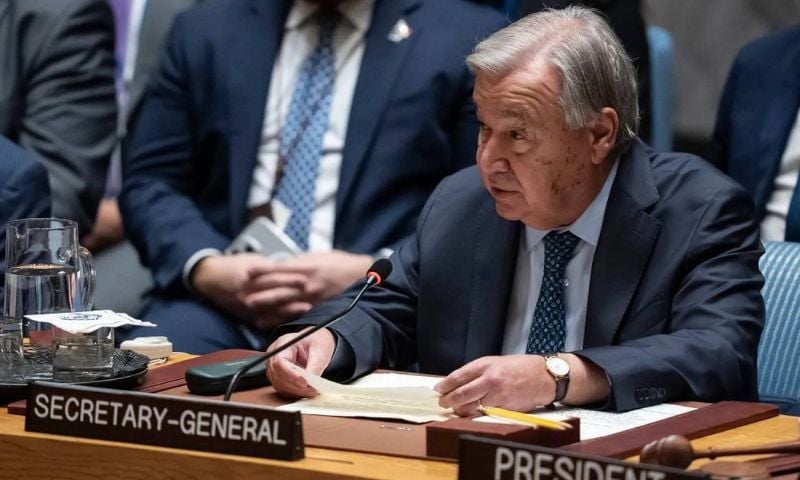



UNITED NATIONS: UN Secretary-General Antonio Guterres on Monday warned that the forces driving nuclear weapons proliferation were accelerating, as he opened a key meeting of countries party to the nuclear non-proliferation treaty (NPT).
“For too long, the Treaty has been eroding. Commitments remain unfulfilled. Trust and credibility are wearing thin. The drivers of proliferation are accelerating. We need to breathe life into the Treaty once more,” Guterres told delegates at the start of the meeting at UN headquarters in New York.
Across the decades, we developed a web of instruments to prevent the use, proliferation and testing of nuclear weapons.
The Treaty on the Non-Proliferation of Nuclear Weapons is the bedrock of those efforts.
– @antonioguterres' full remarks: https://t.co/Niub55VMnW
— UN Spokesperson (@UN_Spokesperson) April 27, 2026
The meeting comes amid heightened geopolitical tensions since the last review conference in 2022, when Guterres warned that humanity was “one misunderstanding, one miscalculation away from nuclear annihilation.”
Diplomats cautioned that expectations for the current conference remain modest.
“We should not expect this conference to resolve the underlying strategic tensions of our time,” said Do Hung Viet, Vietnam’s UN ambassador and president of the conference.
He added that a balanced outcome reaffirming core commitments and outlining practical steps would help strengthen the treaty.
“The success or failure of this conference will have implications way beyond these halls and way beyond these next five years. The prospects of a new nuclear arms race are looming over us,” he said.
The NPT treaty has faced repeated setbacks. Decisions require consensus, and the last two review conferences failed to adopt final political declarations.
In 2015, disagreements centred on proposals for a nuclear-weapon-free zone in the Middle East.
In 2022, talks broke down over Russian opposition to references to Ukraine’s Zaporizhzhia nuclear power plant.
According to the Stockholm International Peace Research Institute (SIPRI), the world’s nine nuclear-armed states — the United States, Russia, China, France, the United Kingdom, India, Pakistan, Israel and North Korea — possessed 12,241 nuclear warheads as of January 2025.
The United States and Russia together hold nearly 90 percent of these weapons and have undertaken extensive modernisation programmes in recent years, SIPRI said.
China has also rapidly expanded its nuclear arsenal.
Earlier this year, US President Donald Trump indicated plans to conduct new nuclear tests, while accusing other countries of doing so secretly.
In Europe, French President Emmanuel Macron announced in March a shift in nuclear deterrence policy, including an expansion of France’s arsenal, currently estimated at around 290 warheads.