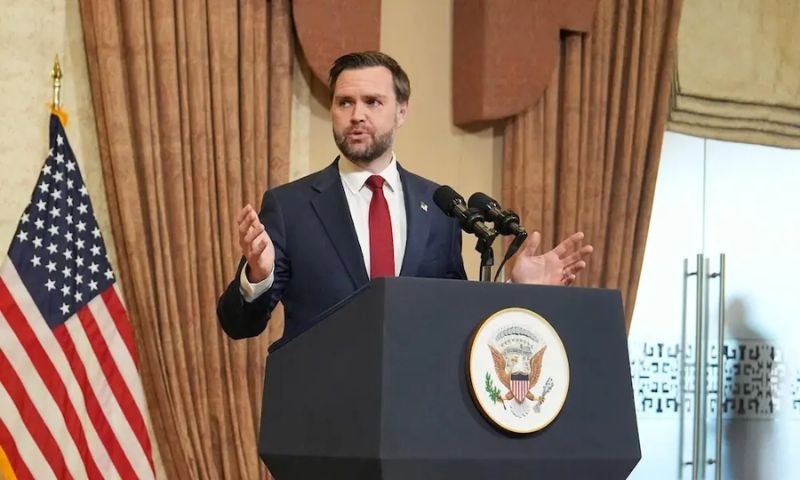
ISLAMABAD: A high-stakes round of negotiations between the United States and Iran concluded in Islamabad early Sunday without reaching an agreement, as US Vice President JD Vance said Tehran had declined Washington’s “final and best offer” following nearly 21 hours of intensive discussions.
Addressing a press conference after the marathon session, Vance said both sides engaged in “substantive discussions” but remained divided on critical issues, particularly Iran’s long-term nuclear intentions.
Key takeaways from Vance’s Islamabad presser
Pakistan’s mediation praised
Vance commended Pakistan’s leadership for facilitating the dialogue, singling out Prime Minister Shehbaz Sharif and Chief of Defence Forces Field Marshal Syed Asim Munir for their efforts to bridge differences between the two sides.
He emphasised that the failure to reach an agreement “was not because of the Pakistanis,” describing their role as constructive and proactive in attempting to narrow the gap.
Core dispute: nuclear commitments
The central sticking point, according to Vance, was Washington’s demand for firm and lasting assurances that Iran would not pursue nuclear weapons.
He stressed that the United States sought more than a short-term arrangement, calling instead for a long-term commitment preventing Iran from acquiring nuclear weapons or the capability to rapidly develop them.
Broader issues discussed
Beyond the nuclear question, Vance confirmed that other matters, including Iran’s frozen assets, were also discussed. However, these talks did not yield sufficient common ground to secure an agreement.
Washington claims ‘good faith’ approach
The US vice president said the American delegation entered the negotiations under direction from President Donald Trump to act in good faith and pursue a workable deal.
Vance maintained that Washington demonstrated flexibility throughout the process, including consultations with national security leadership.
‘Final and best offer’ remains on the table
Despite the lack of agreement, Vance said the United States had presented what it considers a straightforward and comprehensive proposal, describing it as its “final and best offer.” He added that the proposal remains available should Iran choose to reconsider.
Outcome ‘worse for Iran,’ says Vance
In a pointed remark, Vance said the absence of an agreement could have more serious consequences for Iran than for the United States.
The outcome underscores persistent mistrust between the two sides and highlights the challenges facing diplomatic efforts to resolve long-standing disputes over Iran’s nuclear programme.
What does Iran say?
Iran described the Islamabad talks as inconclusive amid ‘excessive’ US demands, while stressing that dialogue remains possible and should continue despite the absence of an agreement.
What comes next after Islamabad Talks?
The conclusion of the US–Iran Islamabad Talks without an agreement has drawn measured reactions from global media and diplomats, who largely view the outcome as a setback but not the end of diplomacy.
International coverage suggests the negotiations have been paused rather than terminated, with diplomatic channels expected to remain open.
Analysts say both Washington and Tehran may continue engagement through backchannel contacts or future rounds, particularly given the high stakes involved.
Despite the lack of a deal, a two-week ceasefire agreed earlier in the week remains in place for now, with officials on all sides urging restraint.
Pakistan’s Deputy Prime Minister and Foreign Minister Ishaq Dar stressed the importance of maintaining the ceasefire, warning that any breakdown could risk renewed escalation in an already volatile region.
However, diplomats caution that the ceasefire is delicate and contingent on continued dialogue, especially as key disputes — including Iran’s nuclear programme and security concerns in the Strait of Hormuz — remain unresolved.
Iran says single round of talks was unlikely to bridge decades of mistrust
Iranian officials, including voices reflected in Iran’s Tasnim News Agency, described U.S. demands as “excessive,” while acknowledging that some progress had been made on secondary issues. They emphasised that a single round of talks was unlikely to bridge decades of mistrust.
Diplomatic observers note that the Islamabad meeting marked the first direct high-level engagement in more than a decade, and the most significant since the 1979 Islamic Revolution, underlining both the importance and complexity of the process.
Looking ahead, global powers are expected to encourage continued engagement, warning that failure to resume talks could heighten risks of renewed conflict, disrupt regional stability, and impact global energy markets.
In essence, while no agreement was reached, the process of diplomacy remains active — with the future hinging on whether both sides choose negotiation over escalation.