Key Points
- IFC briefs Finance Minister on Pakistan portfolio exceeding $2 billion annually
- Discussions centred on execution of $40 billion World Bank Group framework
- Emphasis on infrastructure, SME finance, local currency lending and job creation
ISLAMABAD: Pakistan and the International Finance Corporation on Wednesday reviewed progress under the World Bank Group’s long-term Pakistan financing framework, as focus shifts toward execution of the already announced $40 billion decade programme.
The World Bank’s 10-year Pakistan Country Partnership Framework Programme, worth a $20 billion sovereign fund, is combined with $20 billion investments and financing for the private sector by the Group’s commercial lending arm, the IFC.
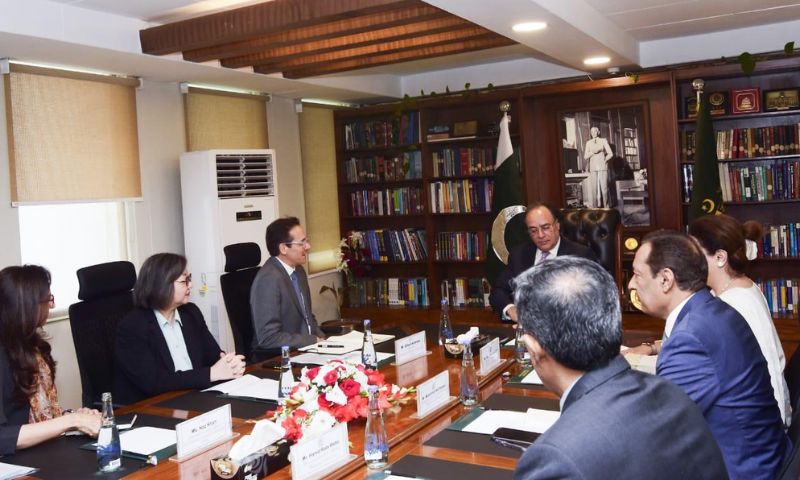
Federal Minister for Finance and Revenue Senator Muhammad Aurangzeb held a meeting with senior representatives of the International Finance Corporation.
The visiting delegation includes Divisional Director Simon Andrews, World Bank Country Director Bolormaa Amgaabazar, and IFC Country Manager Naz Khan.
The meeting reviewed progress under the World Bank Group’s Pakistan financing framework, according to the official statement.
During the meeting, the IFC delegation briefed the minister on its expanding portfolio in Pakistan.
It now exceeds $2 billion annually, with approximately $2.7 billion committed during the current year.
The portfolio includes risk-sharing facilities with commercial banks, trade finance operations, advisory support, and investments for enhancing private-sector access to credit.
The meeting was the first progress review of the implementation of the already announced World Bank Group country framework for Pakistan
The delegation outlined key areas of current and planned activity, including SME (small and medium enterprises) financing through guarantee structures, growth in lending in local currency to reduce exchange rate exposure, and the development of capital market instruments such as green and thematic bond issuances with domestic financial institutions.
IFC-backed investments in Pakistan have increasingly focused on deepening the financial sector, renewable energy financing, microfinance expansion and advisory support aimed at improving regulatory and investment conditions for private capital.
The meeting also reviewed infrastructure-related interventions, including urban water management and distribution efficiency projects, alongside broader efforts to strengthen the pipeline of bankable projects in energy, transport, logistics and agribusiness.
Both sides discussed the importance of accelerating private investment mobilisation through public-private partnership frameworks and blended-finance structures designed to attract institutional capital into long-term infrastructure assets.
The finance minister emphasised expanding the local-currency financing solutions to support domestic investment while reducing exposure to foreign exchange volatility. He described such mechanisms as complementary to external inflows under the broader macroeconomic stabilisation framework.
Discussions also covered job creation, entrepreneurship and the development of a venture capital ecosystem, with IFC advisory platforms expected to support stronger private-sector participation in innovation-led growth.
Broader exchanges included regional economic connectivity, particularly trade and infrastructure linkages with Central Asian markets, positioned as part of the World Bank Group’s wider strategy to enhance regional integration and supply chain development.
Both sides reaffirmed their commitment to advancing implementation under the World Bank Group’s long-term Pakistan framework, with a focus on accelerating project execution, strengthening institutional coordination and expanding private-sector participation in key growth sectors.