
KEY POINTS
- KSE-100 drops 3.21 percent or 4,864.54 points to 146,842.97
- Broad-based selling hits banking, cement, energy and industrial stocks
- Global oil surge and geopolitical tensions drive risk aversion
- Foreign and local investors limit exposure amid volatility
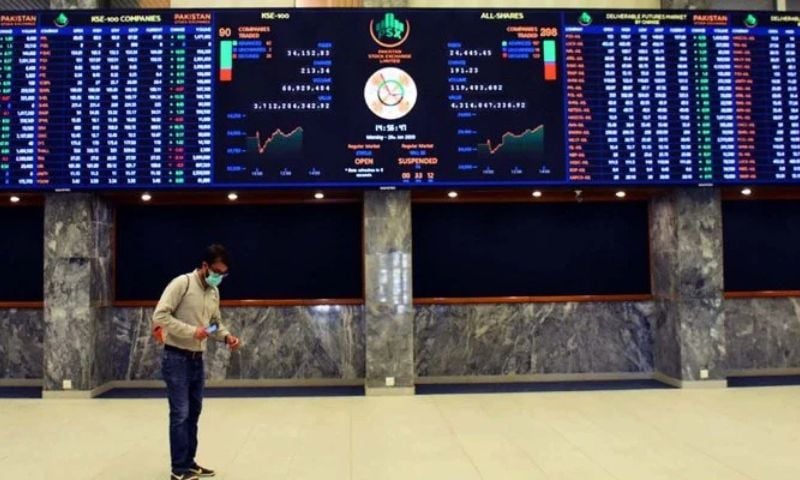
ISLAMABAD: The Pakistan Stock Exchange came under sustained pressure on Monday as the benchmark KSE-100 index fell sharply amid heightened geopolitical tensions and a broad-based risk-off move across global financial markets.
The index rebounded marginally during intraday trade but failed to regain upward momentum, with bearish sentiment dominating throughout the session.
At close, the benchmark KSE-100 index settled at 146,842.97, down 4,864.54 points or 3.21 per cent.
Market participants attributed the decline to surging global oil prices, escalating geopolitical tensions, and cautious investor positioning.
The local bourse “felt the heat” as rising oil prices and geopolitical uncertainty rattled confidence, observed a local brokerage house, Topline Securities.
Investor concern was further fueled by worries over fiscal strain following unchanged fuel prices for a second consecutive week, it added.
Heavyweights including FFC, ENGROH, MEBL, LUCK, and UBL led the downside, collectively dragging the index by more than 1,500 points.
The sentiment remained fragile and highly event-driven. Sana Tawfik, Head of Research at Arif Habib Limited, said markets are likely to remain under pressure until clearer signals emerge on the geopolitical front.
Any de-escalation or ceasefire could help stabilise market sentiment, she added.
Behtari Capital noted that panic selling intensified as regional conflict broadened, increasing risk aversion across emerging markets and shifting investor focus toward diplomatic developments.
Global equities also extended losses as fears of prolonged conflict in the Middle East weighed on sentiment.
The Financial Times reported that US President Donald Trump suggested Washington could consider seizing Kharg Island in the Arabian Sea, a critical Iranian oil export hub, while also indicating a ceasefire could still emerge quickly.
Disruptions to key shipping routes pushed oil, gas, fertiliser, plastic, aluminium and fuel prices higher, with spillovers seen in food, pharmaceutical and petrochemical markets.
Asian markets fell sharply, with Japan’s Nikkei down 4.7 per cent, bringing monthly losses close to 14 per cent. South Korea’s benchmark dropped 4.2 per cent, while the MSCI Asia-Pacific index excluding Japan declined 1.2 per cent.
US futures also pointed lower, with S&P 500 futures down 0.7 per cent and Nasdaq futures off 0.9 per cent. European futures, including EUROSTOXX 50, DAX and FTSE, slid between 1.0 and 1.5 per cent.
In currency markets, the Pakistani rupee posted a marginal gain of Rs 0.01 against the US dollar, closing at 279.16 in the inter-bank market.
Market activity increased from the previous session, with total volume on the all-share index rising to 529.13 million shares from 435.51 million.
Total traded value stood at Rs29.60 billion, compared with Rs23.99 billion in the prior session.
K-Electric Limited led volumes with 56.53 million shares, followed by Bank of Punjab XD with 35.92 million shares and Dost Steels Limited with 31.66 million shares.
Out of 481 companies traded, 51 closed higher, 379 declined, and 51 remained unchanged.