


WASHINGTON: The United States has designated Afghanistan as a “state sponsor of wrongful detention”, accusing the Taliban regime of unjustly holding American citizens and warning that travel restrictions for US passport holders could follow if the detainees are not released.
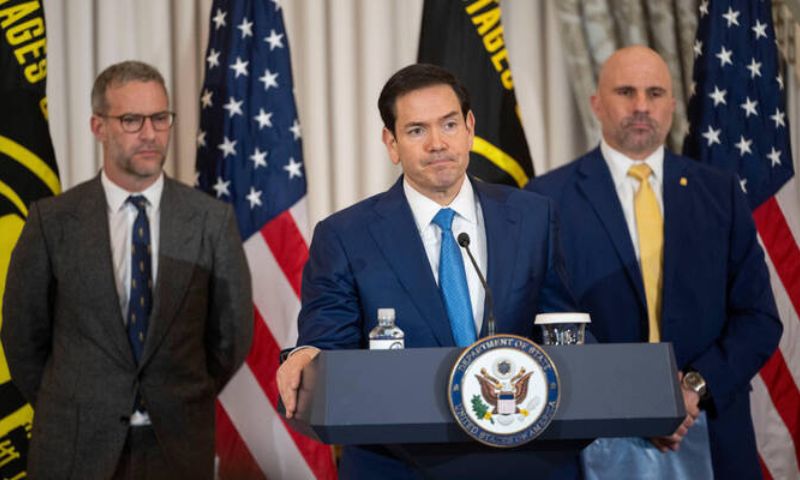
US Secretary of State Marco Rubio announced the decision on Tuesday, saying Washington had determined that Americans faced a serious risk of being detained in Afghanistan.
“The Taliban continues to use terrorist tactics, kidnapping individuals for ransom or to seek policy concessions. These despicable tactics need to end,” Rubio said in a statement.
Rubio urged the Taliban authorities in Kabul to immediately release all American citizens believed to be held in the country, including Mahmood Habibi and Dennis Coyle.
He also warned that it was “not safe for Americans to travel to Afghanistan” because of the risk of arbitrary detention.
Today, I am designating Afghanistan as a State Sponsor of Wrongful Detention. The Taliban continue to use terrorist tactics to seek policy concessions, but it won’t work under this administration. The Taliban must release Dennis Coyle, Mahmood Habibi, and all Americans unjustly…
— Secretary Marco Rubio (@SecRubio) March 9, 2026
Possible travel restrictions
US officials said the designation could lead to restrictions on the use of American passports for travel to Afghanistan if Washington’s demands are not met.
Such a measure is currently imposed only on North Korea, where US citizens are generally prohibited from travelling using US passports.
The designation follows an executive order signed by President Donald Trump in September creating a blacklist for countries accused of wrongfully detaining US citizens abroad.
Iran became the first country to receive the designation in February, when Washington also warned of potential travel restrictions over the detention of Americans.
We’ve told the Taliban that hostage diplomacy is unacceptable. We meant it. Today we are designating Afghanistan a State Sponsor of Wrongful Detention, harsh consequences will follow. We are putting others who engage in this horrific practice on notice. https://t.co/ddSMoHg1qE
— Special Presidential Envoy for Hostage Affairs (@StateSPEHA) March 10, 2026
Americans detained in Afghanistan
US authorities say several American citizens remain detained in Afghanistan.
Mahmood Habibi, an Afghan-American businessman and former head of Afghanistan’s civil aviation authority, was reportedly detained in Kabul in August 2022 along with employees of his telecommunications company.
The US State Department has offered a reward of $5 million for information leading to his return.
Dennis Coyle, an academic from Colorado who worked in Afghanistan for two decades, was detained in January 2025 while conducting research related to Afghan language communities, according to advocacy groups and US officials.
Washington is also seeking the return of the remains of American author Paul Overby, who disappeared near Afghanistan’s border with Pakistan in 2014, according to sources familiar with the matter.
‘Hostage diplomacy’
The Taliban administration has rejected accusations that it engages in “hostage diplomacy”, saying foreign nationals are detained only for alleged legal violations rather than political leverage.
Afghanistan’s foreign ministry described the US designation as “regrettable” but said Kabul remained open to resolving the issue through dialogue.
Officials have pointed to previous prisoner exchanges and releases of foreign nationals, including several Americans freed in 2025, as evidence of ongoing diplomatic engagement between Kabul and Washington.
The designation reflects continuing tensions between the United States and Afghanistan’s Taliban authorities since the group returned to power in 2021 following the withdrawal of US-led forces.
At the United Nations, US Ambassador Mike Waltz recently accused the Taliban of practising “hostage diplomacy” and questioned continued international assistance to Afghanistan while American citizens remain detained.
Human rights organisations and UN officials have also repeatedly criticised Taliban policies, particularly restrictions on women’s education and employment, which have complicated international engagement with the country.