
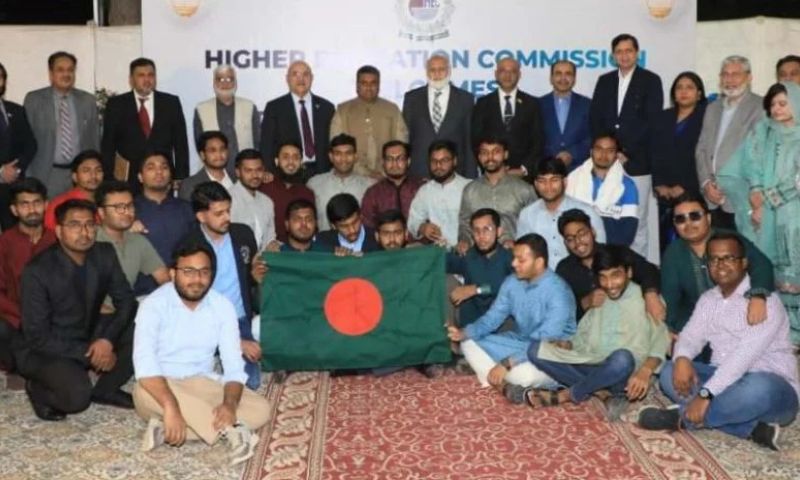
ISLAMABAD: The Higher Education Commission of Pakistan hosted a reception at its Secretariat on Tuesday for students from Bangladesh and Sri Lanka pursuing studies under the Allama Iqbal Scholarship Programme, with officials framing the initiative as a strategic instrument of Pakistan’s foreign policy.
The event brought together scholars studying at various universities in and around the capital, alongside the High Commissioners of Sri Lanka and Bangladesh, Ministry of Foreign Affairs officials, and heads of host institutions.
Educational initiatives as diplomatic bridges
Chairman HEC Dr. Niaz Ahmad Akhtar, in his keynote address, positioned academic cooperation as fundamental to Pakistan’s bilateral engagement strategy.
He emphasized that educational exchanges serve as primary bridges for future collaboration, noting that Pakistan’s relationship with both countries is being continuously strengthened through multiple avenues, with education playing a central role.
HEC recently hosted students from Bangladesh & Sri Lanka currently studying in Pakistan under ‘Allama Iqbal Scholarship Programme’. It was an honor to welcome the High Commissioners & distinguished guests to discuss how these academic collaborations strengthen our bilateral bonds pic.twitter.com/CO8fJoxRXk
— HEC Pakistan (@hecpkofficial) March 10, 2026
The Chairman highlighted that Pakistan’s world-class institutions, including FAST, COMSATS, Pak-Austria Fachhochschule, NUML, Quaid-I-Azam University, NUTECH, UET, and NUST, provide competitive environments for nurturing global talent, reinforcing the country’s capacity to host international scholars as a matter of educational policy.
Scholarship programme as people-to-people catalyst
Sri Lankan High Commissioner Rear Admiral Fred Senavirathne (Rtd) characterised the Allama Iqbal Scholarship Programme as a resounding success in strengthening people-to-people relations.
He noted that collaboration between the nations spans critical sectors, including commerce, sports, defence, and education, with the scholarship initiative specifically prioritised by Sri Lanka for its citizens’ educational development.
Bangladesh High Commissioner Md. Iqbal Hussain Khan described the presence of Bangladeshi students in Pakistani universities as an indicator of deepening educational ties and mutual trust.
He praised the programme for creating a platform where young minds can exchange ideas and contribute to regional socio-economic development, framing educational cooperation as integral to broader policy objectives.
Institutional framework for international students
Director General (HRD) HEC Mrs. Aayesha Ikram outlined the commission’s policy commitment to facilitating international students throughout their academic journey, ensuring a seamless experience.
She positioned the scholars as future ambassadors of goodwill between their countries and Pakistan, carrying forward the spirit of regional cooperation.
The reception underscored HEC’s operational framework for hosting international students, with participation from Vice Chancellors and Rectors of host institutions demonstrating the institutional architecture supporting Pakistan’s educational diplomacy objectives.
Senior officials from the Ministry of Foreign Affairs were also in attendance, reflecting the inter-ministerial coordination underpinning the scholarship programme’s implementation.