Key Points:
- Crew-12 launch set for Feb 13 aboard SpaceX Falcon 9 to restore full staffing on the ISS.
- Eight-month mission includes research on microgravity’s effects and testing AI-assisted medical ultrasounds.
- French astronaut Sophie Adenot becomes France’s second woman in space, following Claudie Haigneré.
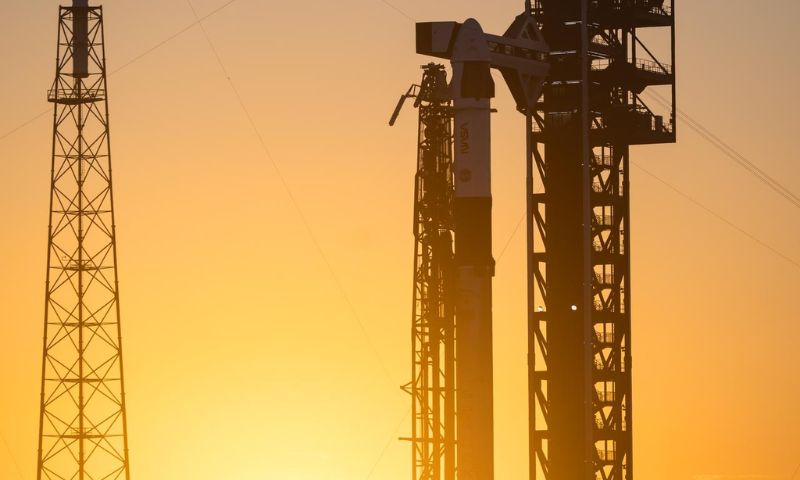
CAPE CANAVERAL, United States: NASA is set to launch four astronauts to the International Space Station (ISS) on Friday, in a mission aimed at restoring normal crew levels after an unprecedented early evacuation triggered by a medical issue.
The US space agency is targeting February 13 for the liftoff of the Crew-12 mission aboard a SpaceX Falcon 9 rocket. The launch window is scheduled to open at 5:15am local time (1015 GMT).
The pre-dawn launch had been delayed by two days due to adverse weather conditions across the US East Coast, including strong winds that could have complicated emergency procedures if needed, according to AFP.
If the launch proceeds as planned on Friday morning, the spacecraft is expected to dock with the orbiting laboratory at around 3:15pm on Saturday.
Crew-12 is composed of two American astronauts, Jessica Meir and Jack Hathaway, French astronaut Sophie Adenot, and Russian cosmonaut Andrey Fedyaev. The crew has been in quarantine at Kennedy Space Center in Florida as final preparations for the mission were completed.
The incoming astronauts will replace Crew-11, which returned to Earth in January—about a month earlier than scheduled—marking the first medical evacuation in the space station’s history.
Since that early return, the ISS has been operated by a reduced “skeleton” crew of just three astronauts. NASA has declined to disclose details about the medical condition that led to the shortened mission.
Once Crew-12 arrives, they will be among the final groups of astronauts to live and work aboard the football field-sized orbital laboratory.
Continuously inhabited for nearly 25 years, the ageing ISS is scheduled to be deorbited in 2030, when it will be guided to re-enter Earth’s atmosphere and crash into a remote area of the Pacific Ocean.
Often described as a symbol of post-Cold War cooperation, the ISS remains one of the few areas of sustained collaboration between Western nations and Russia, even after Moscow’s invasion of Ukraine in 2022. However, geopolitical tensions have at times spilled over into the programme.
In November, Russian cosmonaut Oleg Artemyev—who had long been slated to fly as part of Crew-12—was abruptly removed from the mission.
Independent Russian media reported that he was accused of photographing and transmitting classified information using his phone. Russia’s space agency, Roscosmos, said only that Artemyev had been reassigned to another role.
His replacement, Fedyaev, previously spent time aboard the ISS as part of Crew-6 in 2023.
During their eight-month stay on the station, the four astronauts will carry out a wide range of scientific experiments, including extensive research into how microgravity affects the human body.
Meir, a former marine biologist who has studied animals in extreme environments, will serve as the mission’s commander.
Adenot’s flight will mark a milestone for France, as she becomes the country’s second woman to travel to space, following Claudie Haigneré, who flew aboard the Mir space station.
Adenot has said she was inspired as a teenager after watching Haigneré’s launch.
“It was a revelation,” the former helicopter pilot recalled during a recent briefing. “At that moment, I told myself: one day, that will be me.”
Among other projects, the astronaut from the European Space Agency will test a new system combining artificial intelligence and augmented reality, designed to allow astronauts to conduct their own medical ultrasounds while in orbit—a technology that could have applications both in space and in remote locations on Earth.