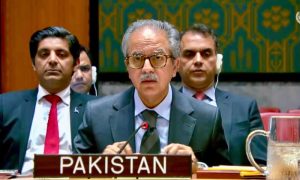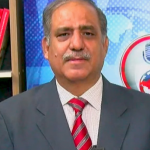
ISLAMABAD: Pakistan’s impartial and principled stance helped build trust between the United States and Iran, enabling the two sides to agree to talks in Islamabad after weeks of war, Pakistan’s former foreign secretary Jauhar Saleem said in an exclusive interview with WE News English.
Speaking at the International Media Centre covering the high-stakes US-Iran talks in Islamabad, Saleem described Pakistan’s role as a mediator as a “significant diplomatic breakthrough” achieved due to Pakistan’s principles and neutral stance.
Neutral stance built credibility
Saleem said Pakistan’s credibility as a key mediator was further strengthened by Islamabad’s consistent and principled stance during the crisis.
He said that Islamabad condemned attacks on Iran, while also condemning Iranian strikes on Gulf countries.
“This principled position enhanced trust on both sides,” he said. “That trust has been leveraged to bring the parties to the negotiating table.”
Pakistan maintains close ties with both Tehran and Washington, along with strong relations with Gulf countries affected by the conflict, he added.
From escalation to peace talks
The former diplomat said the situation had reached a dangerous point before Pakistan’s diplomatic intervention.
“The world was at the brink of not just a disaster, but an apocalypse,” he said, referring to escalating threats and hostilities.
He said Pakistan helped shift the trajectory from “uncontrolled escalation to controlled de-escalation” by persuading both sides to engage.
High-level delegations from the United States and Iran have arrived in Islamabad for the peace talks.
The US side is led by Vice President JD Vance, while the Iranian delegation is headed by Parliament Speaker Mohammad Bagher Ghalibaf.
The US delegation also includes Donald Trump’s son-in-law Jared Kushner and special envoy Steve Witkoff.
Other members of the Iranian delegation include Foreign Minister Abbas Araghchi, Secretary of the Supreme National Security Council Ali Akbar Ahmadian, Central Bank Governor Abdolnaser Hemmati, and former IRGC commander Mohammad Bagher Zolghadr.
Global support for Pakistan’s mediation
Saleem said the Islamabad peace process has received support from major international actors, including China, Saudi Arabia, Turkiye, Egypt and Russia, besides other countries.
He said several of these countries possess leverage that could support progress in negotiations.
“All major powers are supporting this process,” he said, adding that such support strengthens the prospects for sustained dialogue.
Complex negotiations ahead
Despite the breakthrough, Saleem cautioned that the talks would be difficult due to deep differences between Washington and Tehran.
“Their positions remain highly divergent on key issues,” he said, pointing to recent preconditions and strong statements from both sides.
He urged realistic expectations, saying an immediate comprehensive agreement was unlikely.
“It may begin with limited understandings or initial frameworks,” he said, suggesting that multiple rounds of talks could be required.
Ceasefire extension essential
Saleem stressed the importance of extending the current ceasefire to allow space for diplomacy.
“The ceasefire must be extended beyond its initial duration to enable further dialogue,” he said, adding that a permanent ceasefire would significantly stabilise the situation.
He noted that progress should be measured in phases, with incremental gains at each stage.
US influence key on Israel
On the question of Israel’s role, Saleem said only the United States has the influence to ensure Israeli compliance with any future agreement.
“Only the US has the capacity to carry Israel along,” he said, expressing confidence that President Donald Trump could persuade Israeli leadership if needed.
He acknowledged that differing interpretations of agreements could arise during negotiations, calling it a common feature of complex diplomatic processes.
Opportunity for Pakistan
The former foreign secretary said Pakistan’s diplomatic role presents an opportunity to enhance its global standing and attract economic benefits.
“There is an opportunity to transform Pakistan if these gains are utilised effectively,” he said.
Saleem expressed cautious optimism about the outcome of the Islamabad talks, while warning against unrealistic expectations.
“This is a strong beginning, but the process will be long and challenging,” he said.