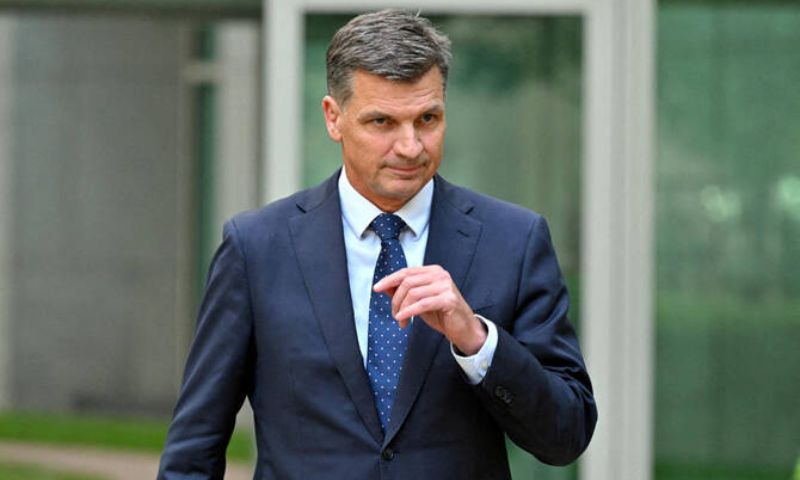
SYDNEY: Australia’s opposition Liberal Party on Friday elected conservative lawmaker Angus Taylor as its new leader, marking a sharp ideological shift as the party struggles to recover from a devastating election defeat and counter growing pressure from right-wing populist forces.
Taylor, a former energy minister and outspoken critic of Australia’s commitment to net zero emissions, replaces Sussan Ley, the party’s first female leader, who had been in the role for just nine months.
His elevation comes amid what senior party figures have described as an existential crisis for the Liberals following their second consecutive loss to Prime Minister Anthony Albanese and the ruling Labor Party.
The Liberals have been deeply divided since the defeat, torn between centrist elements seeking to broaden the party’s appeal and a conservative wing sceptical of climate action, immigration and multiculturalism, according to AFP.
Taylor’s election is widely seen as a victory for the party’s right flank. Speaking after the leadership vote, Taylor struck a combative tone, warning his colleagues that the party faced a stark choice.
“Change or die,” he said, pledging to reposition the Liberals in opposition. He also signalled a tougher approach on immigration, claiming that “our borders have been open to people who hate our way of life,” and vowed to oppose what he described as “Labor’s net zero ideology.”
Ley was ousted after a leadership challenge was called on Thursday, triggering the resignation of several members of her frontbench team.
Her position had become increasingly fragile amid opinion polls showing the Liberal Party slipping behind the right-wing populist One Nation, a development that alarmed party strategists and MPs.
One Nation leader Pauline Hanson has long occupied the fringes of Australian politics but has gained renewed attention in recent years.
Last year, she sparked widespread outrage by wearing a burqa in parliament in a protest widely condemned as racist.
In an upbeat statement following her removal, Ley thanked her supporters and confirmed she would step away from politics altogether.
Her tenure had been marked by internal strains, including a public dispute last month with the Nationals, the Liberals’ long-time coalition partners with whom they have governed Australia for much of the past century.
The party’s internal turmoil has also been fuelled by its evolving stance on climate policy. In November, the Liberals formally abandoned their commitment to net zero emissions by 2050 — a policy first adopted in 2021 under former leader and prime minister Scott Morrison.
Taylor was widely regarded as a key advocate for dropping the target, reinforcing his credentials within the conservative faction.
The son of a sheep farmer, Taylor is closely associated with the party’s right wing. He has previously attracted public attention — and ridicule -including in 2019 when he mistakenly replied to his own social media post with the comment: “Fantastic. Great move. Well done Angus.”
Political analysts say Taylor now faces a formidable challenge in uniting a fractured party and expanding its appeal beyond its shrinking base.
“Angus Taylor has just taken on the hardest job in politics,” said Zareh Ghazarian of the Monash School of Social Sciences.
“He now has to demonstrate what his vision is for the party, and what approach he will take to unite it and galvanise support from the broader community.”
Former Liberal leader and prime minister Malcolm Turnbull, a prominent centrist, warned against further ideological drift to the right. “That will condemn the Liberal Party to further irrelevance,” he told national broadcaster ABC.
Turnbull was particularly scathing in his assessment of the new leader. “A lot of people say about Angus Taylor that he has been the best qualified idiot they’ve ever met,” he said.
“He has this hugely qualified résumé, but when you look at what he’s done in politics so far, it has been disappointing.”
Australia’s next general election must be held by May 2028, giving Taylor limited time to heal internal divisions, counter the rise of populist challengers and rebuild voter trust after one of the most difficult periods in the Liberal Party’s modern history.