KEY POINTS
- Pakistan’s boycott of World Cup match against India sparked major crisis.
- The move strips tournament of its most lucrative and anticipated fixture.
- Indian opposition leader Shashi Tharoor criticised Modi’s govt of politicising cricket.
- Experts warn boycott’s financial fallout will disproportionately impact cricket’s developing nations.
- Cricket lovers commended PCB’s solidarity with Bangladesh, condemning ICC’s favouring India.
ISLAMABAD: The ICC Men’s T20 World Cup, scheduled to start on February 7, has been hit by a major crisis following Pakistan’s decision to boycott its high-octane clash against India, sparking a wave of dismay in India, where critics and fans accuse the Modi government of politicising the sport.
The India-Pakistan cricket match is one of the biggest events in all of sports, watched by hundreds of millions of people.
The boycott not only strips the tournament of its most awaited fixture but also undermines its global reach, competitive intensity, and economic viability.
Indian leaders and media voice disappointment
The reaction in India has been strong. A well-known opposition leader, Shashi Tharoor, called the situation “a disgraceful politicisation of sport.”
He connected Pakistan’s choice to a recent event where a Bangladeshi bowler was not given a contract to play in India’s major league.
#WATCH | On Pakistan to boycott its match against India in the ICC Men’s T20 World Cup 2026, Congress MP Shashi Tharoor says, “It is pretty disgraceful that sport has been politicised in this way on both sides, frankly. I don’t think that Mustafizur (Bangladeshi cricketer… pic.twitter.com/wt3wgwXZPQ
— ANI (@ANI) February 2, 2026
Tharoor said that cricket, which is loved by so many, should bring people together, not push them apart. “This whole thing is spiralling out of control,” he said, asking for urgent talks to solve the problem.
Indian newspapers and TV channels have also expressed sadness.
Many reports say that even though the two countries have political problems, the cricket field has always been a special place where shared passion matters.
Losing this game weakens an important connection between the people of both nations.
Veteran Indian commentator Harsha Bhogle noted that any ‘inevitable loss of ICC revenue’ from the boycott and subsequent uncertainty would impact member nations unevenly.
He stated that boards with robust independent income streams, specifically India, Australia, and England, would feel the financial effect the least.
If there is an inevitable reduction in the ICC’s revenue caused by Pakistan’s forfeit and future uncertainty, the least affected countries, given other strong sources of revenue, will be India, Australia and England. The most affected will be those completely reliant on revenues…
— Harsha Bhogle (@bhogleharsha) February 2, 2026
Conversely, Bhogle warned that the hardest-hit nations would be those most dependent on ICC distributions, a category that includes not only smaller and associate members but also established cricketing countries such as the West Indies, Sri Lanka, Bangladesh, and Pakistan.
Costly decision and old tensions
For Pakistan, this decision comes with a direct penalty. By refusing to play, they would automatically lose the match, giving India two points and hurting Pakistan’s own chances in the tournament.
It also raises a big question: what would happen if the two teams were to meet in a later, knockout round?
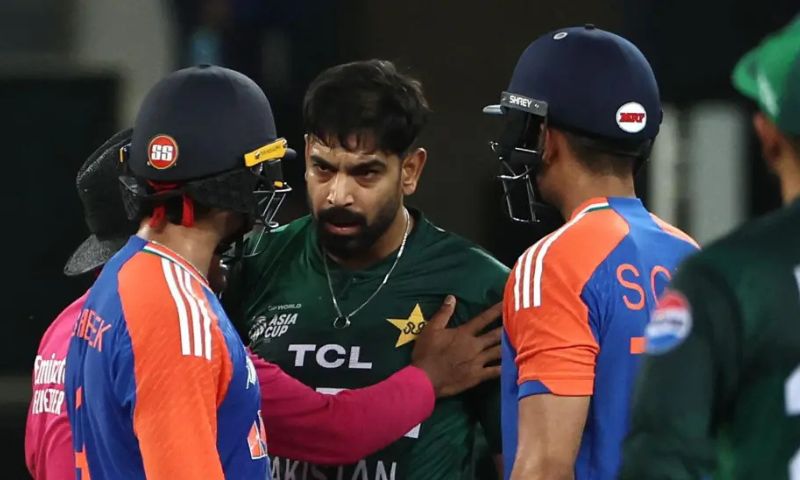
This disagreement is part of a pattern. Last year, after a major tournament final, Indian players did not shake hands with the Pakistani team.
This showed how political tensions are affecting sportsmanship.
Reactions to Pakistan’s World Cup boycott
Former captain Shahid Afridi described the situation as ‘unfortunate’ but supported the government’s position, stating that while cricket can be a unifying force, upholding core principles may require difficult choices.
I’ve always believed cricket can open doors when politics closes them. It’s regrettable that Pakistan won’t play India at the #T20WorldCup, but I stand behind my government’s decision. This is the moment for @ICC to lead and prove through decisions, not statements, that it is…
— Shahid Afridi (@SAfridiOfficial) February 2, 2026
He further called on the International Cricket Council (ICC) to showcase its neutrality through concrete actions, not just words.
Started *No Handshake* from India…. In surprised response Pakistan withdrawal from most important game of the ICC tournament. Not ideal situation for fans of cricket 🏏. Worried
— Mohammad Hafeez (@MHafeez22) February 1, 2026
Expressing disappointment for fans, the former batsman Mohammad Hafeez called the development ‘not ideal’.
He connected the current strain to past on-field tensions, specifically referencing the post-match conduct of Indian players during a recent Asia Cup final.
PakistanvsIndia is one of the greatest sporting events in the world, yet it continues to suffer from political interference that damages the spirit and pride of the game. In such an unfair environment, choosing not to play becomes an act of principle — an eye‑for‑an‑eye response…
— Mohammad Yousaf (@yousaf1788) February 2, 2026
Labelling the government’s decision a ‘difficult but essential’ position, former star Mohammad Yousuf argued that values must come before financial gains.
He added that the historic rivalry, one of sport’s greatest events, is repeatedly damaged by political friction, eroding the essence of cricket.
Not sure if India can meet Pakistan in this World Cup final due to groups and play offs, but if they can, would Pakistan refuse to play the World Cup final?
— Kevin Pietersen🦏 (@KP24) February 1, 2026
Former England cricketer Kevin Pietersen raised a pointed logistical question, asking whether Pakistan would maintain its boycott if the two teams were to meet in the tournament final, highlighting the competitive uncertainty now surrounding the event.
A noted sports journalist, Yahya Hussaini, observed that with official government support, the Pakistan Cricket Board (PCB) faces minimal legal risk.
However, he suggested a narrow window remains for diplomatic efforts to potentially reverse the decision before the tournament begins.
Good decision @TheRealPCB after blatant double-standards demonstrated by @ICC @cricketworldcup when India refused to play in Pakistan, ICC bowed before India unconditionally but when, similarly, Bangladesh sought change of venue in India, they were denied! pic.twitter.com/ExqzoJqlMG
— Mushahid Hussain Sayed (@Mushahid) February 2, 2026
Pakistan’s senior senator Mushahid Hussain Syed commended the PCB for showing solidarity with Bangladesh and criticised what he termed inconsistent past rulings by the ICC, particularly concerning venue allocations involving India.
On Sunday late into the night ICC’s efficiency seemed more of a panic first not welcoming Pakistan’s selective participation & towards the end requesting PCB to reconsider preserving cricket’s ecosystem. Where was ICC when Australia & West Indies forfeited their matches in 1996,… pic.twitter.com/cyoKJY7rng
— Rashid Latif | 🇵🇰 (@iRashidLatif68) February 1, 2026
Former captain Rashid Latif questioned the ICC’s urgent response, calling it a reaction of panic. He cited historical precedents where teams forfeited matches without similar backlash, arguing the governing body now finds itself in a complex predicament.
Former human rights minister Shireen Mazari responded critically, accusing the ICC of actively favouring and advancing Indian influence within the sport.
The ICC is fast deteriorating into the Indian Cricket Council, promoting Indian bullying – time for some restructuring. https://t.co/iP6UYjoaGP
— Shireen Mazari (@ShireenMazari1) February 2, 2026