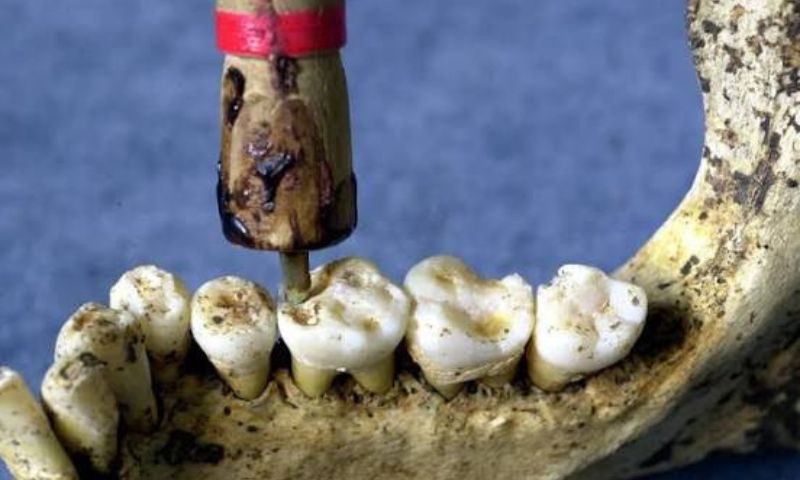
ISLAMABAD: Long before modern dentistry, ancient inhabitants of what is now Pakistan were performing complex dental surgeries, drilling into teeth to remove decay with remarkable precision. New research has confirmed that the world’s oldest known dental procedures were carried out at Mehrgarh in Balochistan, dating back an astounding 9,000 years to around 7000 BCE.
Scientists have reconstructed the primitive yet ingenious tools used by these prehistoric dentists: tiny flint-tipped wooden drills, rotated by a bowstring mechanism at speeds of about 20 times per second.
While modest by today’s standards, modern drills spin at 20,000 revolutions per second, this technology was revolutionary for its time and represents humanity’s earliest known effort to treat dental ailments.
Dental surgery was invented in Mehrgarh, Ancient Pakistan.
That was 9,000 years ago. pic.twitter.com/UKAO2lZQYr
— MD Umair Khan (@MDUmairKh) July 9, 2026
Excavations unearth nine drilled teeth with possible fillings
During archaeological excavations at Mehrgarh, a Neolithic site in Balochistan, researchers from the University of Poitiers in France examined over 300 skeletons and discovered nine human dentures with perfectly drilled holes. These perforations, measuring up to 3.5 millimetres deep, were found in premolars and molars, teeth located at the back of the jaw, suggesting the surgery was medical rather than cosmetic.
Traces of bitumen (tar) were found in some of the drilled cavities, leading scientists to believe that the material was used as a primitive filling, possibly mixed with resin or cotton, which has since disintegrated over millennia.
The location of the holes, combined with wear marks around them, confirmed that patients continued to chew on these teeth after the procedures, evidence that the surgeries were successful and performed on living individuals.
Opium likely used as anaesthesia
Professor Alfredo Coppola of Rome University’s human biology department, who led the Italian team in collaboration with researchers from France, Mexico and the United States, described the treatment as “excruciatingly painful” due to the low-frequency, high-intensity vibrations of the primitive drill.
However, he noted that pain relief was likely available. “This area is well-known for its opium production, so perhaps drugs were used,” Prof Coppola said. Plants with anaesthetic properties may have been administered to patients during these lengthy and painful operations.
From jewellery-making to dentistry
The study revealed that local expertise in manufacturing bone, shell and stone beads, a hallmark of Neolithic craftsmanship in the region, was adapted for early dentistry. The same drill bits used for jewellery-making were repurposed for tooth drilling, demonstrating the ingenuity and resourcefulness of ancient Pakistani communities.
The researchers conducted experimental re-enactments using reconstructed tools and successfully reproduced holes identical to those found in the prehistoric teeth, confirming that the technique was both effective and repeatable.
True pride of Ancient Pakistan! Mehrgarh leading the world in dentistry 9,000 years ago.
— Ali Hasnain khan (@AliHasnain124) July 9, 2026
A legacy that redefined history
Previously, the earliest known evidence of dentistry came from a graveyard in Denmark, dating to around 3000 BCE. The findings at Mehrgarh push that timeline back by an incredible 4,000 years, establishing the region of modern-day Pakistan as the birthplace of dental surgery.
Mehrgarh, located near the Bolan Pass, is one of the world’s oldest Neolithic settlements, dating back to 7000 BCE. Discovered in 1974 by French archaeologists, it provided the earliest evidence of farming and herding in South Asia. Its inhabitants cultivated wheat and barley, raised livestock, and engaged in extensive trade networks spanning as far as Afghanistan.
Spanning nearly 5,000 years of occupation, Mehrgarh laid the foundation for the later Indus Valley Civilization. Today, it remains a proud symbol of Pakistan’s ancient heritage and its profound contributions to human civilisation.