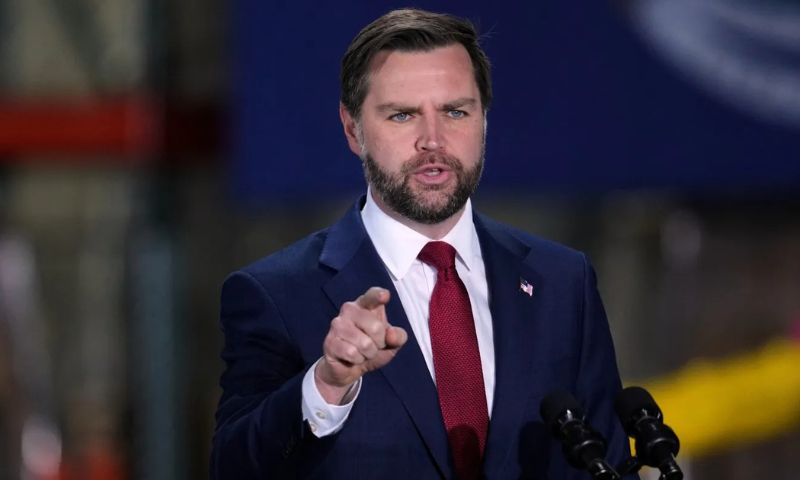
WASHINGTON: US Vice President JD Vance said Washington plans to withdraw from the conflict in Iran “soon” amid ongoing diplomatic efforts to de-escalate the widening conflict through meaningful negotiations.
Speaking in an interview with podcaster Benny Johnson, Vance said the US had already achieved most of its military objectives but would press ahead briefly to ensure lasting impact.
“The president’s going to keep at it for a little while longer to ensure that once we leave, we don’t have to do this again for a very, very long time,” Vance said.
“We need to neuter them for a very, very long time, and that’s the purpose,” the US Vice President said.
He added that President Donald Trump had no intention of maintaining a prolonged presence in Iran.
“We’re not interested in being in Iran a year down the road, two years down the road,” Vance said. “We’re taking care of business, we’re going to be out of there soon.”
The conflict began on February 28 when the United States and Israel launched coordinated strikes on Iran, triggering a broader regional confrontation.
US Central Command (CENTCOM) Commander Brad Cooper said the operation, dubbed Operation Epic Fury, had struck more than 10,000 targets to eliminate Iran’s ability to project power beyond its borders.
Iran responded with large-scale missile and drone attacks, targeting Israel and various Gulf states.
Diplomatic efforts and Pakistan’s role
Amid the escalating conflict, Pakistan has intensified diplomatic efforts to promote de-escalation and facilitate dialogue between Iran and the US.
Pakistan’s Prime Minister Shehbaz Sharif held a telephone conversation with Iranian President Masoud Pezeshkian.
PM Sharif briefed the Iranian leader on Islamabad’s diplomatic outreach, including contacts with the United States and Gulf and Islamic countries aimed at promoting peace.
Held a detailed telephone conversation with my brother President Masoud Pezeshkian of Iran earlier today, lasting over one hour.
I reiterated Pakistan’s strong condemnation of the continued Israeli attacks on Iran, including recent strikes on civilian infrastructure, and…
— Shehbaz Sharif (@CMShehbaz) March 28, 2026
Pezeshkian lauded Pakistan’s diplomatic efforts and stressed the importance of trust-building measures to facilitate dialogue.
Pakistan is set to host high-level talks from March 29 to 30 with foreign ministers from Saudi Arabia, Turkiye and Egypt.
The visiting foreign ministers — Prince Faisal bin Farhan Al Saud, Hakan Fidan and Badr Abdelatty — will hold consultations in Islamabad focusing on regional and international developments, with particular emphasis on de-escalation.
🔊PR No.7️⃣7️⃣/2️⃣0️⃣2️⃣6️⃣
Foreign Ministers of Saudi Arabia, Türkiye, and Egypt to Visit Islamabad for Consultations
🔗⬇️https://t.co/ehLoO2Av8I pic.twitter.com/3UIAKm2zwm
— Ministry of Foreign Affairs – Pakistan (@ForeignOfficePk) March 28, 2026
Pakistan’s Foreign Office said the country attaches high importance to its relations with the three “brotherly nations” and expects the visit to strengthen coordination on matters of mutual interest.
Tehran has reportedly responded to a 15-point US proposal aimed at ending the war and is awaiting Washington’s reply.
Energy markets and Strait of Hormuz
The conflict has disrupted global energy markets, particularly after Iran tightened control over the Strait of Hormuz, a vital route for around 20 per cent of global seaborne oil trade.
The closure has halted commercial traffic and pushed global oil prices up by 40 to 50 percent, according to estimates cited in the reports.
Vance acknowledged that fuel prices had risen due to the conflict but described the spike as temporary.
“This is a very, very temporary reaction to what is ultimately going to be a short-term conflict,” he said, adding that prices would fall once the situation stabilises.