


TEHRAN/WASHINGTON: Iran and the United States traded fresh military strikes for a second consecutive day on Thursday, with Tehran launching missile and drone attacks on US military bases in Bahrain and Kuwait after Washington carried out another wave of strikes on Iranian military targets, deepening the biggest confrontation between the two countries since the war began in February.
The latest exchange comes less than 48 hours after the United States launched major strikes on Iranian military infrastructure in response to attacks on commercial shipping in the Strait of Hormuz, triggering the first direct Iranian attacks on American military installations in the Gulf since the ceasefire collapsed.
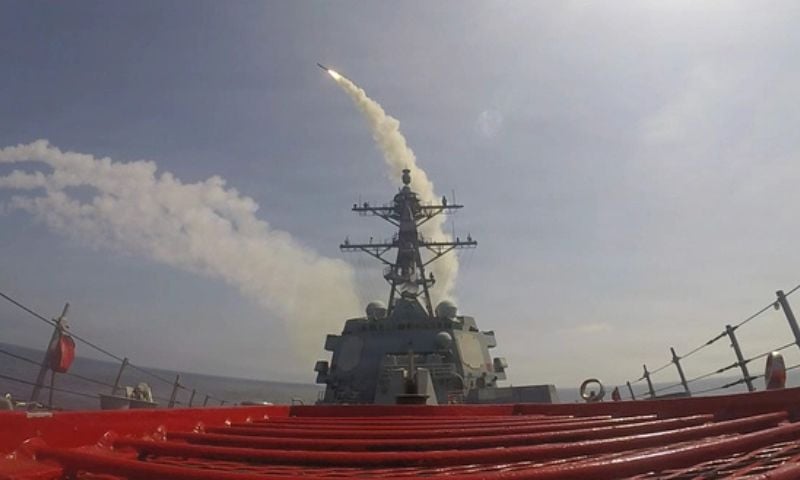
The US Central Command said they had struck approximately 90 military targets, including missile and drone storage as well as military logistics sites along Iran’s coastline.
The strikes killed three people and wounded several others on the outskirts of Ahvaz in Iran’s southwest, the country’s official news agency IRNA reported, quoting an official.
President Donald Trump declared on Wednesday that the June 17 ceasefire was “over” as the fighting intensified, but later signalled he remained open to diplomacy, saying Iran was seeking renewed negotiations.
BREAKING:
🇺🇸🇮🇷 U.S President Trump announced that the CEASEFIRE WITH IRAN IS OVER.
“To me, I think it’s over. I don’t want to deal with them…They’re scum. They’re sick people.” pic.twitter.com/qvDXZY60fc
— Commentary Donald J. Trump Truth Social Posts On X (@TrumpTruthOnX) July 8, 2026
US Launches New Wave of Strikes
The United States launched fresh strikes across southern Iran after Trump vowed to “hit them hard again” following overnight exchanges between the two sides.
Iranian state media reported explosions in Sirik and the strategic port city of Bandar Abbas, while warplanes were heard over Kish Island. Further explosions were reported in Konarak and Chabahar, with parts of the affected areas losing electricity, according to the official IRNA news agency.
At the direction of the Commander in Chief, U.S. Central Command forces have started conducting additional strikes against Iran to further degrade their ability to threaten freedom of navigation in the Strait of Hormuz. The United States is holding Iran accountable for recent…
— U.S. Central Command (@CENTCOM) July 8, 2026
The operation was confirmed by US Central Command (CENTCOM), which said the strikes were aimed at weakening Iran’s ability to threaten international shipping through the Strait of Hormuz.
“At the direction of the Commander in Chief, U.S. Central Command forces have started conducting additional strikes against Iran to further degrade their ability to threaten freedom of navigation in the Strait of Hormuz.”
“The United States is holding Iran accountable for recent unjustified aggression against commercial shipping.”
A US official told Reuters, speaking on condition of anonymity, that Wednesday’s operation would be larger than the strikes carried out a day earlier.
Following the attacks, Trump defended the military operation on Truth Social.
“This is in retribution for yesterday’s bombing of ships by Iran. If it happens again, it will get much worse!” – President Donald J. Trump pic.twitter.com/TKKf8cIzCr
— The White House (@WhiteHouse) July 8, 2026
“This is in retribution for yesterday’s bombing of ships by Iran. If it happens again, it will get much worse!” he wrote.
Iran Retaliates Against US Bases
Hours after the American strikes, Iran’s Revolutionary Guards (IRGC) announced missile and drone attacks on US military facilities in Bahrain and Kuwait.
In a statement carried by state television IRIB, the Guards said they had struck “key infrastructure and facilities” at the Arifjan and Ali Al Salem bases in Kuwait, and the Juffair and Sheikh Isa bases in Bahrain.
The IRGC said the attacks were carried out in retaliation for the latest American strikes on Iran and warned that further US military action would prompt additional attacks on American bases across the region.
Kuwait said it intercepted two ballistic missiles and 13 drones, while the Iranian military said it had also targeted US forces stationed at Sheikh Isa Air Base in Bahrain.
A US military official said the Iranian attacks caused no American casualties or significant damage.
“All missiles and drones fired by Iran were intercepted or failed to cause major damage,” the official told AFP.
Trump Leaves Door Open to Talks
Despite ordering fresh military action, Trump suggested diplomacy remained possible.
Speaking in Ankara, where he is attending a regional summit, the US president said Tehran had reached out seeking negotiations but questioned whether it could be trusted.
.@POTUS on Iran: “They called a little while ago. They want to make a deal so badly — I just don’t know if they’re worthy of making a deal. I don’t know that they’re going to honor the deal. That’s the problem.” pic.twitter.com/jQTENvyRGM
— Rapid Response 47 (@RapidResponse47) July 9, 2026
“They called a little while ago. They want to make a deal so badly — I just don’t know if they’re worthy of making a deal. I don’t know that they’re going to honor the deal. That’s the problem.”
His comments highlighted the contradictory US approach of intensifying military pressure while keeping open the possibility of renewed negotiations.
Strait of Hormuz Remains Flashpoint
The latest military exchanges have centred on the Strait of Hormuz, one of the world’s most strategically important waterways through which around one-fifth of global oil and liquefied natural gas supplies normally pass.
Washington said the latest strikes were launched after Iran allegedly attacked three commercial cargo ships transiting the strategic waterway.
Although Tehran has not claimed responsibility for the attacks, it has repeatedly insisted on controlling shipping through the strait, saying vessels must follow routes authorised by Iran while warning of consequences for those that do not.
CENTCOM said its forces struck more than 80 targets during Tuesday’s operation, including Iranian air defence systems, coastal radar installations and 60 Islamic Revolutionary Guard Corps fast attack boats.
Ceasefire Collapses
The latest fighting has apparently ended the June 17 ceasefire, which had briefly raised hopes that months of conflict could be brought to an end through diplomacy.
The war began on February 28, when US-Israeli airstrikes on Iran triggered a cycle of retaliatory attacks across the region.
The June 17 ceasefire, brokered with the support of Pakistan and Qatar, led to a temporary reduction in hostilities and allowed maritime traffic through the Strait of Hormuz to begin recovering.
However, Trump declared the ceasefire “over” on Wednesday after the latest escalation, paving the way for renewed military action by both sides.
International Maritime Organisation Secretary-General Arsenio Dominguez said nearly 6,000 seafarers remain stranded in the region despite the brief lull in fighting.
International Calls for Restraint
As the conflict entered its second day of direct exchanges between Washington and Tehran, world leaders renewed calls for restraint.
UN Secretary-General Antonio Guterres urged “all parties to exercise maximum restraint” to prevent a wider regional war.
Pakistan, which played a key mediating role in securing the June 17 ceasefire, also called for de-escalation, while Iran said Foreign Minister Abbas Araghchi and Qatar’s prime minister spoke by telephone on Wednesday and “underscored the importance of using diplomatic means to resolve regional issues.”
The renewed exchange of attacks has raised fresh concerns that the conflict could spread further across the Gulf, threatening regional security and global energy supplies.