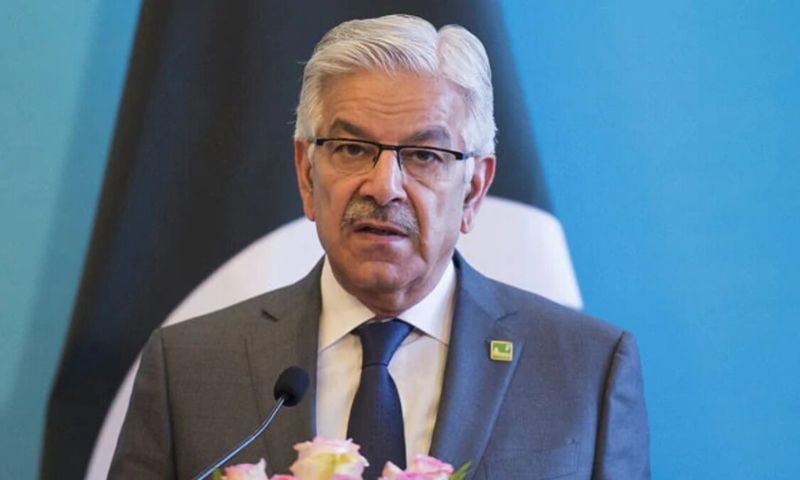



ISLAMABAD: Pakistan’s Defence Minister said on Tuesday that the United States and Iran are close to a deal over the Strait of Hormuz.
Defence Minister Khawaja Asif, in an interview with Bloomberg News, said that Washington and Tehran are “close to some sort of arrangement” over the near-closed strait, which has been the sticking point to stall talks between the two warring sides.
“The signals in the last two or three days are that we are close to some sort of an arrangement,” the defence minister added. “Things are shaping up in favour of peace,” Asif said.
Pakistan’s defense minister Khawaja Asif said the US and Iran are close to “some sort of an arrangement,” adding that a lasting peace will be in the region’s interest. https://t.co/FM7qEw7Qje
— Bloomberg (@business) August 11, 2026
Khawaja Asif’s remarks come as Pakistani Interior Minister Mohsin Naqvi is currently in Tehran for meetings with Iranian leadership as part of Islamabad’s diplomatic efforts to revive talks between the US and Iran to permanently end the conflict.
Mohsin Naqvi held a meeting with Iranian Foreign Minister Abbas Araghchi in Tehran on Tuesday, IRNA News agency reported.
Syed Mohsin Naqvi, Pakistan's Interior Minister, convened with Foreign Minister @araghchi on Tuesday evening for discussions. pic.twitter.com/gRya7pa0Nz
— IRNA News Agency ☫ (@IrnaEnglish) August 11, 2026
Pakistan’s efforts to revive US-Iran talks
Mohsin Naqvi arrived in Tehran on Tuesday for talks with Iranian officials as part of diplomatic efforts to revive negotiations between Iran and the United States, Al Arabiya reported.
Naqvi’s visit comes as Pakistan and Qatar intensify mediation efforts to create conditions for the resumption of direct US-Iran talks.
The Pakistani Interior Minister’s visit was part of Islamabad’s efforts to revive talks between Tehran and Washington, Al Arabiya reported while citing sources.
Iran’s official IRNA news agency, citing a diplomatic source, said Naqvi had left Islamabad for Tehran for discussions with Iranian officials on bilateral ties and issues of mutual interest. Iran’s semi-official Mehr News Agency later reported that he had arrived in the Iranian capital.
Naqvi has been a key member of Pakistan’s mediation team and the Tehran visit is his sixth since the US-Iran conflict began.
The visit comes about a month after Iranian Interior Minister Eskandar Momeni travelled to Islamabad for talks with Pakistani leadership.
Iran-Oman talks on Hormuz reach advanced stage
Naqvi’s visit coincides with a separate diplomatic effort involving Iran and Oman over arrangements for shipping through the Strait of Hormuz.
Qatar’s Foreign Ministry spokesman Majed al-Ansari said on Tuesday that negotiations between Iran and Oman had reached an “advanced stage”.
The talks were at a “critical juncture”, Ansari said, adding that Doha supported efforts to de-escalate tensions in the region.
“As mediators, we want the Strait of Hormuz reopened as soon as possible,” he said.
Key Highlights from the Weekly Media Briefing by Dr. Majed bin Mohammed Al-Ansari @majedalansari , Advisor to the Prime Minister and Official Spokesperson for the Ministry of Foreign Affairs#MOFAQatar pic.twitter.com/LSch9JUxdS
— Ministry of Foreign Affairs – Qatar (@MofaQatar_EN) August 11, 2026
Iran and Oman have been negotiating legal and technical arrangements for navigation through the strategic waterway after maritime traffic was disrupted following the conflict between Iran and the United States.
Iranian Foreign Ministry spokesman Esmaeil Baqaei said on Monday that the talks were proceeding in a “very smooth and constructive manner”, according to IRNA.
He said the two sides had reached an understanding on a traffic map, while technical issues related to a joint statement were still being discussed.
Baqaei said the discussions were not currently focused on how any transit fees would be divided between Iran and Oman.
Instead, mechanisms would be established to monitor the safe passage of shipping, promote environmental co-operation, provide maritime services and combat crime, he said.
He added that maritime services would normally require compensation.
Baqaei stressed that the discussions with Oman over a safe shipping route were separate from the broader question of reopening the Strait of Hormuz.
Iranian Foreign Minister Abbas Araghchi said on Sunday that an agreement with Oman on the strait was in its “final stages”, according to Mehr news agency.
He said the agreement would establish new shipping lanes that could be used once other conditions were met and the waterway was reopened.
Tehran and Washington exchange messages
Iran said on Monday that Tehran and Washington were exchanging messages through intermediaries as efforts to revive negotiations intensified.
Baqaei stressed, however, that the contacts did not amount to direct negotiations between the two sides.
“Of course, it is natural to exchange messages through mediators on current issues, but what the next step will be depends on the circumstances,” he said, according to IRNA.
“Currently, we are focused on negotiations with Oman to determine the shipping route,” he added.
Araghchi made a similar distinction on Sunday. “This is not called ‘negotiation’, it’s an ‘exchange of messages’,” he said.
Pakistan and Qatar are mediating between Tehran and Washington under the framework of the Islamabad Memorandum of Understanding to permanently end the conflict.
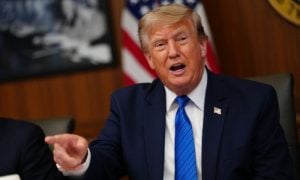
US President Donald Trump said on Sunday that Washington was “semi-negotiating” with Iran, suggesting that contacts were continuing through backchannels.
“We are low keying it,” Trump told Axios in a telephone interview. “We are only semi-negotiating with them.”
Trump said Iran was facing severe economic pressure and claimed the US naval blockade had worsened the country’s economic crisis.
Baqaei responded on Monday by saying Iranians had shown they were “professional chess players”.
He also reiterated that Tehran did not consider the Strait of Hormuz a safe waterway while what it describes as a US naval blockade and other alleged violations continued.
Pakistan and Qatar intensify mediation
Pakistan has emerged as a key mediator to end the conflict between Iran and the United States.
Baqaei said on Monday that Pakistan was playing a central role in mediation between Tehran and Washington.
He also said invitations extended by Pakistan to Iranian Parliament Speaker Mohammad Bagher Ghalibaf and Foreign Minister Abbas Araghchi to visit Islamabad would be considered when the time was right.
“The relationship between Iran and Pakistan is a very important one,” Baqaei said, describing such visits as a natural part of the close relationship between the two neighbours.
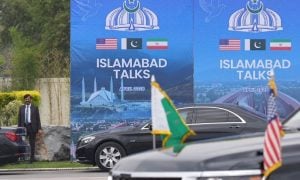
Pakistan has sought to facilitate dialogue between Iran and the United States after helping secure a ceasefire on April 8 and hosting high-level talks between the two sides in Islamabad on April 12 and 13.
Under the Islamabad memorandum of understanding, Iran and the United States committed to halt military operations, reopen the Strait of Hormuz to commercial shipping and negotiate a comprehensive agreement covering Iran’s nuclear programme, US sanctions and a permanent ceasefire within 60 days.
Pakistan and Qatar later co-mediated the first round of high-level talks in Lucerne, Switzerland, on June 21. The meeting was attended by US Vice President JD Vance and Iranian Parliament Speaker Mohammad Bagher Ghalibaf.
Following the meeting, Pakistan and Qatar said significant progress had been made in diplomatic efforts between Washington and Tehran.