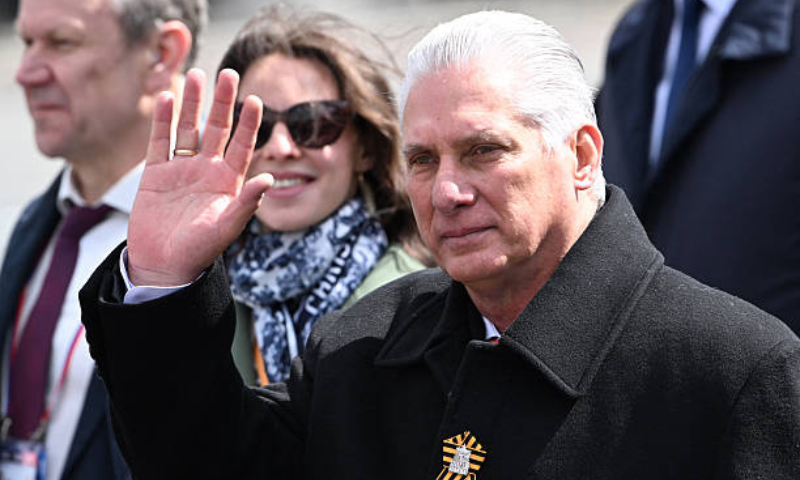
WASHINGTON: The United States has imposed a new round of sanctions on Cuban President Miguel Diaz-Canel, members of his family and relatives of former leader Raul Castro, in the latest escalation of pressure on the communist-run island.
Among those targeted are a son and a grandson of Raul Castro, who no longer holds formal office but remains one of the most influential figures in Cuba.
For decades, Cuba has been the world capital for radical left-wing terrorism. The regime in Havana has recruited, trained and backed violent Marxist and third-worldist movements across our hemisphere and beyond. Today, we are targeting the network that enables and funds Cuba’s…
— Secretary Marco Rubio (@SecRubio) June 4, 2026
President Diaz-Canel, his wife and stepson were also sanctioned, along with Cuba’s Ministry of the Revolutionary Armed Forces and several other entities. The measures were announced by the US Treasury Department on Thursday.
The sanctions come as President Donald Trump continues to intensify pressure on Havana. Cuba has been under a US trade embargo since 1962, but Washington has tightened restrictions in recent months, including measures that have sharply reduced fuel supplies to the island.
The Trump administration argues that Cuba’s government poses a threat to US national security and maintains links with hostile actors and groups.
Trump has repeatedly suggested that Cuba could face further action after the overthrow of Venezuela’s socialist leader, Nicolas Maduro, earlier this year and the ongoing US confrontation with Iran.
“We’ll take care of the Islamic Republic of Iran, and as soon as that’s done, on our way back, we’ll just make a little brief stopover,” Trump said on Thursday, in comments widely interpreted as a reference to Cuba.
The US president denied that the latest sanctions were intended to accelerate the collapse of Cuba’s government.
The measures follow a US murder indictment against Raul Castro and previous sanctions targeting a military conglomerate that controls a significant share of the Cuban economy.
Washington had already barred Diaz-Canel and members of his family from entering the United States last year.
In a post on X, Diaz-Canel accused Trump of attempting to “strengthen the blockade and scenario of conflict between Cuba and the United States.”
El presidente de EE.UU hace nuevas declaraciones amenazadoras contra #Cuba; y el Departamento del Tesoro incorporó nuevos nombres de dirigentes, organizaciones y empresas cubanas a una lista ilegítima de sanciones.
Están dirigidas a reforzar las medidas de #bloqueo y el…
— Miguel Díaz-Canel Bermúdez (@DiazCanelB) June 4, 2026
He said Cuba would resist the “aggressiveness and perversity of the Yankee government” and “the imperialist onslaught.”
Cuban Foreign Minister Bruno Rodriguez condemned the sanctions as “vile” and said they would be met with “greater unity and determination from our people.”
Speaking at the White House, Trump said he wanted Cuba to become “a nicely run country that can feed its people.”
“But the country is starving, and it’s got no energy, it’s got no oil, it’s got no money, it’s got nothing,” he said.
He added that Cuba had “a beautiful piece of land” and suggested it could host “beautiful resorts.”
Humanitarian Concerns Grow
The tightening of US restrictions has coincided with a deepening crisis on the island.
A fuel embargo imposed earlier this year has left Cuba struggling to secure diesel for electricity generators, contributing to prolonged blackouts that in some areas last up to 22 hours a day. Water shortages have also become increasingly common.
With transport services severely disrupted, shortages of food and medicine have worsened, leaving Cuba increasingly dependent on aid shipments from countries including Mexico and China.
The United Nations representative in Cuba warned on Thursday that the humanitarian emergency, combined with the start of the Caribbean hurricane season, created an “explosive cocktail.”
Eastern parts of the island are still recovering from Hurricane Melissa, which caused widespread destruction last October.