Key Points
- Taliban policies blamed for worsening economic collapse in Afghanistan
- Restrictions and isolation under Taliban rule deepen humanitarian crisis
- Aid cuts linked to Taliban curbs push families towards extreme poverty
CHAGHCHARAN: Deepening poverty and widespread unemployment in Afghanistan are driving families towards unimaginable decisions, with some parents reportedly selling their own children to survive, according to a recent report by BBC from the central province of Ghor.
The report paints a grim picture of life in Taliban-controlled Afghanistan, where economic collapse, shrinking humanitarian assistance and severe food shortages have left millions struggling to meet even the most basic needs.
One of the most heartbreaking accounts featured in the report is that of Saeed Ahmad, a resident of Ghor, who said he was forced to sell his five-year-old daughter, Shaiqa, after she was diagnosed with appendicitis and a liver cyst.
“I had no money to pay the medical expenses. So I sold my daughter to a relative,” Saeed told the BBC. According to the report, Shaiqa’s operation was successful, with the medical expenses covered from the 200,000 afghanis — approximately 3,200 dollars — agreed upon in the arrangement.
Saeed explained that the agreement with his relatives allowed them to initially pay only for the surgery, while the remaining amount would be provided over the next five years.
“If I had taken the whole sum at that time, he would have taken her away,” he said. The desperate father said the decision was agonising but unavoidable. “If I had money, I would never have taken this decision, but then I thought, what if she dies without the surgery? This way at least she will be alive,” he added.
The BBC report further described how unemployed men gather every morning at a crossroads in Chaghcharan, hoping someone will hire them for daily labour work. Many return home empty-handed after waiting for hours. Juma Khan, a 45-year-old labourer, said he had secured work only three times during the previous six weeks, earning between 150 and 200 afghanis per day.
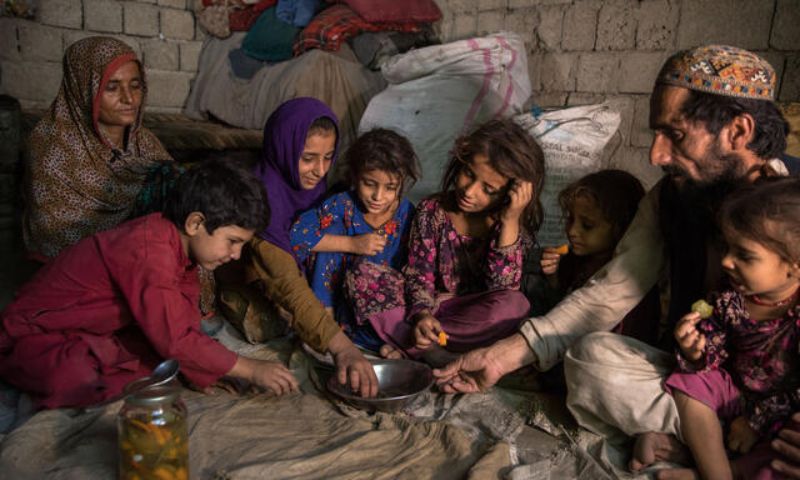
“My children went to bed hungry three nights in a row,” he said. “My wife was crying, so were my children. So I begged a neighbour for some money to buy flour.” Another resident, Abdul Rashid Azimi, said poverty had driven him to consider selling his seven-year-old twin daughters, Ruqia and Rohila. Holding the children in his arms, Azimi broke down in tears while speaking to the BBC. “I’m willing to sell my daughters. I’m poor, in debt and helpless,” he said.
“I come home from work with parched lips, hungry, thirsty, distressed and confused. My children come to me saying, ‘Baba, give us some bread’. But what can I give? Where is the work?” While kissing one of his daughters, Rohila, he added: “It breaks my heart, but it’s the only way.”
His wife, Kayhan, described the family’s dire living conditions, saying they survive mainly on bread and hot water. “All we have to eat is bread and hot water, not even tea,” she said.
The report noted that two adolescent boys from the same family polish shoes in the city centre to earn money, while another child collects rubbish, which the family uses as fuel for cooking. The humanitarian crisis has also contributed to rising child mortality across Afghanistan.
Mohammad Hashim, who recently lost his 14-month-old daughter, said poverty and lack of medical treatment were directly responsible for her death.
“My child died of hunger and a lack of medicine,” he said. “When a child is sick and hungry, it is obvious they will die.” Local elders in Ghor told the BBC that child deaths linked to hunger and malnutrition have noticeably increased over the past two years.
Because no official records of child deaths exist in the province, the BBC visited a local cemetery for evidence. According to the report, there were significantly more small graves than adult graves, indicating a disturbing rise in the number of child burials.
Further evidence of the worsening crisis was reportedly found at the main provincial hospital in Chaghcharan, where overcrowded neonatal wards are struggling to cope with increasing admissions.
The report said some hospital beds were occupied by two babies at the same time, with many newborns suffering from severe malnutrition and breathing difficulties. Fatima Husseini, a nurse working at the hospital, said infant deaths have become alarmingly frequent.
“In the beginning, I found it very hard when I saw children dying. But now it has almost become normal for us,” she said, adding that on some days as many as three newborn babies die within 24 hours.
The crisis highlighted in Ghor reflects the broader humanitarian emergency unfolding across Afghanistan since the Taliban returned to power.
According to the United Nations, nearly three out of every four Afghans are currently unable to meet basic needs such as food, healthcare and shelter.
The report said unemployment has become widespread, the healthcare system is collapsing, and international aid — once relied upon by millions — has sharply declined.
The United Nations has previously warned of severe shortages of food, clean water, heating, clothing and medical services across Afghanistan, noting that more than 80 per cent of households are trapped in debt.
Responding to the findings, Taliban deputy spokesperson Hamdullah Fitrat blamed the economic crisis on the aftermath of two decades of war and dependence on foreign funding.
“During the 20 years of invasion, an artificial economy was created due to the influx of US dollars. After the end of the invasion, we inherited poverty, hardship, unemployment and other problems,” he told the BBC.
However, international aid organisations and human rights groups have repeatedly argued that Taliban restrictions on women and girls remain a major factor behind declining foreign assistance and reduced donor confidence.
Fitrat rejected those claims, insisting that humanitarian assistance should not be politicised.