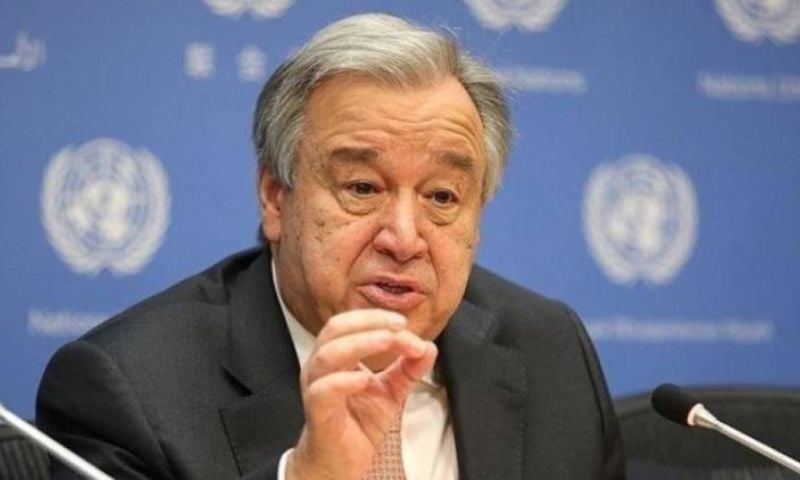
UNITED NATIONS: United Nations Secretary-General Antonio Guterres has stressed the importance of maintaining a UN security presence in Lebanon after the current peacekeeping mission concludes at the end of the year, warning that the country will continue to require international support to preserve stability and prevent renewed conflict along its southern border.
In a report submitted to the UN Security Council, Guterres outlined three possible options for a future UN presence in Lebanon, ranging from nearly 2,000 to more than 5,500 uniformed personnel.
The proposed missions would focus on monitoring the ceasefire between Lebanon and Israel, supporting the Lebanese Armed Forces, and facilitating dialogue and coordination aimed at reducing tensions in the region.
The recommendations come as the mandate of the United Nations Interim Force in Lebanon (UNIFIL) is scheduled to expire on December 31, 2026. Last August, the Security Council voted to terminate the long-standing mission under pressure from the United States, while requesting the Secretary-General to present alternatives that would allow a continued UN role in the country.
According to the report, a uniformed UN presence would remain essential under all proposed scenarios. Guterres argued that international personnel would be needed to help facilitate de-escalation efforts, maintain communication channels between the parties, and assist Lebanese authorities in implementing security arrangements, with the broader goal of achieving a lasting resolution to the conflict.
The future of international peacekeeping in Lebanon has become increasingly significant amid ongoing tensions between Israel and Hezbollah. The Blue Line, a 120-kilometre demarcation separating Lebanon and Israel, remains a focal point of security concerns and has witnessed repeated hostilities over the years.
Concerns surrounding the departure of UNIFIL have intensified as Israeli forces continue to maintain positions in parts of southern Lebanon and as direct negotiations between Israel and Lebanon seek to address longstanding disputes and reduce decades of hostility.
UNIFIL currently comprises approximately 7,500 peacekeepers drawn from nearly 50 countries. Since its establishment in 1978, the force has served as a buffer between Lebanon and Israel, helping to monitor ceasefire arrangements and support regional stability, although it has not prevented periodic outbreaks of violence.
Lebanon has expressed strong support for maintaining a UN role after the expiry of UNIFIL. Diplomatic sources indicated that Beirut views continued international engagement as critical to ensuring Israel’s withdrawal from disputed border areas and strengthening the Lebanese state’s authority across its territory.
Lebanon’s Ambassador to the United Nations, Ahmad Arafa, welcomed the Secretary-General’s proposals, stating that recent developments have underscored the country’s need for sustained UN and international assistance. He said such support would be vital both in facilitating an Israeli withdrawal and in helping Lebanese institutions extend state authority nationwide.
Several members of the Security Council have also voiced support for a successor mission. China and Russia, in particular, have advocated maintaining a UN presence in Lebanon to avoid a security vacuum that could undermine regional stability.
China’s Permanent Representative to the United Nations, Fu Cong, urged the Security Council to act responsibly as UNIFIL’s mandate approaches its conclusion, warning that the absence of an international mission could create new security risks in the volatile border region.
However, the prospects for a replacement force may face resistance from both the United States and Israel, according to AFP. Washington and its ally welcomed last year’s decision to end UNIFIL’s mandate, reflecting broader scepticism within the US administration regarding the effectiveness of some UN peacekeeping operations.
The United States has also reduced portions of its financial contributions to UN peacekeeping activities, contributing to budgetary pressures that have compelled the organisation to scale back deployments in several parts of the world.
The Security Council is expected to review Guterres’s recommendations in the coming months as member states debate the future of the UN’s role in Lebanon and consider measures aimed at preserving stability in one of the Middle East’s most sensitive and strategically important regions.