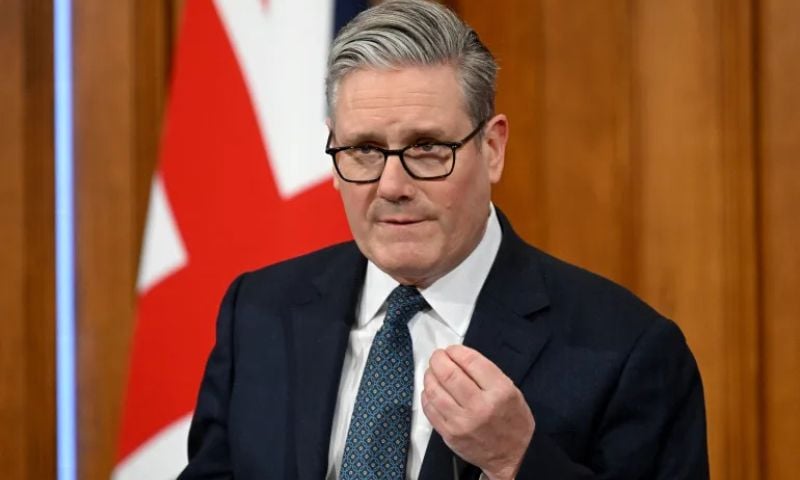



LONDON: British Prime Minister Keir Starmer said on Monday that the United Kingdom would not support the United States’ naval blockade of Iranian ports, stressing that Britain would not be drawn into the conflict in the Middle East.
“We are not supporting the blockade,” Starmer told the BBC, adding that the UK “is not getting dragged in” to the Iran war.
He said Britain’s priority was to restore free navigation through the Strait of Hormuz, a vital global shipping route.
“It is, in my view, vital that we get the strait open and fully open,” he said, noting that roughly one-fifth of the world’s oil supply passes through the waterway in normal conditions.
US announces blockade
The US military said it would begin enforcing a blockade on vessels entering and exiting Iranian ports from 14:00 GMT, following the conclusion of the US-Iran talks in Islamabad on Sunday.
According to the United States Central Command, the restrictions would apply to vessels of all nationalities accessing Iranian ports in the Arabian Gulf and Gulf of Oman.
However, ships transiting between non-Iranian ports would not be impeded.
US President Donald Trump said the move aimed to clear the Strait of mines and prevent Iran from profiting from control of the waterway.
The decision followed more than 21 hours of Pakistan-mediated talks between US and Iranian negotiators that ended without a breakthrough.
UK rules out military involvement
Starmer said British forces would not participate in enforcing the blockade, despite maintaining a presence in the region.
UK minesweepers and anti-drone capabilities would continue operating, but naval ships and troops would not be used to block Iranian ports, he said.
Speaking to BBC, Starmer added that all British diplomatic and military efforts were focused on reopening the Strait.
“My decision has been very clearly that whatever the pressure… we’re not getting dragged into the war,” he said, adding that any action would require a clear legal basis and a defined strategy.
He noted that Britain had been working with partners, including Gulf states, to keep the Strait open rather than restrict access.
Global concern over energy security
Around 20 percent of global oil and liquefied natural gas shipments pass through the corridor, and benchmark crude prices rose sharply following the US blockade decision.
German Chancellor Friedrich Merz warned that the economic impact of the Iran conflict would be prolonged, as Berlin announced measures including fuel tax cuts to cushion the shock.
The Association of Southeast Asian Nations called for the restoration of safe and continuous transit, urging all parties to ensure maritime security and continue negotiations.
Criticism of the US move
Several US allies voiced opposition to the blockade.
Spain’s Defence Minister Margarita Robles said the move “makes no sense” and would deepen instability, describing it as part of a “downward spiral”.
China also urged restraint. Chinese foreign ministry spokesperson Guo Jiakun said maintaining the Strait’s security and stability was in the common interest of the international community
Beijing called on both Washington and Tehran to avoid further escalation.
Turkish Foreign Minister Hakan Fidan said the Strait should be reopened through negotiations and warned that any armed intervention would be highly complex.
Iran’s armed forces condemned the US restrictions as “piracy” and warned that Tehran could introduce a “permanent mechanism” to control the Strait.