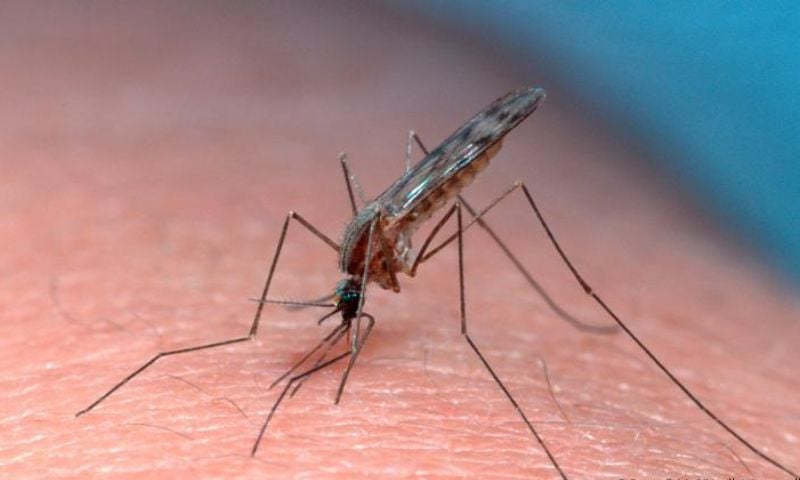
FRANKFURT, Germany: Two workers at Germany’s Frankfurt airport who caught malaria from a mosquito thought to have arrived on a plane have died, the city’s health authority said Wednesday.
Frankfurt’s health authority confirmed the second death, while airport operator Fraport said six employees in total had contracted airport malaria in connection with their work.
The Robert Koch Institute (RKI), Germany’s federal public health institute, said an imported Anopheles mosquito transported by aircraft was the likely source of the infections.
Fraport expressed its “deepest sympathy” to the family of the latest victim. The company said it had been informed of the death by the responsible health authority.

Malaria infections
The first four infections became known in mid-July. The RKI said the affected employees fell ill between July 4 and 6 and that their infections were believed to have been transmitted by an infected Anopheles mosquito brought into Germany by aircraft.
MOSQUITO ON A PLANE: RARE “AIRPORT MALARIA” CLAIMS A LIFE AT FRANKFURT AIRPORT
A tragic and highly unusual aviation-linked health incident has emerged at Frankfurt Airport, Germany, where six airport employees have contracted malaria and one has died.
🇩🇪 According to the Robert… pic.twitter.com/kR5ZttrL4f
— FL360aero (@fl360aero) August 26, 2026
An airport spokesman said the remaining five infected workers were receiving medical treatment, with four of them being treated in hospital.
Fraport said it had informed employees about the outbreak and advised them to seek medical attention if they developed symptoms.
Mosquito traps have also been installed at the airport as authorities investigate the source of the infections.
Mosquitoes captured in the traps will be sent to the Institute of Tropical Medicine in Antwerp, Belgium, for genetic testing to establish their species and origin.
Rare form of malaria
Airport malaria occurs when an infected mosquito is transported on an aircraft or in luggage and subsequently infects people on board, at an airport or in nearby areas.
The RKI said such cases were very rare in Germany. The last documented case of airport malaria at Frankfurt Airport was in 2023.
Malaria cases in Germany normally involve people who have travelled to countries where the disease is endemic. The absence of a travel history can make airport malaria harder to recognise and may delay diagnosis, the RKI said.
“A lack of travel history can lead to a delayed diagnosis,” the institute said in an earlier epidemiological bulletin, warning that delayed diagnosis increases the risk of severe disease.
The latest outbreak is being investigated by the local health authority, which is continuing to monitor the situation.
Mosquito-borne disease
Malaria is caused by parasites transmitted through the bites of infected Anopheles mosquitoes. It does not normally spread directly from person to person.
Symptoms can include fever, chills, headache and nausea, and the disease can become life-threatening if not treated promptly.
According to the World Health Organisation, malaria is preventable and curable and occurs mainly in tropical countries. It causes hundreds of thousands of deaths each year, with the vast majority occurring in sub-Saharan Africa.
People diagnosed and treated early generally make a full recovery, although severe malaria can be fatal.