


ANKARA, Turkiye: Turkiye on Monday called for the reopening of the Strait of Hormuz through diplomacy, warning that any armed international intervention to secure the critical waterway would face serious challenges.
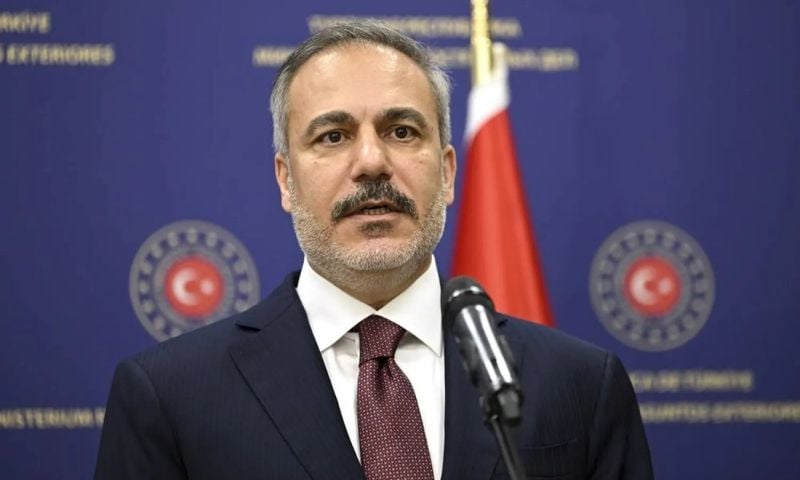
Turkish Foreign Minister Hakan Fidan said military approaches to safeguarding key global sea lanes would be highly complex, urging dialogue to ensure uninterrupted maritime trade through the strategic chokepoint.
Speaking at the Editor’s Desk programme hosted by Anadolu Agency in Ankara, Fidan said the international community wanted shipping routes to remain open.
“What the entire world wants is that international transit remain free and not be obstructed,” he said.
He stressed that stability in the Strait could not be achieved through force.
“Our position is to reopen it through peace. There are many difficulties in intervening here with an international armed peace force,” he added.
#BREAKING Türkiye supports reopening Strait of Hormuz through peaceful means, armed international intervention would face serious challenges: Turkish Foreign Minister pic.twitter.com/C9G8zlUjBt
— Anadolu English (@anadoluagency) April 13, 2026
Tensions after Trump orders blockade
Shipping through the Strait of Hormuz halted earlier on Monday after US President Donald Trump announced a naval blockade targeting Iranian ports.
The move marked a sharp escalation following high-stakes negotiations between Washington and Tehran in Islamabad that made significant progress but ended without agreement.
The United States said the blockade would take effect on April 13 at 10 a.m. ET, according to the United States Central Command.
The restrictions apply to Iranian ports and vessels of all nationalities, although ships travelling between non-Iranian ports would still be allowed to transit.
— U.S. Central Command (@CENTCOM) April 12, 2026
Washington said the decision followed Iran’s refusal to concede on key elements of its nuclear programme during 21 hours of talks mediated by Pakistan.
US Vice President JD Vance had led the American delegation in Islamabad, where he met Iranian delegation headed by Parliamentary Speaker Mohammad Bagher Ghalibaf.
The talks ended without a breakthrough, though the United States described its proposal as a “final and best offer”.
Iran warns of retaliation
Iran’s armed forces condemned the US restrictions, calling them “piracy” and warning that Tehran would introduce a “permanent mechanism” to control the Strait.
Tehran has also maintained that it has the right to impose transit charges in the Strait, a claim rejected by Washington, which says freedom of navigation is a fundamental principle of international maritime law.
World leaders urge restraint
Fidan said both Washington and Tehran appeared aligned on the need to reduce tensions.
“Both sides are sincere about a ceasefire and aware of the need,” he said.
China urged calm and restraint, with foreign ministry spokesperson Guo Jiakun saying safe and unimpeded transit through the waterway served the interests of the international community.
Spain’s Defence Minister Margarita Robles criticised the US move, saying it “makes no sense” and warned it would deepen instability.
British Prime Minister Keir Starmer said the United Kingdom would not support the blockade and stressed the need to restore access to the Strait.
“It is vital that we get the Strait open and fully open,” he said.
The Association of Southeast Asian Nations also called for the restoration of safe and continuous transit, urging all parties to ensure the safety of seafarers and to continue negotiations towards a lasting settlement.