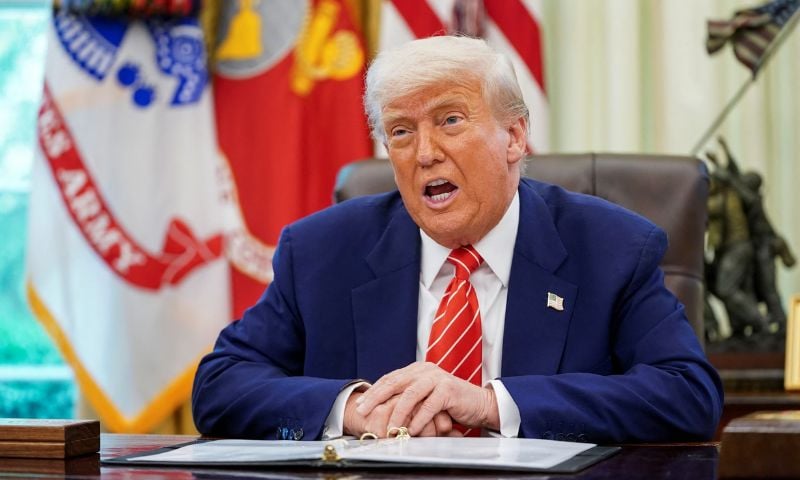



WASHINGTON: US President Donald Trump on Sunday warned that “the clock is ticking” for Iran, urging Tehran to move quickly in ongoing negotiations to end the Middle East conflict.
In a post on Truth Social, Trump said Iran should “better get moving, FAST, or there won’t be anything left of them,” adding that “TIME IS OF THE ESSENCE.”
“For Iran, the Clock is Ticking, and they better get moving, FAST, or there won’t be anything left of them. TIME IS OF THE ESSENCE!” – President Donald J. Trump pic.twitter.com/33gyF0c0O5
— The White House (@WhiteHouse) May 17, 2026
The US President’s remarks come as Pakistan-led diplomatic efforts are continuing to end the US-Iran conflict through dialogue and diplomacy.
On Saturday, US President Donald Trump said Iran had “an interest in reaching an agreement” with Washington.
In a telephone interview with French broadcaster BFMTV on Saturday, Trump said he remained uncertain whether negotiations would soon produce a final deal.
“I have no idea. If they don’t, they’re going to have a very bad time. They have an interest in reaching an agreement,” Trump said.
Iranian Foreign Minister Araghchi said on Friday that Tehran had received messages from the Trump administration signalling willingness for new talks.
US conditions for Iran deal
Iranian media on Sunday said the US has not made any concrete concessions in its response to Iran’s proposal for negotiations to end the war.
Iran’s semi-official Fars news agency reported that Washington gave a five-point list which included a demand for Iran to keep only one nuclear site in operation and transfer its stockpile of highly enriched uranium to the US.
Mehr news agency meanwhile said: “The United States, offering no tangible concessions.”
The US has outlined five key conditions to reach a deal with Tehran, including “allowing only one Iranian nuclear facility to remain operational,” Fars news agency reported.
Washington’s four other conditions include refusing to pay any compensation or damages, demanding the transfer of 400 kilograms of Iranian uranium to the US, withholding the release of even 25% of Iran’s frozen assets, and conditioning any halt to the war on all fronts on the outcome of negotiations, Fars news agency reported.
Iran’s key conditions include ending the war across all fronts, including in Lebanon, lifting sanctions, releasing frozen Iranian assets, compensating for war damage, and “recognition of Iran’s sovereignty over the Strait of Hormuz,” it said.
Regional tensions have escalated since the US and Israel launched strikes against Iran on February 28.
Tehran retaliated with strikes targeting Israel as well as several Gulf countries, along with the closure of the Strait of Hormuz.
Pakistani minister, Iranian President discuss mediation efforts
Meanwhile, Pakistan’s Interior Minister Mohsin Naqvi on Sunday held a meeting with Iranian President Masoud Pezeshkian in Tehran and discussed mediation efforts to revive talks between the US and Iran.
The meeting at the Presidential Palace lasted around 90 minutes and focused on bilateral relations as well as Pakistan’s mediation efforts aimed at promoting regional peace and stability, Iran’s state news agency IRNA reported.
Iranian Foreign Minister Abbas Araghchi and Interior Minister Eskandar Momeni were also present during the meeting, IRNA reported.
Earlier, the Pakistani minister also met Iranian Parliament Speaker Mohammad Bagher Ghalibaf. Iranian media said the two sides exchanged views on regional peace and stability.
Pakistan’s Interior Minister Naqvi arrived in Tehran on Saturday on an unannounced visit linked to Pakistan’s mediation efforts to facilitate dialogue between Washington and Tehran.
Pakistan’s diplomatic push
Naqvi’s trip is part of Pakistan’s shuttle diplomacy to preserve the ceasefire between the United States and Iran and encourage progress towards a permanent peace agreement.
Pakistan brokered a ceasefire between Washington and Tehran on April 8 after weeks of escalating regional tensions involving Iran, the United States and Israel.
Three days later, Islamabad hosted direct negotiations between American and Iranian delegations on April 11 and 12.
Although the talks concluded without a final settlement, however, Islamabad Talks paved the way for further negotiations to permanently end the conflict.
US Vice President JD Vance, who led the American delegation during the Islamabad talks, said earlier this week that progress was being made.
“I think that we are making progress. The fundamental question is, do we make enough progress that we satisfy the president’s red line?” Vance told reporters at the White House.
The Iranian delegation was headed by Ghalibaf.
Pakistan’s Deputy Prime Minister and Foreign Minister Ishaq Dar has repeatedly reaffirmed Islamabad’s commitment to “proactive diplomacy and sustained regional engagement”.
Trump earlier this week also praised Pakistan’s role in facilitating the ceasefire and diplomacy.
“They’re great. I think the Pakistanis have been great. The Field Marshal and the Prime Minister of Pakistan have been absolutely great,” Trump said, referring to Prime Minister Shehbaz Sharif and Chief of Defence Forces and Chief of Army Staff Field Marshal Syed Asim Munir.
Pakistan’s mediation efforts have also drawn support from regional and international leaders.