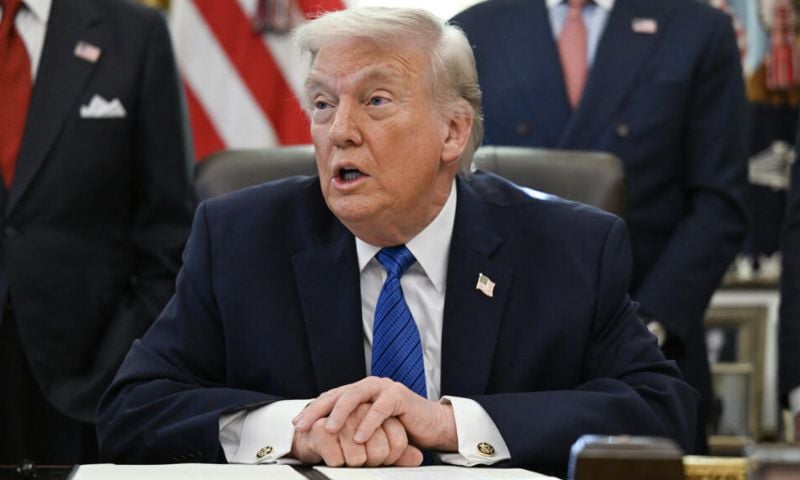



WASHINGTON: US President Donald Trump warned on Wednesday that the United States would bomb and destroy Iranian infrastructure, including bridges and power plants, if Tehran attacked any ship in the Strait of Hormuz.
In a post on his Truth Social platform, Trump said that “from this point forward”, any Iranian attack on a vessel in the strategic waterway using “Missile, Rocket, Drone, or any other device or weapon” would trigger US strikes on “ONE BRIDGE OR POWER PLANT”, including facilities “located next to, or in, the Capital City of Tehran”.
— Rapid Response 47 (@RapidResponse47) July 22, 2026
Later, talking to reporters, Trump said that Iran is “going to pay a big price”.
“Iran can never have a nuclear weapon, they won’t have a nuclear weapon,” the US President said.
“So we’re going to honour them — one of the hardest things to do. For me it’s one of the hardest things to do as a president.”
Trump’s warning came as the US military said its forces had carried out strikes against military targets in Iran for an 11th consecutive night on Wednesday.
According to US Central Command, the operations are aimed at reducing Iran’s ability to threaten commercial shipping passing through the Strait of Hormuz, one of the world’s busiest energy transit routes.
On Tuesday, Trump threatened to strike one of Iran’s heavily fortified underground nuclear facilities.
Trump singled out the deeply buried Pickaxe Mountain facility, which Western intelligence agencies suspect is being developed as an undeclared uranium enrichment site, as a potential target for future US strikes.
Iran hasn’t seen anything yet. pic.twitter.com/Q46oHTco7C
— The White House (@WhiteHouse) July 21, 2026
“If we left right now, it would take Iran 20, 25 years to rebuild,” Trump said. “We’re not finished at all… we’re not leaving right now.”
Iran war costs US $37.5 billion
The Pentagon said the latest strikes were aimed at further degrading Iran’s military capabilities and its ability to threaten commercial shipping through the Strait of Hormuz.
Defence Secretary Pete Hegseth told lawmakers this week that the conflict has already cost the United States $37.5 billion, while defending the Pentagon’s request for tens of billions of dollars in additional emergency military funding.
Also Read: Iran War Costs US $37.5 Billion as Pentagon Seeks Emergency Funding
Iran warned that any attack on sensitive facilities would trigger a broader regional response.
The Khatam al-Anbiya Central Headquarters said Tehran would consider strikes on sites such as Pickaxe Mountain an expansion of the war and warned it would target American interests, as well as those of US allies and supporters.
Iran also intensified military pressure on Gulf states after the Houthis threatened to blockade Gulf ports.
Rubio warns against Iran control of Hormuz
US Secretary of State Marco Rubio on Wednesday warned that allowing Iran to control the Strait of Hormuz would create a dangerous international precedent. He said such a move would undermine the principle of freedom of navigation and could encourage similar actions in other parts of the world.
Speaking at a meeting of foreign ministers from the Association of Southeast Asian Nations (ASEAN) in Manila, Rubio said no country should be permitted to dominate an international maritime route, impose charges on commercial vessels or threaten shipping.
He cautioned that any attempt by Iran to assert control over the strategically important waterway would have consequences extending far beyond the Middle East.
“If a nation is allowed to control an international waterway, demand payment from passing ships and threaten those that refuse, it would establish a dangerous precedent that could be repeated elsewhere, including in this region,” Rubio told the gathering.
He stressed that Iran had no recognised legal authority to regulate or control international transit through the Strait of Hormuz, describing freedom of navigation as a fundamental principle of international law that must be protected.
“The right to free and secure passage through international waterways cannot be compromised,” he said, adding that such a development must not be allowed.
Pressure Mounts Over War Strategy
Senators from both parties also demanded greater transparency over the Trump administration’s strategy for the conflict, expressing concern about the long-term financial and military implications of the war.
Republican Senator John Kennedy called for clearer answers on Washington’s objectives, asking what would happen if the United States withdrew from the Strait of Hormuz.
“We need some hard answers and some straight talk,” Kennedy said.
Neither Hegseth nor Caine offered specific details on whether Iran could impose transit fees on commercial vessels passing through the strategically vital waterway.