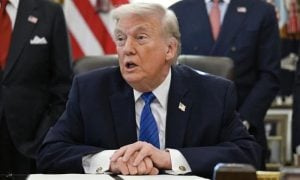
WASHINGTON: US President Donald Trump said on Sunday that oil prices would fall sharply once the war with Iran ends, adding that he expected the conflict to be over soon.
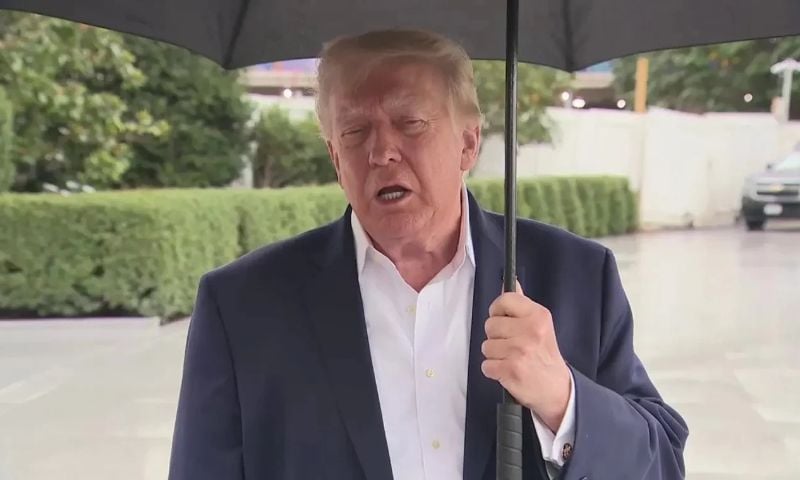
Speaking to reporters on the South Lawn of the White House before departing for Illinois, Trump said a record volume of oil had been transported through the Strait of Hormuz overnight, claiming it exceeded levels recorded before the war.
“Oil will come dropping down as soon as Iran gives up, as soon as the war is over, which will be soon,” Trump said. “Oil is going to come plummeting down and oil prices are coming down.”
“Remember one thing: oil is less expensive now than it was under the Biden administration,” he said. “With all of that being said, we’re taking tremendous amounts of oil out. Last night, we took a record amount of oil out of the Hormuz Strait, more than we took out before the war.”
Energy prices will DROP when Iran gives up, which will be ‘SOON’ — Trump pic.twitter.com/kIDLTUBI1u
— RT (@RT_com) September 27, 2026
Trump Rejects Iran’s Proposal
Trump’s comments came a day after the US President said he had rejected a proposal from Iran conveyed through mediators during indirect negotiations this week in New York.
“They made a proposal, but I rejected it,” Trump told reporters on Saturday before leaving the White House.
Trump on Iran:
They made a proposal, but I rejected it. pic.twitter.com/HIY06XhRXS
— Clash Report (@clashreport) September 26, 2026
Iranian Foreign Minister Abbas Araghchi said on Friday that Tehran had conveyed a seven-day plan to US officials through mediators. Under the proposal, a countdown would begin towards reopening the Strait of Hormuz and halting hostilities if Washington accepted Iran’s conditions.
“If there is seriousness on the US side to come to a deal and reopen the Strait of Hormuz, everything is now prepared,” Araghchi said.
Also Read: Iran Made a Proposal to US, but I Rejected It: Trump
He said the proposal called for an end to hostilities on all fronts, including in Lebanon. In return, he said, the United States would have to lift its blockade on Iranian ports, release frozen Iranian funds and waive oil sanctions.
US-Iran Indirect Talks
US envoys Steve Witkoff and Jared Kushner held a new round of indirect talks with Araghchi on the sidelines of the UN General Assembly in New York this week, according to Axios.
Axios reported that Araghchi presented Iran’s conditions for reopening the Strait of Hormuz and resuming nuclear negotiations.
Iran proposed reopening the strait and restarting nuclear talks within a week if Washington lifted its naval blockade, removed sanctions on Iranian oil sales and reinstated a regional ceasefire, according to the report.
A source told Axios that US negotiators made clear during Tuesday’s talks that Iran did not control the Strait of Hormuz and therefore could not make demands concerning its reopening.
A US official cited by Axios described the discussions through mediators as “positive and constructive”, including on nuclear issues.
Iran was awaiting a US response after the Wall Street Journal reported that Trump had rejected Tehran’s proposal.
Hormuz and Iran’s Nuclear Programme
The Strait of Hormuz is a critical global energy route through which a significant share of the world’s oil supplies normally passes.
Dozens of oil tankers have been transiting the waterway under US protection, carrying millions of barrels of oil to global markets. Volumes remained well below pre-war levels, although the movement of tankers had eased some pressure on international energy supplies.
US officials told Axios on Saturday that about 60 million barrels of oil had passed through the strait over the previous 72 hours.
The nuclear issue remains a major point of disagreement between Washington and Tehran.
Trump has repeatedly said Iran must not acquire a nuclear weapon.
A senior Iranian official told Reuters that Tehran would not show flexibility over its nuclear programme even if Washington accepted its proposed peace plan.
Iranian President Masoud Pezeshkian told CBS programme “Face the Nation” that Tehran was prepared to negotiate over its nuclear programme and other issues but would not accept what he described as “bullying or coercion”.
“Iran is not seeking war, but will defend itself against pressure, threats and attacks,” Pezeshkian said.
He added that Iran had already agreed that it was “not supposed to develop nuclear weapons”.
Mediators Continue Diplomacy
Mediators are working to revive diplomatic efforts between Washington and Tehran.
Qatar’s Prime Minister and Foreign Minister Sheikh Mohammed bin Abdulrahman Al Thani said Doha had spent recent weeks trying to bring the diplomatic track between Washington and Tehran back on course.
Speaking to CNN’s Christiane Amanpour in New York last week, Sheikh Mohammed said the latest indirect talks had shown “positive progress”.
“We believe that we have sensed that from both parties, that they want to see some positive progress,” he said, adding that the exchanges suggested “diplomacy can prevail at the end and we can find a solution”.
“We have walked every avenue between the US and Iran in order to find a diplomatic solution between them,” Sheikh Mohammed said.
Qatar has called for the reopening of the Strait of Hormuz.
Pakistan’s Mediation Role
Pakistan is the key mediator between the US and Iran after helping secure a ceasefire on April 8. Later, Pakistan hosted high-level US and Iranian delegations for talks in Islamabad on April 12 and 13.
On Wednesday, Pakistan’s Prime Minister Shehbaz Sharif said Islamabad was “completely focused” on mediating an end to the war between the United States and Iran through dialogue and diplomacy.
“Pakistan is playing the role of a sincere and honest mediator between Iran, our neighbourly country, and the United States,” Prime Minister Sharif told reporters at the United Nations.
Prime Minister Sharif said he signed the Islamabad Memorandum of Understanding (MoU) in June with Iranian President Masoud Pezeshkian and US President Donald Trump.
“Unfortunately, events after that got a bit unpredictable, but Pakistan is completely focused. We have not lost hope; we are absolutely determined that we will further make efforts and make progress to de-escalate the situation,” the Prime Minister added.
رئيس الوزراء الباكستاني شهباز شريف: باكستان “تركز تماماً” على الوساطة لإنهاء الحرب المتعلقة بإيران pic.twitter.com/g9vR38RMKQ
— العربية (@AlArabiya) September 23, 2026
Pakistan has repeatedly urged a return to the Islamabad Memorandum of Understanding (MoU) between the US and Iran, maintaining that dialogue and diplomacy were the only way to resolve the months-long conflict.
The Pakistan-brokered Islamabad MoU, signed in June, provides the framework for ending the US-Iran conflict and pursuing a negotiated settlement.
Under the Islamabad MoU, Iran and the United States committed to halt military operations, reopen the Strait of Hormuz to commercial shipping and negotiate a comprehensive agreement covering Iran’s nuclear programme, US sanctions and a permanent ceasefire within 60 days.
Pakistan and Qatar later co-mediated the first round of high-level talks in Lucerne, Switzerland, on June 21. The meeting was attended by Vance and Ghalibaf.
Pakistan is making efforts to revive talks under the Islamabad MoU framework to permanently end the conflict through diplomacy and dialogue.