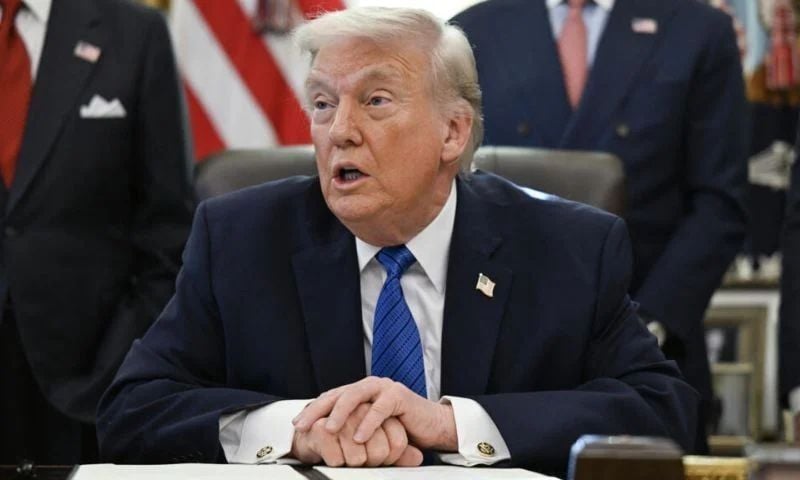
WASHINGTON: US President Donald Trump is willing to offer economic sanctions relief and release frozen funds to Iran in exchange for “concrete progress” related to its nuclear programme, a US official told American news outlets Axios and CNN on Monday.
Washington is engaging in “positive and constructive” talks with Iran through mediators, CNN quoted a US official as saying. The US official emphasised that negotiators would not finalise an agreement unless nuclear-related concerns received full resolution.
NEW: Trump offers Iran economic relief for concrete nuclear concessionshttps://t.co/CyP4k4292c
— Axios (@axios) September 28, 2026
The US message to Iran comes as Qatari and Pakistani mediators try again this week to strike a deal between the two warring countries, Axios reported.
Iran wants talks to focus on the Strait of Hormuz and US naval blockade, while the Trump administration is demanding that Iran agree to nuclear concessions, according to Axios.
The mediators are meeting with Iranian Foreign Minister Abbas Araghchi in New York today (Monday) to discuss mediators’ proposal that the parties have been negotiating over the last few days, Axios said.
According to Axios, mediators are expected to meet with Trump administration officials later Monday or Tuesday to try to reach a breakthrough.
A US official with knowledge of the indirect talks called them “positive and constructive” and said Iran “has indicated they are flexible on the nuclear issues”, the Axios report added.
But the official also noted there are still gaps and stressed there won’t be a deal “unless the nuclear issues are addressed.”
“The sides still remain apart on the timing of the commitments and who takes which steps first,” the official said.
The prospective diplomatic opening comes after Trump on Saturday rejected an Iranian proposal aimed at easing tensions and reopening the strategic Strait of Hormuz, calling Tehran’s conditions “unacceptable”.
Trump said Sunday that he expects US negotiators to hold further talks with Iran this week, while saying Tehran has yet to offer terms acceptable to Washington to resolve the conflict.
“I expect more talks with Iran this week,” Trump told US news website Axios in an interview, adding that Iran wanted to reach a deal but that its terms were not acceptable to him.
“They want to make a deal, but it is not the deal that I want to make. It is what we would have maybe agreed to a year ago. They overplayed their hand,” Trump told Axios.
After nixing Iran proposal, Trump tells Axios he expects talks this week https://t.co/YREe8GfiKT
— Axios (@axios) September 27, 2026
Asked whether Washington was considering resuming military strikes against Iran, Trump said the option remained on the table.
The remarks followed indirect diplomatic exchanges last week on the sidelines of the United Nations General Assembly in New York, where Iranian Foreign Minister Abbas Araghchi held talks with US envoys Steve Witkoff and Jared Kushner through mediators.
Also Read: Oil Prices Jump After Trump Rejects Iranian Peace Proposal
According to reports, Tehran offered to reopen the strategic Strait of Hormuz and resume nuclear talks within a week if Washington lifted its naval blockade, removed sanctions on Iranian oil sales and reinstated a regional ceasefire.
Trump rejected the proposal on Saturday. The US and Iran remain locked in the seven-month war that began with large-scale strikes by the US and Israel in late February.
On Saturday, Trump said he had rejected a proposal from Iran conveyed through mediators during indirect negotiations this week in New York.
“They made a proposal, but I rejected it,” Trump told reporters on Saturday before leaving the White House.
Trump on Iran:
They made a proposal, but I rejected it. pic.twitter.com/HIY06XhRXS
— Clash Report (@clashreport) September 26, 2026
Iranian Foreign Minister Abbas Araghchi said on Friday that Tehran had conveyed a seven-day plan to US officials through mediators. Under the proposal, a countdown would begin towards reopening the Strait of Hormuz and halting hostilities if Washington accepted Iran’s conditions.
“If there is seriousness on the US side to come to a deal and reopen the Strait of Hormuz, everything is now prepared,” Araghchi said.
He said the proposal called for an end to hostilities on all fronts, including in Lebanon. In return, he said, the United States would have to lift its blockade on Iranian ports, release frozen Iranian funds and waive oil sanctions.
Trump Says Iran War Will End ‘Soon’
Trump said on Sunday that oil prices would fall sharply once the war with Iran ends, adding that he expected the conflict to be over soon.
Speaking to reporters on the South Lawn of the White House before departing for Illinois, Trump said a record volume of oil had been transported through the Strait of Hormuz overnight, claiming it exceeded levels recorded before the war.
Also Read: Trump Says Oil Prices Will Plunge After Iran War Ends ‘Soon’
“Oil will come dropping down as soon as Iran gives up, as soon as the war is over, which will be soon,” Trump said. “Oil is going to come plummeting down and oil prices are coming down.”
Energy prices will DROP when Iran gives up, which will be ‘SOON’ — Trump pic.twitter.com/kIDLTUBI1u
— RT (@RT_com) September 27, 2026
Mediators Continue Diplomacy
Mediators are working to revive diplomatic efforts between Washington and Tehran.
Qatar’s Prime Minister and Foreign Minister Sheikh Mohammed bin Abdulrahman Al Thani said Doha had spent recent weeks trying to bring the diplomatic track between Washington and Tehran back on course.
Speaking to CNN’s Christiane Amanpour in New York last week, Sheikh Mohammed said the latest indirect talks had shown “positive progress”.
“We believe that we have sensed that from both parties, that they want to see some positive progress,” he said, adding that the exchanges suggested “diplomacy can prevail at the end and we can find a solution”.
“We have walked every avenue between the US and Iran in order to find a diplomatic solution between them,” Sheikh Mohammed said.
Qatar has called for the reopening of the Strait of Hormuz.
Pakistan’s Mediation Role
Pakistan is the key mediator between the US and Iran after helping secure a ceasefire on April 8. Later, Pakistan hosted high-level US and Iranian delegations for talks in Islamabad on April 12 and 13.
On Wednesday, Pakistan’s Prime Minister Shehbaz Sharif said Islamabad was “completely focused” on mediating an end to the war between the United States and Iran through dialogue and diplomacy.
“Pakistan is playing the role of a sincere and honest mediator between Iran, our neighbourly country, and the United States,” Prime Minister Sharif told reporters at the United Nations.
Prime Minister Sharif said he signed the Islamabad Memorandum of Understanding (MoU) in June with Iranian President Masoud Pezeshkian and US President Donald Trump.
“Unfortunately, events after that got a bit unpredictable, but Pakistan is completely focused. We have not lost hope; we are absolutely determined that we will further make efforts and make progress to de-escalate the situation,” the Prime Minister added.
رئيس الوزراء الباكستاني شهباز شريف: باكستان “تركز تماماً” على الوساطة لإنهاء الحرب المتعلقة بإيران pic.twitter.com/g9vR38RMKQ
— العربية (@AlArabiya) September 23, 2026
Pakistan has repeatedly urged a return to the Islamabad Memorandum of Understanding (MoU) between the US and Iran, maintaining that dialogue and diplomacy were the only way to resolve the months-long conflict.
The Pakistan-brokered Islamabad MoU, signed in June, provides the framework for ending the US-Iran conflict and pursuing a negotiated settlement.
Under the Islamabad MoU, Iran and the United States committed to halt military operations, reopen the Strait of Hormuz to commercial shipping and negotiate a comprehensive agreement covering Iran’s nuclear programme, US sanctions and a permanent ceasefire within 60 days.
Pakistan and Qatar later co-mediated the first round of high-level talks in Lucerne, Switzerland, on June 21. The meeting was attended by Vance and Ghalibaf.
Pakistan is making efforts to revive talks under the Islamabad MoU framework to permanently end the conflict through diplomacy and dialogue.