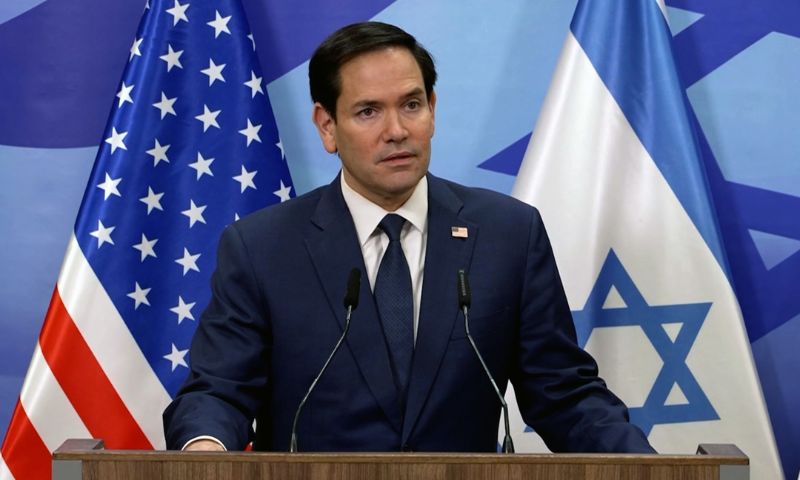
WASHINGTON: US Secretary of State Marco Rubio said President Donald Trump prefers diplomacy to resolve the conflict with Iran, even as Washington maintains pressure on Tehran.
In an interview with Al Jazeera, Rubio said communication between the United States and Iran is ongoing through intermediaries.
“President Trump always prefers diplomacy and always prefers to reach a result, and we could have done that before,” he said.
He added that Washington would welcome a change in Iran’s leadership approach.
“We would always welcome a scenario in which Iran is led by people with a different vision for the future, and if such an opportunity arises, we will seize it,” Rubio said.
Stance on nuclear programme
Rubio reiterated that Iran must not acquire nuclear weapons under any circumstances.
“Iran can never acquire nuclear weapons,” he said, adding that Tehran must also stop manufacturing missiles and drones that threaten neighbouring countries.
“The Iranian regime wants to possess nuclear weapons to threaten and blackmail the world, but we will never allow that to happen. The danger it poses is far too great,” he said.
US military objectives
In a separate video message released by the US State Department, Rubio outlined Washington’s operational goals in Iran.
These include destroying Iran’s air force and navy, significantly reducing its missile-launching capabilities, and targeting facilities producing missiles and drones, Rubio said.
“We are on pace and ahead of schedule on some of those things,” Rubio said, adding that the objectives could be achieved “in a number of weeks, not in a number of months.”
SECRETARY RUBIO: Here are the clear objectives of the operation. You should write them down:
1. The destruction of Iran’s air force
2. The destruction of their navy
3. The severe diminishing of their missile launching capability
4. The destruction of their factories
🎯 pic.twitter.com/SrqCtPLlZB— Department of State (@StateDept) March 30, 2026
Strait of Hormuz in focus
Rubio also warned that the United States would not allow Iran to control the Strait of Hormuz or impose a toll system on shipping.
“Iran is making threats about controlling the Strait of Hormuz and creating a tolling system. That’s not going to be allowed to happen,” he said in remarks shared by the State Department with ABC News.
SECRETARY RUBIO: Iran is making threats about controlling the Strait of Hormuz and creating a tolling system. That’s not going to be allowed to happen.
There is a way forward here to achieve our objectives in a matter of weeks, not months. pic.twitter.com/YG2BdBPHAc
— Department of State (@StateDept) March 30, 2026
Meanwhile, US Treasury Secretary Scott Bessent said the global oil market remains stable despite the tensions.
“Over time, the US is going to retake control of the straits and there will be freedom of navigation, whether it is through US escorts or a multinational escort,” Bessent said in an interview with Fox News.
.@SecScottBessent on the Strait of Hormuz: "We are seeing more and more ships go through on a daily basis…but over time, the U.S. is going to retake control of the straits, and there will be freedom of navigation, whether it is through U.S. escorts or a multinational escort." pic.twitter.com/m0ruKxthRc
— Rapid Response 47 (@RapidResponse47) March 30, 2026
Trump says US in ‘serious discussions’ with Iran
US President Trump said the United States is in “serious discussions” with a “new and reasonable regime” in Iran, claiming that “great progress” has been made.
However, he warned that Washington could escalate its military response if a deal is not reached.
In a post on Truth Social, Trump threatened to “completely obliterate” Iran’s energy infrastructure, including oil facilities and Kharg Island, if the Strait of Hormuz is not reopened or an agreement is not finalised soon.
Iran terms US demands ‘excessive’
Iran has acknowledged receiving messages from Washington via intermediaries but rejected US proposals.
Foreign ministry spokesman Esmaeil Baghaei said the demands were “unrealistic, illogical and excessive,” according to Reuters.
“Our position is clear. We are under military aggression. Therefore, all our efforts and strength are focused on defending ourselves,” he said.
Baghaei also reiterated that Iran does not seek nuclear weapons. “The Islamic Republic of Iran has never sought and does not seek nuclear weapons,” he said, according to AFP.
However, he noted that Iran’s continued membership of the Nuclear Non-Proliferation Treaty is under internal review, reflecting debate at both public and parliamentary levels.