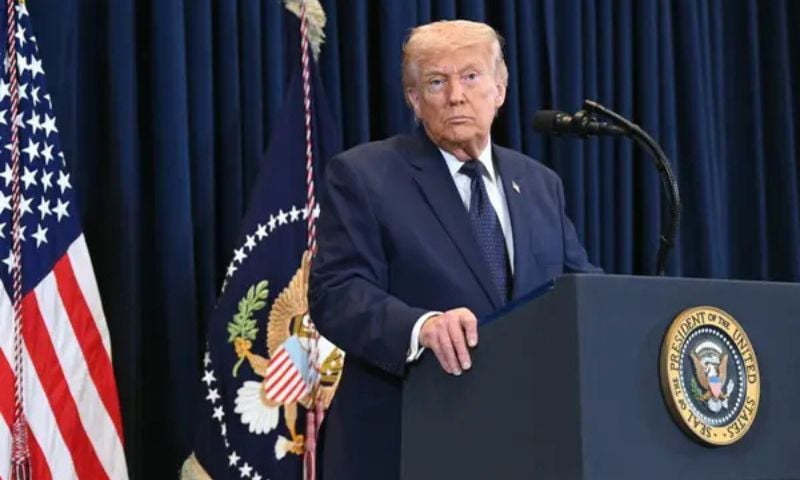
ISLAMABAD: US President Donald Trump has extended his pause on potential strikes against Iranian energy facilities for 10 days, claiming that talks with Tehran are going “very well,” according to a post on his social media platform, Truth Social.
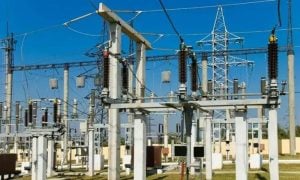
Earlier, Trump had issued an ultimatum, giving Tehran a Friday deadline to enter negotiations to end the ongoing conflict or face the “total destruction” of its energy infrastructure.
“Talks are ongoing and, despite erroneous statements to the contrary by the Fake News Media, and others, they are going very well,” Trump posted on his Truth Social platform.
Last Saturday, Trump had initially given Iran 48 hours to open the crucial Strait of Hormuz to oil tankers, threatening to destroy its power plants, but he has now extended the deadline twice.
“As per Iranian Government request, please let this statement serve to represent that I am pausing the period of Energy Plant destruction by 10 Days to Monday, April 6, 2026, at 8 P.M., Eastern Time. Talks are ongoing and, despite erroneous statements to the contrary by the Fake… pic.twitter.com/LEURAJnRta
— The White House (@WhiteHouse) March 26, 2026
Trump said the deadline would now be extended until April 6 “at the request of the Iranian government,” providing additional time for both sides to negotiate.
“As per Iranian Government request… I am pausing the period of Energy Plant destruction by 10 Days to Monday, April 6, 2026, at 8 P.M., Eastern Time,” he posted.
Tehran has publicly denied that any direct talks are occurring, calling the US claims premature and unverified.
Trump’s envoy Steve Witkoff told a cabinet meeting earlier of “strong signs” that Tehran was ready to negotiate, confirming publicly for the first time that Washington had passed a 15-point “action list” to Tehran through Pakistani officials.
“We will see where things lead, and if we can convince Iran that this is the inflection point with no good alternatives for them, other than more death and destruction,” Witkoff said.
At the meeting, Trump said Iran had allowed 10 oil tankers passage through the Strait of Hormuz to show it was serious about talks.
Casualty risks highlighted
The Iranian news agency Tasnim said that “Iran’s response to the 15 points proposed by the US was officially sent last night through intermediaries, and Iran is awaiting the other side’s response.”
Iran has formally delivered its response to a 15-point proposal from the United States through intermediaries overnight, an informed source told Tasnim News Agency on Thursday, adding that Tehran is now awaiting Washington’s reply. pic.twitter.com/aGKekpursF
— Tasnim News Agency (@Tasnimnews_EN) March 26, 2026
The Tasnim report, citing an unnamed official, said Iran’s reply called for an end to US and Israeli attacks on Iran and also on Tehran-backed groups elsewhere in the region — a reference to Lebanon’s Hezbollah, among others.
War reparations should be paid and Iran’s “sovereignty” over the Strait of Hormuz be respected, it said, citing conditions that put Tehran’s demands far beyond anything in the US plan.
Thousands of American troops have already been deployed to the Middle East ahead of the original Friday deadline. Senior officials in Washington indicated that Trump had been considering a major ground operation in Iran to force Tehran into negotiations, although military planners reportedly warned of the risks involved.
One key strategic target under discussion was Kharg Island, located in the Strait of Hormuz, a critical chokepoint for global oil shipments. US officials believe that controlling the island could provide significant leverage in any potential negotiation with Tehran.
However, military sources told CNN that Kharg Island has recently been reinforced, raising concerns about possible US casualties in any attempted operation.
Regional instability risks
As strikes continued, it remained unclear if the talks would quickly end a war now in its fourth week, after the United States and Israel began airstrikes against Iran on February 28.
Tehran has responded with retaliatory drone and missile launches at sites across the Gulf and a de facto closure of the Strait of Hormuz, sending oil prices soaring and roiling financial markets.
In a televised meeting at the White House, Trump veered between repeated threats to “obliterate” Iran and claims it was already on the verge of capitulating.
Analysts warn that even a limited strike on Iranian energy infrastructure could trigger broader regional instability, potentially affecting global oil markets and escalating tensions across the Middle East.
European allies and UN officials have reportedly urged restraint, highlighting the catastrophic consequences that any military escalation could entail.
Too few soldiers
Trump’s tough talk came as Israeli opposition leader Yair Lapid warned his country’s government for the first time that the war was taking too high a toll.
“The IDF is stretched to the limit and beyond. The government is leaving the army wounded out on the battlefield,” Lapid said, echoing a warning delivered a day earlier by military chief Lieutenant General Eyal Zamir.
“The government is sending the army into a multi-front war without a strategy, without the necessary means, and with far too few soldiers,” Lapid said.
In a televised briefing, Israeli military spokesman Brigadier General Effie Defrin said: “On the Lebanese front, the forward defensive zone that we are creating requires additional IDF forces… For that, more combat soldiers are needed in the IDF.”
No turning back
Elsewhere in the region, Lebanese media reported an Israeli strike hit Beirut’s southern suburbs early Friday, with AFP correspondents hearing several explosions from the Hezbollah stronghold.
Lebanon said it would complain to the UN Security Council over Israeli attacks as a threat to its “sovereignty” and “the integrity of its territory.”
Israel said this week that its military would take control of south Lebanon up to the Litani River, around 30 kilometres (20 miles) from the border, to create a buffer zone against Hezbollah-fired rockets.
In the UAE, two people were killed by debris from an Iranian ballistic missile intercepted near Abu Dhabi.