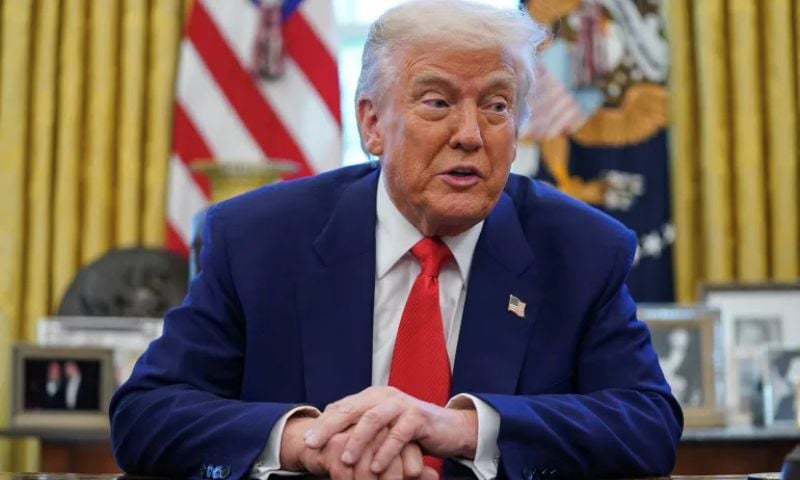
WASHINGTON: US President Donald Trump on Sunday warned that he would order strikes on Iran’s power plants and bridges on Tuesday if the Strait of Hormuz is not reopened to maritime traffic.
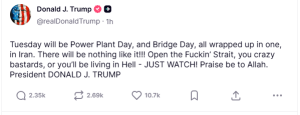
In a post on his Truth Social platform, Trump warned that Iran would be “living in Hell” if the vital waterway remained closed.
He reiterated that US forces could target key infrastructure as early as Tuesday if there was no progress.
“Tuesday will be Power Plant Day, and Bridge Day, all wrapped up in one, in Iran. There will be nothing like it!!! Open the Fuckin’ Strait…, or you’ll be living in Hell – JUST WATCH!,” Trump’s Truth Social post read.
The US president has repeatedly issued deadlines to Iran in recent weeks, linking any military action to the reopening of the strategic strait, a crucial route for global oil shipments.
On Saturday, Trump said Iran had 48 hours to “make a deal” or reopen the Strait of Hormuz, warning that “all hell” would break loose if it failed to comply.
“Time is running out — 48 hours before all Hell will reign down on them,” he wrote.
Trump had earlier threatened on March 21 to “obliterate” Iran’s energy infrastructure if the waterway was not reopened within 48 hours.
However, he subsequently delayed action twice, citing what he described as “very good and productive conversations” with Iranian officials.
On March 26, he extended the pause on strikes targeting energy facilities by 10 days, until April 6, saying the move followed a request from Tehran and that talks were “going very well”.
Strait of Hormuz disruption
The war between the United States, Israel and Iran, which began on February 28, has intensified, with Tehran targeting Israel and Gulf states.
Iran has also tightened control over the Strait of Hormuz, significantly slowing oil flows and pushing global fuel prices higher.
Trump had earlier urged other countries to “get your own oil” from the strait as disruptions deepened.
The conflict has already destabilised regional economies and global energy markets, with both sides striking economic and civilian infrastructure.
US rescues downed pilot
The United States said on Sunday it had rescued a service member who had been missing after Iran shot down a US fighter jet.
Trump said the airman, who had been stranded in mountainous terrain, was injured but in stable condition following the operation.
A second crew member had been rescued earlier.
The aircraft, identified as an F-15E Strike Eagle, crashed on Friday. It was the first confirmed US aircraft loss inside Iranian territory since the war began.
Iranian state television later aired footage it said showed debris from downed US aircraft and claimed multiple American planes had been destroyed during the rescue mission.
A regional intelligence official, speaking on condition of anonymity, told The Associated Press that two US transport planes were destroyed by US forces due to technical malfunctions during the operation.
Iran warns of escalation
Meanwhile, Iran’s military joint command warned it would intensify attacks if US or Israeli strikes continued against civilian infrastructure.
“We once again repeat: if you commit aggression again and strike civilian facilities, our responses will be more forceful,” a spokesman said, according to the IRNA news agency.
A senior Iranian commander also warned that “the doors of hell will be opened” if Iranian infrastructure is targeted, adding that US military assets in the region could be hit in response.
Iran targets Gulf countries’ infrastructure
Iran has intensified attacks on infrastructure in neighbouring Gulf countries in recent days.
In Kuwait, drone strikes damaged power plants and a petrochemical facility and disrupted a water desalination station, according to the Ministry of Electricity.
No injuries were reported in the attack.
In Bahrain, a drone attack caused a fire at a storage facility operated by the national oil company, as well as at a state-run petrochemical plant, authorities said.
The fires were later extinguished.
In the United Arab Emirates, officials said debris from an intercepted attack caused fires at a petrochemical plant in Ruwais, forcing a suspension of operations.
The strikes followed an Israeli attack on Iran’s petrochemical plant, which Prime Minister Benjamin Netanyahu said had been generating revenue for Tehran’s war effort.
Pakistan intensifies diplomatic efforts
Meanwhile, Pakistan and other regional countries are attempting to promote dialogue and diplomacy and de-escalate the conflict.
A telephone call between Pakistan’s Deputy Prime Minister and Foreign Minister Ishaq Dar and the Iranian Foreign Minister Abbas Araghchi resulted in agreement on close and continuous contact.
Islamabad geared up its diplomatic endeavour to contain the rising regional conflict.
The two sides reviewed the fast-evolving situation and committed to remaining in close coordination in the wake of ongoing developments as the war between Iran and the US-Israel alliance is escalating fast.
According to a statement issued by the Ministry of Foreign Affairs, the two leaders exchanged views on the current regional environment, with Islamabad reiterating its support for all efforts aimed at de-escalation and peaceful resolution of the conflict.
“Dialogue and diplomacy remain the only viable path forward,” the statement quoted him as saying during the telephonic counterpart.
Continued escalation could destabilise an already volatile region and carry far-reaching consequences beyond the immediate area of conflict, it added.
Deputy Prime Minister / Foreign Minister Senator Mohammad Ishaq Dar @MIshaqDar50 spoke tonight with Foreign Minister Abbas Araghchi @Araghchi.
They exchanged views on the evolving regional situation.
DPM/FM reiterated Pakistan’s support for all efforts aimed at de-escalation… pic.twitter.com/PvLp2tpDM0
— Ministry of Foreign Affairs – Pakistan (@ForeignOfficePk) April 4, 2026
The latest engagement reflects Islamabad’s growing diplomatic efforts to position itself as a mediator between Iran and the US.
Pakistan has maintained active contact with multiple regional capitals in recent days, advocating restraint and encouraging negotiated solutions and has also offered to host a dialogue between the warring parties.