
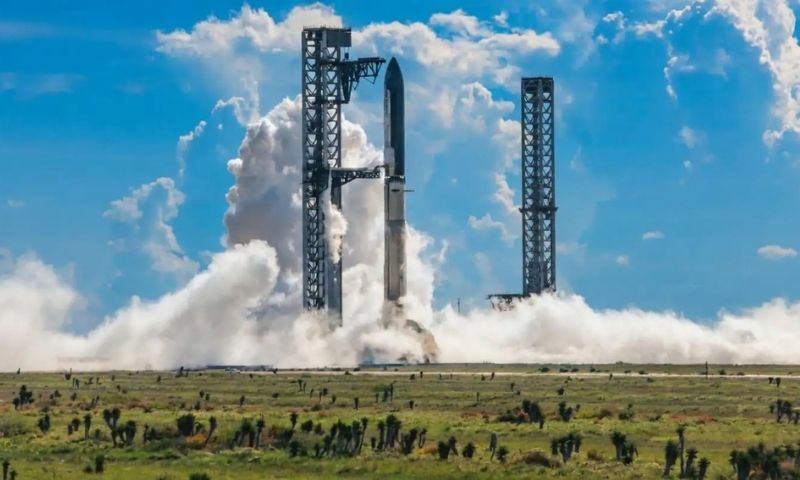
WASHINGTON, United States: SpaceX is preparing for the first attempt to send its Starship rocket into Earth orbit, marking a major milestone in the development of the massive launch vehicle designed for future missions to the Moon and Mars.
The 14th test flight of Starship is scheduled for Monday from Texas and is expected to last around 10 hours. The mission will test the upper stage’s ability to enter orbit and deploy 26 next-generation Starlink satellites if all systems perform as planned.
Starship prepares for orbital challenge
The launch is expected to begin at 7:15am local time (1215 GMT) from SpaceX’s Texas facility.
Starship has undergone several years of development and testing since the company began flying the complete rocket system in 2023. Earlier flights followed suborbital paths to reduce technical challenges during testing.
The black-and-silver spacecraft is the largest and most powerful object ever flown, but engineers still face significant challenges before it can support commercial operations or missions beyond Earth.
Mission targets high-speed orbital flight
During the latest test, SpaceX plans to send Starship into a circular orbit around 275 kilometres above Earth.
The spacecraft will need to reach speeds of around 28,000 kilometres per hour to achieve the required altitude and maintain orbit.
ALSO READ: Bill Gates Warns AI Could Lead to a Billion Deaths
Kathleen Curlee, a senior analyst at Georgetown University’s Center for Security and Emerging Technology, said reaching orbit is one of the most difficult parts of the mission because it requires complex calculations as the rocket experiences different levels of gravity.
If successful, Starship will deploy satellites aimed at expanding SpaceX’s Starlink internet network before completing its planned journey in the Pacific Ocean after orbiting Earth six times.
Reusable rocket development continues
The Super Heavy first-stage booster is expected to fall into the Gulf of Mexico after launch, with SpaceX not planning to capture it using mechanical arms during this test.
SpaceX hopes the flight will begin a new phase of development, including future tests of refuelling spacecraft in orbit.
The company continues to develop Starship as a fully reusable rocket system, with long-term goals including lunar and Mars missions.