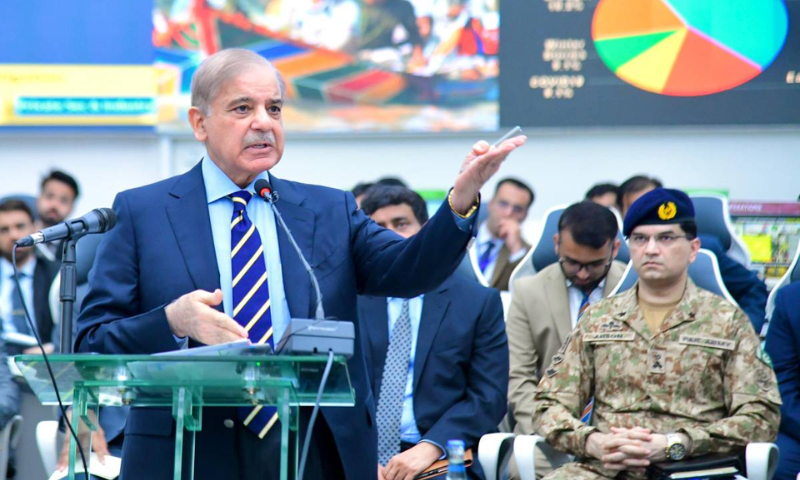
ISLAMABAD: Pakistan’s Prime Minister Shehbaz Sharif on Thursday praised the revamped National Emergencies Operation Center (NEOC) equipped with advanced capabilities including multiple satellite feeds and artificial intelligence tools.
He expressed hoped that the National Disaster Management Authority (NDMA) would serve as a protective barrier for Pakistan against the effects of climate change.
“Pakistan is in the red zone and among the top ten vulnerable countries due to climate change. We should stay motivated and work hard. With this achievement, I am confident that the NDMA, in collaboration with provincial PDMAs, will become a safety wall for Pakistan,” Shehbaz Sharif said during his visit to the NEOC, accompanied by federal ministers and secretaries.
On this occasion, the premier commended NDMA Chairman Lt Gen Inam Haider Malik for focusing on enhancing the Authority’s capacity and human resource development instead of pursuing an earlier project to build an office tower.
Reflecting on past meetings after the 2022 floods, the prime minister said he had advised the NDMA chief to prioritize building the organization’s capacity by incorporating the latest technology, gathering input from provinces, recruiting permanent human resources, and establishing a digital hub.
“Today, seeing that dream realized deserves applause. No province has achieved such capacity with world-class systems. I am pleased that instead of a high-rise building, you invested in this digital hub,” said Shehbaz Sharif.
He said that the 2022 floods had caused $30 billion in damages, a burden that would take years to overcome. The government spent Rs 100 billion on rehabilitation efforts, supplemented by provincial funding and aid from friendly countries.
The prime minister acknowledged the efforts of then Climate Change Minister Sherry Rehman, Foreign Minister Bilawal Bhutto Zardari, and other federal and provincial organizations in rehabilitating millions of affected people.
Prime Minister Sharif lauded the merit-based recruitment of quality human resources and the establishment of a third-party validation mechanism at the NDMA, assuring government support and funding for staff training and equipment procurement.
“This is not normal. This is far above normal,” he emphasized, urging federal ministers and secretaries to follow this example to elevate Pakistan.
He advised the NDMA to ensure close coordination with provinces, including Gilgit-Baltistan and Azad Jammu & Kashmir, and to procure equipment in coordination to avoid duplication.
“This is not an expenditure. This is an investment to save our future investments,” he remarked.
The prime minister informed the gathering that the Federal Government had allocated Rs 80 billion to promote information technology, and had signed an agreement with Huawei to train 300,000 Pakistani youngsters in IT annually.
He praised the creation of the NEOC with cutting-edge technology, recognizing it as a testament to Pakistan’s commitment to disaster readiness and mitigation.
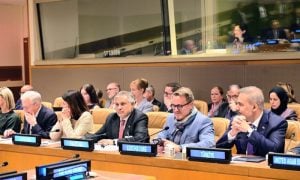
NDMA Chairman Lt Gen Inam Haider Malik briefed the prime minister on the NEOC’s capabilities, including multiple satellite feeds, software, and AI tools to generate a National Common Operating Picture (NCOP). This enhances digital risk assessment, early warning systems, and preparedness strategies for Pakistan.
During his briefing, he highlighted the NEOC’s ability to forecast weather patterns six to ten months in advance at both national and regional levels.
The chairman explained the NDMA’s operating procedures and the NEOC’s role as a hub for emergency response and coordination among PDMAs, DDMAs, relevant ministries/departments, and other stakeholders, including international humanitarian partners, ensuring swift and effective disaster response.
During the briefing, the NDMA showcased its newly developed mobile application aimed at empowering individuals and communities with crucial information to prepare for and respond to potential disasters.
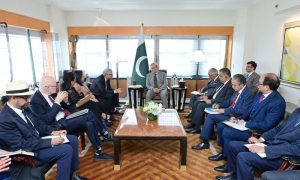
The prime minister was accompanied by cabinet members including Deputy Prime Minister and Foreign Minister Ishaq Dar, Information Minister Attaullah Tarar, Industries Minister Rana Tanveer Hussain, Petroleum Minister Dr. Musaddik Malik, Advisor to PM Rana Sanaullah, and PM’s coordinators Romina Khurshid Alam and Dr. Mukhtar Ahmed. Chief secretaries of the provinces, Gilgit Baltistan, and Azad Jammu & Kashmir joined the meeting via video link.