ISLAMABAD: Pakistan is weighing whether to attend an upcoming Shanghai Cooperation Organisation (SCO) meeting in New Delhi after receiving an invitation from India, while reaffirming its commitment to regional diplomacy amid growing security and geopolitical challenges.
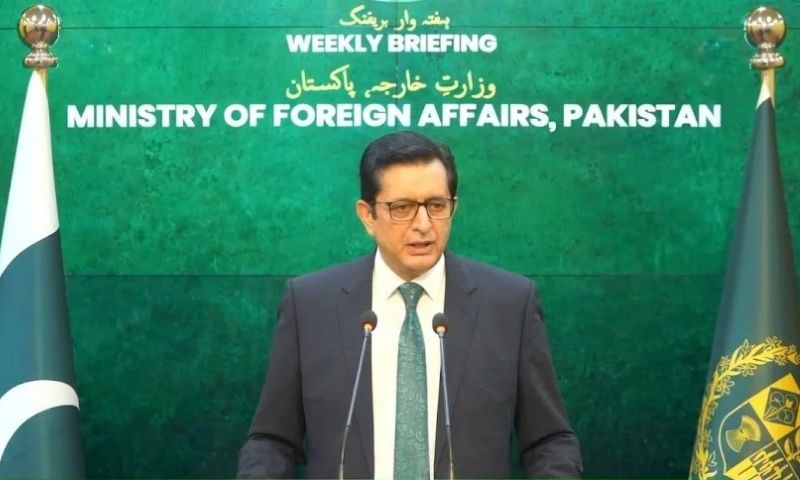
🔴LIVE: Spokesperson’s Weekly Press Briefing 06-11-2026 at Ministry of Foreign Affairs, Islamabad https://t.co/3QBo3AGmz3
— Ministry of Foreign Affairs – Pakistan (@ForeignOfficePk) November 6, 2026
Foreign Office spokesperson Ambassador Sajjad Haider Khan said on Friday that the meeting would take place in the Indian capital from November 20 to 22, with invitations extended to all SCO member states. He said Pakistan’s leadership would make a final decision after consultations among relevant institutions and completion of established protocols.
The announcement came during a wide-ranging weekly media briefing in which the spokesperson also discussed Pakistan’s diplomatic role in regional peace efforts, the evolving Makkah defence alliance, an attack on a Karachi-bound LNG vessel in the Persian Gulf and developments concerning Iran, Palestine and regional maritime security.
Five key takeaways from the foreign office briefing
- SCO meeting in India: Pakistan has received an invitation to attend the November 20-22 meeting in New Delhi, but has not yet decided whether to participate.
- Makkah defence alliance: Pakistan, Saudi Arabia and Turkiye will jointly decide on any expansion of the alliance.
- LNG vessel incident: A QatarEnergy-operated vessel carrying LNG for Karachi was hit by projectiles in the Persian Gulf, but all 25 crew members remained safe.
- Regional peace efforts: Pakistan reiterated its support for diplomatic engagement, including efforts to resolve regional disputes and promote stability.
- ECO meeting postponed: A meeting of Economic Cooperation Organisation interior ministers has been delayed because of the regional security situation, with new dates yet to be announced.
Pakistan yet to decide on SCO meeting in New Delhi
Responding to a question about India’s invitation, Khan said Pakistan had received the invitation extended to all member states of the regional organisation.
“Pakistan, being a responsible member of the comity of nations, believes in positive engagement on regional and global forums,” he said.
However, he clarified that Islamabad had not yet taken a decision on participation.
“The decision to join the dialogue will be undertaken by the leadership after completion of the institutional deliberations and established protocols,” he added.
The spokesperson said peace in the neighbourhood remained Pakistan’s foremost priority, reiterating Islamabad’s commitment to diplomatic engagement and regional stability.
He also referred to Pakistan’s recent mediation efforts, saying the country had provided all possible facilitation to bring two countries that had not spoken to each other for 47 years to the negotiating table.
Khan described the signing of the Islamabad Memorandum of Understanding between the two countries as evidence of Pakistan’s diplomatic efforts and said Islamabad would continue supporting regional peace.
Makkah Defence Alliance still in institutionalisation phase
The spokesperson said any decision to expand the Makkah Alliance for Defence would be taken collectively by its three founding members: Pakistan, Saudi Arabia and Turkiye.
“On expanding Makkah agreement, the three countries which are members of this alliance, they will mutually decide,” he said.
Khan explained that the alliance was still evolving and its institutional structure was being formalised.
He said its secretary general would soon assume responsibilities in Riyadh, after which the relevant bodies would take further steps towards operationalising the arrangement.
Pakistan, Saudi Arabia and Turkiye signed the Makkah Joint Defence Agreement in August, under which an armed attack against one member is to be treated as an attack against all three.
Khan reiterated that Pakistan had made clear from the outset that the arrangement was not directed against any country.
He also referred to Pakistan’s condemnation of Houthi ballistic missile attacks targeting Saudi Arabia’s Makkah and Madinah regions on October 26, including areas near the Holy Sites.
Pakistan had described the attacks as a violation of Saudi Arabia’s sovereignty and territorial integrity, reaffirming its solidarity with Riyadh and commitment to protecting the Two Holy Mosques against external aggression or threats.
The spokesperson also mentioned an October 28 meeting between Deputy Prime Minister and Foreign Minister Ishaq Dar and Lieutenant General Noman Mehmood, the alliance’s first secretary general.
Karachi-bound LNG vessel hit by projectiles in Arabian Gulf
In another significant development, the Foreign Office confirmed that an LNG vessel carrying cargo destined for Karachi had been struck by projectiles while sailing through international waters in the Arabian Gulf.
Khan identified the vessel as the Al Maida, registered in the Marshall Islands and operated by QatarEnergy.
He said the ship was travelling eastbound through the Persian Gulf with 25 multinational crew members, including Pakistani nationals.
“Luckily, no one is harmed,” he said, confirming that all crew members were safe and the vessel had returned to Qatar.
The incident caused a small fire aboard the ship, but no casualties were reported.
Khan added that Pakistani authorities were coordinating with relevant parties to establish further details.
The incident has renewed attention on maritime security and the vulnerability of commercial shipping routes in the region, particularly around the strategically important Strait of Hormuz.
Read Also: Pakistan Demands Action Against Terrorists From Taliban But Keeps Door Open for Talks
Pakistan supports diplomatic solution to Iran nuclear issue
Addressing questions about Iran and its nuclear programme, Khan reiterated Pakistan’s support for a peaceful resolution through diplomatic engagement.
“Pakistan supports a peaceful resolution of this matter,” he said, adding that Pakistan, Qatar and other countries remained involved in mediation efforts.
He also referred to discussions among the R4 foreign ministers, who welcomed ongoing diplomatic initiatives, including the Islamabad MoU, and called for the safe and unimpeded resumption of navigation through the Strait of Hormuz.
The ministers also condemned Houthi attacks against Saudi Arabia and commercial shipping in the Red Sea and Bab al-Mandab.
On Palestine, they reiterated support for a sovereign and contiguous Palestinian state based on the June 4, 1967 borders, with East Jerusalem as its capital.
They also called for an immediate end to violence, unhindered humanitarian assistance to Gaza and progress towards implementing the two-state solution.
Khan said the R4 ministers later met their counterparts from France, Germany, Italy and the United Kingdom on October 23 to discuss the US-Israel-Iran conflict, Palestine, Yemen and maritime security.
He said the ministers had reaffirmed their commitment to dialogue, de-escalation and negotiated solutions.
ECO interior ministers’ meeting postponed
The spokesperson also confirmed that a meeting of Economic Cooperation Organisation (ECO) interior ministers, scheduled for October 29 and 30, had been postponed because of the regional security situation.
He said heightened geopolitical tensions and security concerns, including the cancellation of several flights due to an imminent threat, had necessitated the postponement.
Fresh dates were being worked out, but no revised schedule had been finalised.
Pakistan says no ban on visas for Indian nationals
Responding to questions about travel between Pakistan and India, Khan said Islamabad had issued visas to around 300 Hindu pilgrims and had not stopped issuing visas to Indian citizens.
“We have not stopped visas for Indian citizens,” he said, adding that there were no restrictions on pilgrims seeking to visit Pakistan for religious purposes.
Read Also: Pakistan Warns India of Forceful Response to Any Military Aggression
Asked about reports that the chief minister of Indian Punjab wanted to visit Pakistan, the spokesperson said permission for such a visit would have to be granted by the Indian government.
He also confirmed that crossings were taking place at the Pakistan-Iran border, while advising that the relevant authorities be contacted for precise details about the border’s operational status.