Key Points
- Pakistan and Maldives exchange 20 agreements during President Muizzu’s state visit.
- Islamabad calls for stronger SCO trade, connectivity and regional economic integration.
- Pakistan and the European Union agree to deepen counterterrorism cooperation.
- Pakistan says the Makkah Defence Agreement is for defensive purposes.
- Pakistan warns that diverting its allocated water would constitute an act of war.
ISLAMABAD: Pakistan remains open to dialogue with Afghanistan but insists that any meaningful negotiations must be backed by credible action against terrorist groups operating from Afghan territory, the Foreign Office said on Friday, underscoring the key obstacle to easing tensions between the two neighbours.
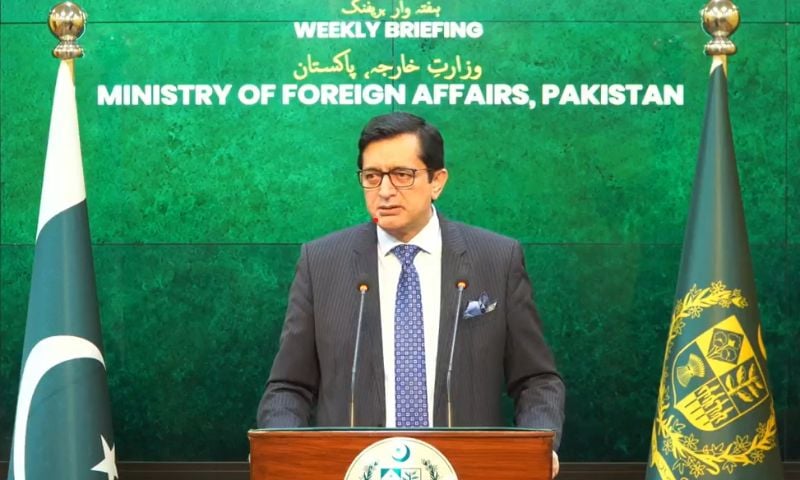
Foreign Office spokesperson Sajjad Haider Khan said Pakistan had repeatedly pursued negotiations with the Afghan Taliban through bilateral contacts and regional diplomatic forums, including the Moscow Format and initiatives involving Qatar, Türkiye, Saudi Arabia and China.
However, the spokesperson said, these efforts had failed because of the Taliban’s intransigence and unwillingness to acknowledge the presence of terrorist organisations in Afghanistan.
Citing United Nations monitoring reports and other assessments, Haider said more than 20 terrorist organisations were operating in Afghanistan, raising security concerns for Pakistan and other regional countries, including China, Uzbekistan and Iran.
He said more than 1,300 Pakistanis had been killed in terrorist attacks over the past year, arguing that further talks would have little practical value unless the Taliban acknowledged the threat and established a credible mechanism to prevent Afghan territory from being used for attacks against Pakistan.
Sajjad Haider said Pakistan valued Russia’s engagement on Afghanistan and regional security but had no new Russian-backed initiative on the table to resolve the tensions.
🔊 Transcript of the Weekly Press Briefing by the Spokesperson
https://t.co/IBRZCZjJ2R
🔗⬇️ https://t.co/APzZlHao5i
— Ministry of Foreign Affairs – Pakistan (@ForeignOfficePk) October 23, 2026
Maldives visit strengthens ties
Pakistan and the Maldives exchanged 20 agreements and memorandums of understanding (MoUs) during Maldivian President Mohamed Muizzu’s state visit from 20 to 22 October.
Muizzu met President Asif Ali Zardari and held talks with Prime Minister Shehbaz Sharif, discussing cooperation in trade, investment, health, education, tourism, agriculture, defence, maritime security and climate change.
The visit was the first by a Maldivian president to Pakistan in 11 years and coincided with the 60th anniversary of diplomatic relations.
Deputy Prime Minister and Foreign Minister Ishaq Dar also attended the Shanghai Cooperation Organisation (SCO) Council of Heads of Government meeting in Dushanbe, advocating stronger regional trade, connectivity, energy cooperation and economic integration.
Pakistan and Egypt separately condemned Houthi attacks against Saudi Arabia, while Dar discussed regional developments with his Iranian counterpart, Abbas Araghchi, emphasising dialogue and diplomacy.
European and defence partnerships
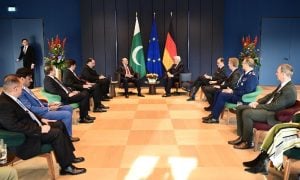
President Zardari is visiting Germany from 22 to 24 October to discuss trade, investment and economic cooperation, as Pakistan and Germany mark 75 years of diplomatic relations.
Pakistan also held political consultations with Lithuania and Latvia, focusing on trade, investment, information technology, education, professional mobility and visa facilitation.
Meanwhile, Pakistan and the European Union held their 10th counterterrorism dialogue in Islamabad on 22 October. The EU condemned recent terrorist attacks in Pakistan, expressed solidarity with affected civilians and acknowledged Islamabad’s counterterrorism efforts.
Both sides discussed terrorist financing, violent extremism, radicalisation and the misuse of cyberspace by terrorist groups. They also expressed concern over security developments in Afghanistan and agreed to hold their next dialogue in Brussels in 2027.
Pakistan, Qatar, Türkiye and Indonesia signed the Badr multilateral MoU in Doha on 21 October to expand cooperation in defence manufacturing, research, technological innovation, training and industrial capacity.
The spokesperson described the agreement as a framework for future cooperation, including technology transfer and joint ventures, noting that participating countries could combine their respective industrial capabilities.
Makkah defence pact
Responding to questions about the Makkah Joint Defence Agreement involving Pakistan, Saudi Arabia and Türkiye, Sajjad Haider Khan said Pakistan and Saudi Arabia had completed their ratification processes, while Türkiye was pursuing approval under its domestic legal framework.
He said the agreement was defensive, consistent with Article 51 of the United Nations Charter and not directed against any particular country.
Under Article 2, external armed aggression against one party would provide a framework for collective assistance. The nature and extent of assistance would be determined collectively by the three countries after assessing the circumstances, he added.
He said decisions on invoking its mechanisms would be made by the three partners under the agreement.
Iran tensions and mediation
Pakistan also reiterated its commitment to mediation between Iran and the United States, urging both sides to exercise restraint and implement the Islamabad Memorandum of Understanding (MoU).
The spokesperson reaffirmed Pakistan’s commitment to applicable sanctions regimes under international and domestic law. He also stressed Pakistan’s longstanding strategic relationship with Washington, including economic, diplomatic and security ties.
Sajjad Haider Khan said Pakistan would continue pursuing negotiations, adding that implementation of the Islamabad MoU could help de-escalate tensions and restore stability.
Kashmir, water and regional stability
Pakistan rejected India’s criticism of resolutions adopted at the Organisation of Islamic Cooperation’s Council of Foreign Ministers meeting in Baghdad, saying they reaffirmed the Kashmiri people’s right to self-determination under relevant UN Security Council resolutions.
Islamabad also expressed concern over an eviction notice reportedly issued against New Delhi’s historic Race Course Mosque, describing it as part of a wider pattern of pressure on Muslim religious sites and waqf properties. Pakistan urged the international community to press India to protect religious heritage and minority rights.
On the Indus Waters Treaty, Sajjad Haider Khan called water security an international concern, arguing that allowing an upstream country to misuse treaty provisions could set a dangerous precedent globally.
He said Pakistan would not allow its allocated water to be diverted and recalled that the National Security Committee had warned that any such diversion would be considered an act of war.
Pakistan also called for reviving the South Asian Association for Regional Cooperation (SAARC), blaming India for the prolonged suspension of its summit process since 2016. Sajjad Haider Khan said intra-regional trade accounted for less than five per cent of the region’s trade, underscoring the need for greater connectivity and economic integration.
Wider diplomatic coordination
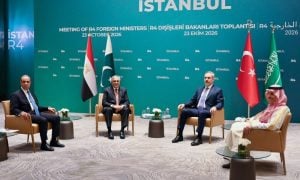
Dar travelled to Istanbul to participate in meetings of the Regional Four grouping — Pakistan, Saudi Arabia, Türkiye and Egypt — and the expanded R4+E3 format involving Britain, France and Germany.
He also reaffirmed Pakistan’s commitment to the United Nations Charter and multilateralism at a ceremony marking United Nations Day.
Sajjad Haider Khan said Pakistan would continue pursuing a balanced foreign policy based on sovereign equality, mutual respect and peaceful cooperation, while strengthening economic partnerships and working with international partners to address shared security challenges.