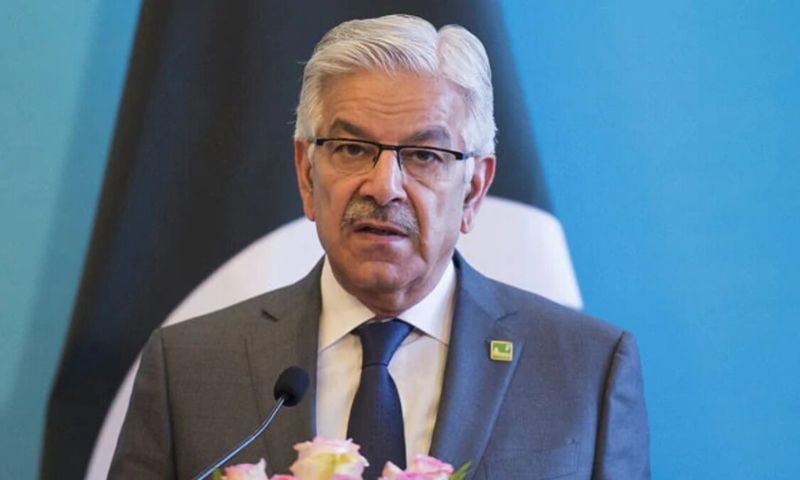



ISLAMABAD: Pakistan’s Defence Minister Khawaja Asif said on Monday that Islamabad reserves the right to respond to terrorist attacks originating from Afghan territory, adding that locations used for such attacks would be targeted in retaliation.
Speaking to the media outside Parliament House in Islamabad, the Defence Minister emphasised that Pakistan would respond to terrorist attacks launched from Afghanistan. He asserted that terrorists’ hideouts across the border in Afghanistan would not be spared if used against Pakistan.
Khawaja Asif added that the Afghan Taliban were “playing into the hands of India” and said that directives given to the Afghan administration were influenced by New Delhi. He further stated that Kabul would not adopt a firm stance without India’s approval.
He noted that Pakistan had repeatedly sought written assurances from the Afghan Taliban regime that Afghan soil would not be used against Pakistan.
The Defence Minister said that despite multiple meetings, the Afghan Taliban regime refused to provide any formal written commitment. He said that while verbal assurances were offered, no official guarantee was given, raising concerns within Pakistan’s security establishment.
Earlier on May 3, Khawaja Asif, stated that Afghan territory is being used as a proxy base for India and that terrorist elements are receiving support from across the border.
The Defence Minister reiterated that Afghan soil is being used as a proxy platform for Indian interests and that terrorist networks are operating with external backing.
He added that Pakistan’s national interest remains paramount and cannot be swayed by external influences, citing the 2019 handover of Indian pilot Abhinandan Varthaman as an instance when the leadership chose restraint over escalation.
Terrorist sanctuaries in Afghanistan
Pakistan has witnessed a surge in cross-border terrorist attacks since the Afghan Taliban returned to power in Kabul in August 2021.
Islamabad has repeatedly asked the Taliban regime to take decisive and credible action against terrorist groups based in Afghanistan; however, the Taliban regime failed to curb terrorist groups operating from Afghan soil, particularly the TTP.
Afghanistan continues to remain a major regional security concern due to the presence of terrorist groups.
Pakistan has repeatedly expressed concern over the presence of terrorist sanctuaries inside Afghanistan, particularly those linked to the banned Tehreek-e-Taliban Pakistan (TTP) terrorist group.
TTP is involved in various terrorist attacks inside Pakistan, as the terrorist group enjoys support from the Taliban regime and freely operates in Afghanistan.
According to reports, some Afghan Taliban commanders are acting as facilitators for TTP terrorists, helping them regroup after attacks inside Pakistan.
Afghanistan-based cross-border terror networks
A recent suicide attack on a Frontier Corps (FC) camp in the Bajaur district of Pakistan’s northwestern Khyber Pakhtunkhwa province involved two Afghan nationals linked to the TTP terrorist network.
The Afghan nationals’ involvement reinforced Islamabad’s longstanding concerns over cross-border terrorist networks and sanctuaries in Afghanistan.
The Bajaur Damangi Camp attack involved coordinated suicide bombers identified as Jalaluddin alias Sajjad and Baitullah alias Akif, both from Afghanistan’s Wardak province, security officials said.
Security analysts said the involvement of Afghan nationals in the suicide attack pointed to the external facilitation and transnational terrorist networks operating against Pakistan from Afghan territory.
In a statement, the TTP has identified the Afghan national Baitullah as Hunain from Wardak province of Afghanistan. He was previously a member of the Afghan Taliban.
The Bajaur Damangi Camp attack represents a calibrated cross-border terrorist operation executed through Afghan-origin suicide operatives linked with the banned TTP networks, security analysts said.
Security analysts said that the identification of Afghan nationals in suicide attacks in Pakistan provides credible evidence of external facilitation and transnational extremist linkages threatening regional stability.
Bajaur incident substantially strengthens Pakistan’s diplomatic position regarding the existence of cross-border terrorist sanctuaries operating against the state, security analysts said.
Security analysts said that the presence of former Afghan Taliban affiliated individuals within TTP suicide structures raises serious concerns regarding terrorist overlap and regional radical networks.
Pakistan’s security forces have always demonstrated operational readiness by successfully neutralising coordinated and high-intensity terrorist assaults, analysts said.
Afghanistan remains terrorism hub
Last week, Russia’s Security Council Secretary Sergei Shoigu warned that Afghanistan remains a major source of terrorism, saying thousands of terrorists linked to various terrorist groups continue to operate freely inside the country.
Speaking at the 21st Meeting of the Secretaries of Security Councils of the Shanghai Cooperation Organization (SCO), Shoigu said between 18,000 and 23,000 terrorists affiliated with more than 20 terrorist groups were currently active in Afghanistan, Russia’s state-run TASS news agency reported.
Shoigu said around 3,000 terrorists linked to the Islamic State group were also present in Afghanistan, underscoring growing concerns among SCO member states over terrorism and cross-border security threats originating from the country.
The Russian Security Council chief warned about the movement of foreign fighters from Syria into Afghanistan and the expansion of terrorist infrastructure in the region.
He said there were increasing numbers of Uyghur, Tajik and Uzbek terrorists relocating from Syria to Afghanistan.
According to Shoigu, these fighters were previously associated with Hayat Tahrir al-Sham in Syria.
Shoigu expressed serious concern over the possibility of security spillover into Central Asia and other parts of the SCO region.