ISLAMABAD: Pakistan and Turkiye expressed hope that the US-Iran ceasefire would pave the way for lasting peace and stability in the Middle East region, as Islamabad prepares to host high-stakes peace talks between Washington and Tehran this weekend.
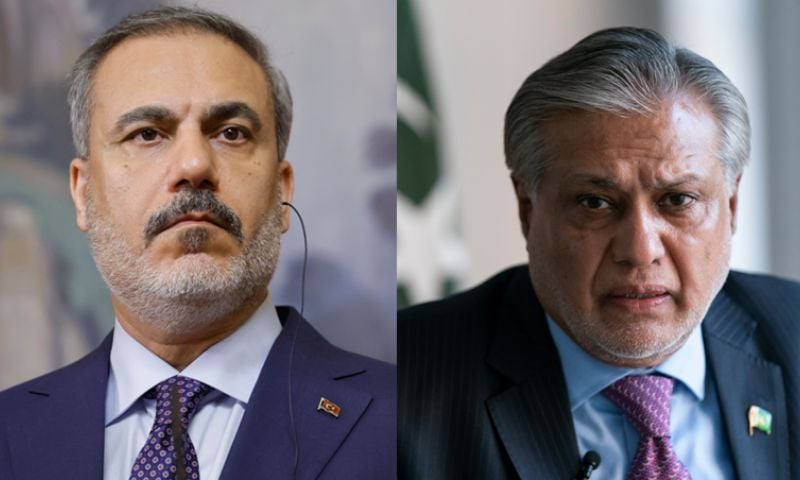
Pakistan’s Deputy Prime Minister and Foreign Minister Ishaq Dar held a telephonic conversation on Thursday evening with Turkish Foreign Minister Hakan Fidan and exchanged views on the latest developments in the regional situation after the Pakistan-brokered two-week ceasefire between the US and Iran.
The Turkish top diplomat appreciated and extended full support to Pakistan for its role in helping secure the recent ceasefire, Pakistan’s Foreign Office stated in a press release.
Underscoring the importance of continued engagement, both leaders hoped that the ceasefire would pave the way for lasting peace and stability in the region.
They reaffirmed strong and fraternal ties between Pakistan and Turkiye and agreed to remain in close contact.
DPM/FM Senator Mohammad Ishaq Dar @MIshaqDar50 held a telephonic conversation this evening with Turkish Foreign Minister Hakan Fidan @HakanFidan.
They exchanged views on the latest developments in the regional situation. FM Hakan Fidan appreciated and extended full support to… pic.twitter.com/EohgHS8oej
— Ministry of Foreign Affairs – Pakistan (@ForeignOfficePk) April 9, 2026
Trump ‘optimistic’ about US-Iran deal
Meanwhile, US President Donald Trump told NBC News on Thursday he was “very optimistic” about a peace deal with Iran after the Pakistan-brokered ceasefire paved the way for the high-stakes US-Iran talks in Islamabad.
Trump told the US broadcaster in a telephone interview that Iran’s leaders were “much more reasonable” in private but added that “if they don’t make a deal, it’s going to be very painful.”
Pakistan set to host US-Iran talks
Meanwhile, Pakistan is set to host high-stakes negotiations between the United States and Iran this weekend after Islamabad’s intensive diplomatic efforts achieved a two-week ceasefire.
The US and Iranian delegations will arrive in Islamabad on Friday, with formal negotiations scheduled for Saturday.
The talks mark a pivotal moment in efforts to de-escalate a conflict that had threatened to engulf the wider Middle East, with Pakistan now positioned at the centre of global diplomacy.
On Wednesday, Pakistan’s Prime Minister Shehbaz Sharif said that delegations from Washington and Tehran will arrive in Islamabad following the breakthrough ceasefire.
PM Sharif said the aim is to “further negotiate for a conclusive agreement to settle all disputes”.
JD Vance to lead US negotiation team
The United States negotiation team will be led by Vice President JD Vance, underscoring the significance Washington attaches to the Islamabad talks.
According to White House Press Secretary Karoline Leavitt, the delegation will also include Special Envoy for the Middle East Steve Witkoff and senior adviser Jared Kushner.
“The first round of those talks will take place on Saturday morning local time, and we look forward to those in-person meetings,” Leavitt said during a press briefing.
She emphasised Vance’s central role in the diplomatic process:
“Vice President Vance has played a very significant and key role in this since the very beginning… he’s been involved in all of these discussions and will be leading this new phase of negotiations in Islamabad.”
Reuters quoted US Vice President JD Vance as saying: “The president of the United States has told me, and he’s told the entire negotiating team, the secretary of state, the special envoy Steve Witkoff — he said, go and work in good faith to come to an agreement.”
He added, “He’s impatient. He’s impatient to make progress. He has told us to negotiate in good faith, and I think if they negotiate in good faith, we will be able to find a deal. But that’s a big if, and ultimately it’s up to the Iranians how they negotiate. I hope they make the right decision.”
Iranian negotiation team
Iran is expected to be represented by Parliament Speaker Mohammad Bagher Ghalibaf and Foreign Minister Abbas Araghchi, signalling Tehran’s serious engagement in what is being seen as a decisive diplomatic opening.
The negotiations follow a critical breakthrough earlier this week, when both the United States and Iran agreed to a two-week ceasefire just hours before a major escalation deadline.
The agreement came after direct engagement between Pakistan’s leadership — including Prime Minister Shehbaz Sharif and Army Chief Field Marshal Asim Munir — and senior officials in Washington and Tehran.
US President Donald Trump announced a suspension of military action after accepting Pakistan’s proposal for a pause in hostilities.
“I agree to suspend the bombing and attack of Iran for a period of two weeks. This will be a double-sided ceasefire,” Trump said.
Iran swiftly issued a reciprocal confirmation, with Foreign Minister Abbas Araghchi acknowledging Pakistan’s role and signalling readiness for negotiations.