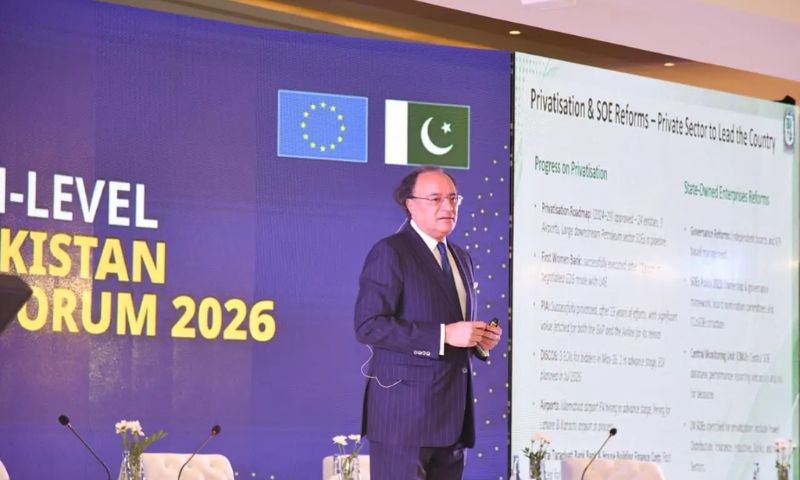
ISLAMABAD: Pakistan’s Finance Minister Muhammad Aurangzeb on Tuesday said the country’s economy is expected to grow by around 4 percent in the current fiscal year, noting that this marks a notable improvement compared to the previous year.
He made these remarks while addressing the EU-Pakistan High-Level Business Forum in Islamabad, adding that the country is steadily strengthening key macroeconomic indicators.
He said that Pakistan recorded a current account surplus of just over $1 billion in March, while also seeing positive trends in IT exports, value-added industries, and remittance inflows.
The minister further stated that foreign exchange reserves are projected to reach approximately $18 billion by the end of June, providing import coverage for around three months.
He said Pakistan is moving ahead with plans to access international capital markets through a diversified fundraising approach, adding that the issuance of a $250 million Panda bond is in its final stages of preparation.
“We are in the final stages of the inaugural Panda bonds. This is going to be roughly $250 million in RMB. If all goes well, then by the middle of May, we will have printed that as well,” he said.
“For the next two to three years, we will be able to access Eurobonds, Sukuks, and for the first time, we are going to make an attempt at dollar-settled-rupee-rate-bond, because we have received a lot of feedback from our institutional investors, as there has been a missing link in terms of our product repertoire,” he added.
Special Assistant to the Prime Minister on Industries and Production Haroon Akhtar Khan also addressed the forum, emphasising that the European Union remains Pakistan’s largest export market, with the GSP+ framework playing an important role in improving market access and standards compliance.
He said the future of Pakistan-EU relations should extend beyond trade to include investment, technology transfer, and integration into global supply chains.
He identified major investment opportunities in sectors such as mining, tourism, renewable energy, agriculture modernisation, pharmaceuticals, logistics, and infrastructure.
He also highlighted the untapped potential of regions, including Gilgit-Baltistan, Khyber Pakhtunkhwa, and Balochistan. Inviting European investors, he stressed Pakistan’s tourism potential, driven by its natural landscapes and cultural heritage.
Earlier on Monday, the State Bank of Pakistan had raised its benchmark policy rate by 100 basis points to 11.50 per cent, signalling a tightening of monetary policy as authorities respond to inflationary pressures in the economy.
The decision was taken at a meeting of the central bank’s Monetary Policy Committee on April 27, according to an official announcement.
The policy rate is a key instrument used by central banks to influence borrowing costs, credit conditions and overall economic activity. An increase typically raises interest rates across the financial system, dampening demand and helping to contain inflation.