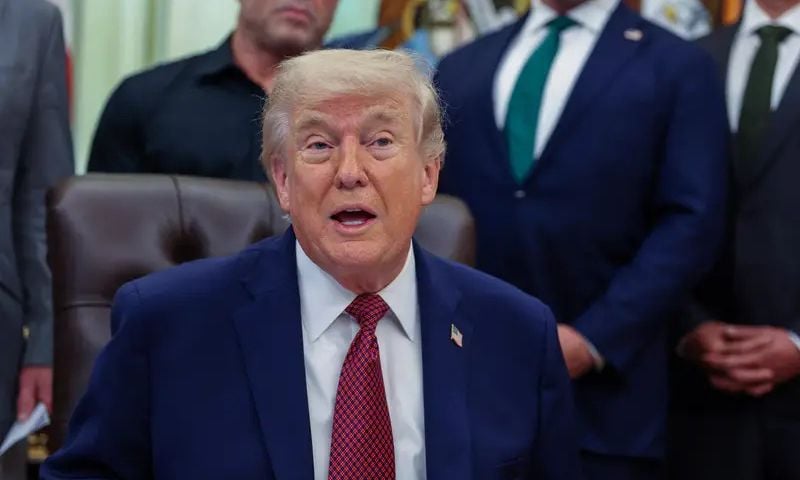



WASHINGTON: US President Donald Trump said on Tuesday that Iran wanted the United States to “open the Strait of Hormuz as soon as possible,” claiming Tehran is in a “state of collapse.”
In a post on his Truth Social platform, the US President said that Iran is trying to figure out their leadership situation, which he hoped they would be able to do so.
“Iran has just informed us that they are in a “State of Collapse.” They want us to “Open the Hormuz Strait,” as soon as possible, as they try to figure out their leadership situation (Which I believe they will be able to do!),” Trump posted on his Truth Social account.
— Rapid Response 47 (@RapidResponse47) April 28, 2026
Meanwhile, Iran has warned that submarine cables in the Strait of Hormuz are a vulnerable point for the region’s digital economy.
The narrow waterway, already a chokepoint for global oil shipments, is equally vital for the digital world.
Several fibre-optic cables snake across the seabed of the strait, connecting countries from Southeast Asia to Europe via the Gulf states and Egypt.
Pakistan stresses diplomacy
On Monday, Pakistan told the UN Security Council that it remains firmly committed to a peaceful resolution of tensions between the US and Iran, warning that continued disruption of the Strait of Hormuz could trigger serious global economic and security consequences.
Speaking at a high-level debate on “The Safety and Protection of Waterways in the Maritime Domain,” Pakistan’s Permanent Representative Asim Iftikhar Ahmad stressed the urgent need to restore maritime stability and ensure uninterrupted global trade flows.
“Any disruptions to the routine traffic at sea gravely impact international trade with negative repercussions for the global economy, and breed volatility that imperils international peace and security,” he said, describing the Strait of Hormuz crisis as “a case in point”.
The global governance order is coming under increasing strain with wide-ranging consequences. Even international waterways have not been able to escape these impacts. The rules and norms that we had collectively and painstakingly put in place to precisely avoid such contestations… pic.twitter.com/desutZt28p
— Permanent Mission of Pakistan to the UN (@PakistanUN_NY) April 27, 2026
He cautioned that if the crisis persists, its immediate effects on energy supplies and essential commodities would ripple outward.
“The first order impacts… will increasingly translate into second and third order impacts on inflation, growth, current account and balance of payment issues — no doubt, developing countries will be most affected,” he warned.
Pakistan has emerged as an active diplomatic interlocutor in recent weeks, maintaining contacts with both Tehran and Washington while coordinating with key regional actors.
Officials say Islamabad has leveraged its ties with Gulf states, as well as its strategic partnership with China, to encourage de-escalation and explore pathways for reopening the critical waterway.
Ambassador Ahmad highlighted these efforts, noting that “Pakistan, supported by brotherly countries including China, Saudi Arabia, Turkiye and Egypt, has spearheaded constructive diplomatic efforts for de-escalation and the broader pursuit of stability between the United States and Iran.”
Statement by Ambassador Asim Iftikhar Ahmad,
Permanent Representative of Pakistan to the UN,
At the High-Level Open Debate of UN Security Council on “The Safety and Protection of Waterways in the Maritime Domain”
(27 April 2026)
******Mr. President,
I wish to congratulate… pic.twitter.com/Nci3SxLN5T
— Permanent Mission of Pakistan to the UN (@PakistanUN_NY) April 27, 2026
He reiterated Islamabad’s commitment to dialogue, adding that Pakistan “remains firm in its faith in diplomacy and dialogue” and will continue efforts to help secure a lasting resolution.
The Strait of Hormuz, through which a significant share of the world’s oil passes, has remained effectively closed amid rising hostilities, raising alarm in global markets and prompting calls for urgent international action.
Ahmad said the situation has exposed deeper vulnerabilities in the global system, warning that the resilience of global governance and strategic stability is now being tested by the safety of maritime waterways.
He also cautioned against the erosion of established international norms. “The rules and norms that we had collectively and painstakingly put in place… are being challenged or set aside. This is an untenable situation,” he told the council.
Pakistan’s diplomatic push comes amid growing international concern over the risk of a broader regional conflict, with diplomats noting Islamabad’s quiet role in facilitating contacts and encouraging dialogue.
Diplomatic channels remain open
Meanwhile, diplomatic channels remained open between the US and Iran through mediators to resolve the conflict.
Iran’s Foreign Minister, Abbas Araghchi, has intensified regional diplomacy, travelling between Islamabad, Oman, and Moscow.
In Russia, he met President Vladimir Putin, securing expressions of support from a longstanding ally.
Washington has made it clear that any meaningful negotiations must include the nuclear issue from the outset — a position that remains a key sticking point between the two sides.
According to Reuters, a senior US official, speaking on condition of anonymity following a high-level meeting on Monday, confirmed that President Trump was particularly dissatisfied with the sequencing proposed by Iran.
The White House reiterated its stance, with spokeswoman Olivia Wales stating that the United States “will not negotiate through the press” and remains firm on its defined red lines.
Iran seeks guarantees
Meanwhile, Iran has called for binding and credible assurances against any future military attack, warning that without such guarantees, long-term stability in the Gulf region will remain elusive.
Speaking during a session of the UN Security Council, Iran’s Permanent Representative Amir Saeid Iravani stressed that sustainable peace in the Gulf hinges on ending hostilities directed at Tehran and respecting its sovereignty.
The meeting, convened at the request of Bahrain, saw widespread criticism from dozens of nations accusing Iran of attempting to assert control over the strategically vital Strait of Hormuz – a crucial maritime route through which a significant portion of the world’s oil supply passes.
Addressing the council, Iravani underscored that regional security cannot be achieved through pressure or confrontation.
Instead, he argued, it requires a “durable and permanent cessation of aggression” against Iran, coupled with dependable guarantees that such actions will not recur.
Oil markets react to ongoing disruption
Despite ongoing diplomatic efforts, global oil markets are once again under pressure.
Prices have continued to rise amid ongoing disruptions in shipping through the strategically vital Strait of Hormuz.
Market analysts note that physical supply constraints, rather than political rhetoric, are now driving price movements.
Recent data indicate that at least six tankers carrying Iranian crude have been turned back due to a US naval blockade.
Before the conflict, approximately 125 to 140 vessels transited the strait daily; that number has now dropped dramatically, with only a handful of ships passing through in the past 24 hours — none carrying oil destined for global markets.
Iran has strongly condemned US actions at sea, accusing Washington of effectively legitimising “piracy” by intercepting and redirecting oil shipments.
On Tuesday, oil prices rose 3 percent, extending the previous session’s gains, as efforts to end the US-Iran war appeared to have stalled, with the crucial Strait of Hormuz waterway still mainly shut.
Brent crude futures for June climbed $3.28, or 3.03 percent, to $111.51 a barrel by 1115 GMT, after gaining 2.8 percent to close the previous session at its highest since April 7.
The contract is up for a seventh straight day.
At their intra-day peak on Tuesday, Brent was up 3.4 percent on the day at $111.86 a barrel.
US West Texas Intermediate (WTI) crude for June rose $3.47, or 3.6 percent, to $99.84 a barrel, after gaining 2.1 percent in the previous session.