Key Points
- Pakistan offers Saudi companies tax-neutral oil storage
- Two sides reviewed Saudi Aramco cooperation on oil
- Dedicated liquefied petroleum gas (LPG) shipments also discussed
ISLAMABAD: Pakistan has offered Saudi Arabia tax-free commercial oil storage facilities and investment opportunities in petroleum infrastructure, refinery modernisation and energy security.
In the latest high-level interaction in Islamabad, the two countries seek to expand their strategic economic partnership.
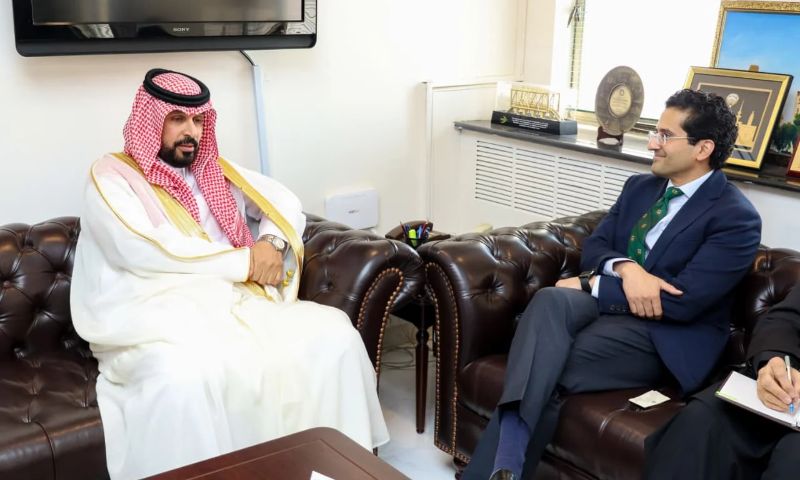
Federal Minister for Petroleum Ali Pervaiz Malik made the proposals during a meeting with Saudi Arabia’s new Ambassador to Pakistan, Dr Rajeh Tami Albugami.
The discussions covered strategic oil reserves, refinery upgrades, liquefied petroleum gas (LPG) supplies, mining investment and stronger commercial engagement between the two countries.
The minister said Pakistan had approved a tax-neutral bonded policy, modelled on international energy hubs such as Fujairah in the United Arab Emirates and Singapore.
The framework would allow Saudi companies to establish commercial oil reserves in Pakistan without local tax liabilities.
He said the arrangement could help Saudi Arabia diversify maritime transit risks associated with the Strait of Hormuz and the Bab el-Mandeb Strait while improving access to Asian markets.
Malik said strategic storage facilities in Pakistan would give Saudi Arabia greater flexibility in managing oil supplies and reaching regional markets.
Hub Petroleum Complex
The minister also outlined plans for a major petroleum storage and refining complex at Hub in Balochistan, which is being developed under the guidance of Technip Energies UK.
The proposed facility is designed to accommodate Very Large Crude Carriers (VLCCs), enabling the handling of large volumes of imported crude oil.
With support from the prime minister and the chief of defence forces, the project is intended to strengthen Pakistan’s position as a regional energy corridor serving Central Asian and Chinese markets.
Malik also highlighted investment opportunities under Pakistan’s ongoing refinery upgradation programme, which aims to modernise existing facilities, improve operational efficiency and facilitate a transition to Euro 5 fuel standards.
He invited Saudi investors to participate in the programme, saying their involvement could contribute to Pakistan’s domestic refining capacity.
Saudi oil and LPG supplies
The minister thanked Saudi Arabia for supporting Pakistan during recent disruptions in global energy markets, particularly for prioritising crude oil shipments to Pakistan through Yanbu port.
He also discussed closer coordination with Saudi Aramco to explore increased crude oil purchases and dedicated LPG shipments to meet Pakistan’s energy requirements.
Both sides said their longstanding defence and strategic partnership provided a foundation for expanding economic cooperation and promoting regional peace and stability.
Ambassador Al-Baqami reaffirmed Saudi Arabia’s appreciation for Pakistan’s longstanding support, saying the two countries stood together in all circumstances.
He said their defence and energy cooperation frameworks were intended to promote peace, stability and economic growth across the region.
The ambassador also announced that the Saudi Embassy in Islamabad had introduced same-day processing of visa applications for Pakistani citizens to facilitate travel and encourage business, cultural and people-to-people exchanges.
Minerals investment
Separately, Malik invited Saudi Arabia’s Vice Minister of Mining, Khalid Al-Mudaifer, to attend the Pakistan Minerals Investment Forum, scheduled for November 12 and 13 in Islamabad.
The invitation aimed to expand Saudi participation in Pakistan’s mineral resources sector, which Islamabad has identified as an important area for attracting foreign investment.
The meeting concluded with both sides reaffirming their commitment to strengthening bilateral ties through increased investment, commercial engagement and mutually beneficial cooperation in petroleum, energy and mining.