ISLAMABAD: Pakistan has sounded an urgent alarm, calling for immediate, coordinated action to translate the country’s National Clean Air Policy (NCAP) into a time-bound implementation plan.
Federal Minister for Climate Change and Environmental Coordination Dr Musadik Masood Malik issued the stark warning on Tuesday, declaring that “time is running out” and that clean air must be treated as a fundamental human right rather than a secondary environmental luxury.
Speaking at the opening of a three-day Stakeholders Workshop for Supporting the Development of the Pakistan National Clean Air Policy Implementation Plan in Islamabad, Dr Malik emphasised that Pakistan can no longer afford to delay concrete action.
Government is taking concrete measures to curb pollution by upgrading oil refineries, promoting electric vehicles and strengthening public transport: @DrMusadikMalik @ClimateChangePK #RadioPakistan #news https://t.co/xC3lUHcl1J pic.twitter.com/VFKtorNAwi
— Radio Pakistan (@RadioPakistan) August 18, 2026
The workshop, jointly organized by the Ministry of Climate Change and Environmental Coordination, the Pakistan Environmental Protection Agency (Pak-EPA), and the Asian Development Bank (ADB), brings together federal and provincial representatives, development partners, academia, researchers, and civil society to chart a definitive path forward.
“Air quality is not a secondary environmental luxury; it is a primary indicator of human survival and dignity,” Dr Malik told the gathering. “This is not an abstract global problem for Pakistan. It is a reality that millions of our citizens experience every year.”
Pakistan’s air pollution crisis by the numbers
The minister’s warning comes against the backdrop of a public health emergency. According to the World Health Organisation, an estimated 99 per cent of the global population breathes air that exceeds recommended pollution limits.
For Pakistan, the situation is particularly dire. Citing World Bank analysis, Dr Malik revealed that average PM2.5 exposure across Punjab hovers around 52 micrograms per cubic metre, more than ten times the WHO guideline of 5 micrograms. In central Lahore, annual averages have been measured at a staggering 110 to 130 micrograms, exposing millions to chronic respiratory and cardiovascular risks.
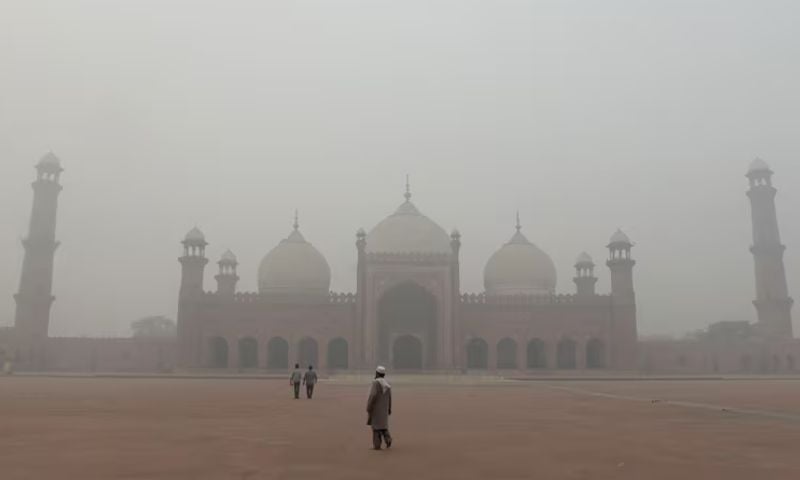
The recurring winter smog that blankets Punjab and other regions has become an annual health crisis, shutting down schools, closing highways, and overwhelming hospitals with patients suffering from pollution-related illnesses. The economic toll, too, is immense, with lost productivity and healthcare costs straining an already fragile economy.
Read Also: Pakistan Urges Greater Global Investment in Green Skills Development
From policy to action: The roadmap ahead
Pakistan adopted its first dedicated National Clean Air Policy in 2023, following decades of fragmented environmental legislation. The policy, approved unanimously by the Federal Cabinet on March 9, 2023, set ambitious targets: a 38 per cent reduction in PM2.5 emissions by 2030 and an 81 per cent reduction by 2040, compared with the baseline.
It identifies five priority sectors, transport, industry, waste, agriculture, and households, and proposes measures including Euro-5 and Euro-6 fuel standards, enforcement of industrial emission standards, prevention of open burning of municipal and agricultural waste, and promotion of low-emission cooking technologies.
However, translating these commitments into on-the-ground action has proven challenging. The three-day workshop aims to bridge that gap by validating Pakistan’s air-quality management landscape, identifying implementation gaps, establishing priority actions, and clarifying institutional responsibilities, financing, and investment opportunities.
An independent review of the NCAP, commissioned by the ADB in collaboration with the ministry, is also underway to examine governance arrangements and sectoral measures, with the goal of developing a more effective, measurable, and legally enforceable implementation framework.
Federal-provincial coordination: The 18th amendment challenge
Pak-EPA Director General Syed Abrar Hussain highlighted one of the key hurdles in implementing the clean-air agenda: the devolution of environmental matters to the provinces under the 18th Constitutional Amendment. While the policy framework exists at the federal level, air-pollution monitoring, control, and mitigation now largely fall under provincial jurisdiction, necessitating stronger federal-provincial coordination.
Hussain supported reviewing the existing committee-based mechanism in favour of a lean, robust, and science-based implementation secretariat focused solely on clean air. He stressed the need for regular air-quality data, annual updating of the Air Pollutant Emission Inventory, resource mobilisation, and sustained public communication.
Dr Malik also revealed that the government is considering establishing a National Clean Air Secretariat within the ministry to strengthen coordination and implementation across all provinces, including Gilgit-Baltistan and Azad Jammu and Kashmir.
Read Also: Pakistan Commits Rs 2.48 Billion to Combat Climate Change Under PSDP 2026-27
Public Awareness: A Critical Missing Piece
Ministry Media Spokesperson and Climate Policy Advocacy Expert Saleem Shaikh underscored that tackling air pollution requires not only policy action but also stronger public awareness and advocacy. He warned against viewing air pollution merely as a seasonal smog problem, noting that its consequences extend to public health, the environment, economic productivity, and climate resilience.
“People cannot support solutions to a problem they do not fully understand. We need to make clean air a public conversation that connects scientific evidence and government policy with people’s everyday lives,” Shaikh said. “Public awareness must become part of implementation, not an afterthought.”
Read Also: Pakistan Plans National Climate Change Fund to Drive Green Transition
He called on government institutions, provinces, researchers, development partners, industry, civil society, and media to work together in translating air-quality data and scientific evidence into information that citizens can understand and act upon. Stronger public engagement, he argued, would help build support for necessary measures concerning fuel quality, industrial emissions, waste and crop-residue burning, and cleaner household energy.
The workshop, running from August 18 to 20, is expected to shape a national implementation plan with clear actions, institutional responsibilities, financing arrangements, and timelines.