Key Points
- Oil price surge has reduced EV cost-recovery period to 1–1.5 years
- Government considers tax incentives to narrow EV price gap with conventional vehicles
- New auto policy could reach cabinet within two weeks
ISLAMABAD: Pakistan expects consumers to switch to electric vehicles faster than previously projected as higher fuel prices have shortened the time needed to recover the higher upfront cost of EVs, a senior government official said.
Haroon Akhtar, adviser to the prime minister on industries and production, told Bloomberg that Pakistan could have an earlier electric-vehicle adoption target well before the 2030 deadline because of the surge in fuel prices following the Middle East conflict.
“I feel that the target we had set in our electric-vehicle policy last year, we will achieve it much earlier as the rise in oil prices has brought cost recovery of EVs to one to one-and-a-half years,” Akhtar said.
Pakistan launched its National Electric Vehicle Policy 2025-30 in June last year, setting a target for electric vehicles to account for 30 per cent of new vehicle sales by 2030.
The policy seeks to reduce the country’s dependence on imported petroleum while promoting cleaner transport and local manufacturing.
The increase in fuel costs has strengthened the economic case for electric vehicles, which generally have higher upfront prices than petrol- and diesel-powered vehicles but lower running costs.
According to Pakistan State Oil Company Ltd, petrol prices have risen 54 per cent and diesel prices 43 per cent since the Middle East war began in February.
The increase has reduced the time consumers have to recover the additional cost of an EV through fuel cost savings.
The shift accelerated after global oil markets saw higher volatility over the Middle East supply disruptions, particularly amid attacks on shipping in the Gulf and the Strait of Hormuz.
Brent crude futures rose $2.28, or 2.28 per cent, to $102.28 a barrel by 0427 GMT on Thursday, while US West Texas Intermediate crude gained $1.66, or 1.88 per cent, to $89.94.
For Pakistan, higher oil prices carry economic implications because the country relies heavily on imported petroleum to meet its transport and energy needs. A sustained increase in fuel costs can raise the import bill and add pressure on inflation and the country’s external accounts.
The government is also preparing a new auto policy that could be presented to the cabinet within the next two weeks, Akhtar said.
The proposed policy could include tax incentives for electric vehicles to narrow the price difference between EVs and conventional vehicles.
Such measures aim to make electric vehicles more affordable and accelerate consumer adoption.
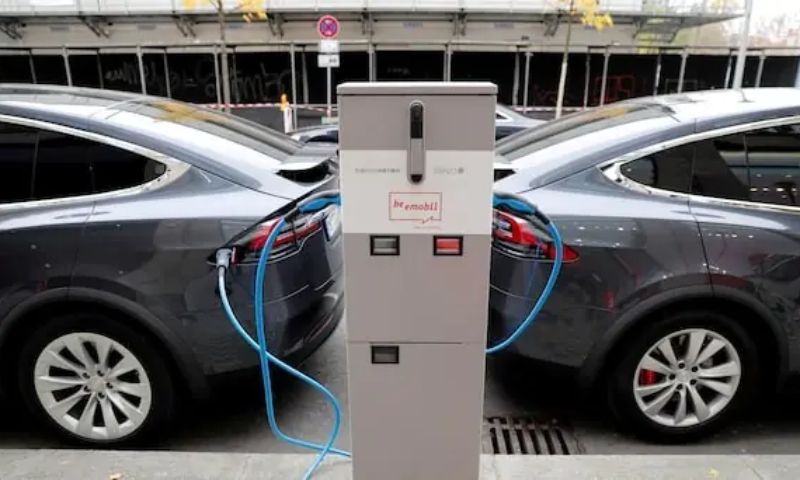
The government has already introduced financial support for electric two- and three-wheelers under its broader electric-vehicle programme, while plans include expanding charging infrastructure and encouraging local production.
The National Electric Vehicle Policy 2025-30 also envisages charging stations, battery-swapping and vehicle-to-grid systems along the motorways.
The government has said the transition could reduce fuel imports, lower carbon emissions and support domestic manufacturing.
Pakistan’s earlier electric-vehicle framework, introduced in 2019, also set ambitious targets for shifting passenger vehicles and heavy commercial transport to electric power.
The new 2025-30 policy broadened the government’s approach to electric mobility and placed greater emphasis on affordability, charging infrastructure and local industry.
The acceleration in EV adoption would offer Pakistan a way to reduce its exposure to international oil-price shocks while lowering transport costs for consumers. But the pace of the transition will also depend on vehicle prices, financing, charging infrastructure and the availability of reliable electricity.
For a country where transport is a major source of petroleum demand, a faster shift to electric mobility could therefore have implications beyond the auto industry, potentially reducing pressure on the import bill while creating new opportunities for domestic manufacturers.