Key Points:
- Putin describes Pakistan as a “large country” with diverse external relations
- Rejects Indian notion of Pakistan being under China’s control
- Remarks made during SPIEF interaction with international media heads
- Question reportedly raised by an Indian journalist
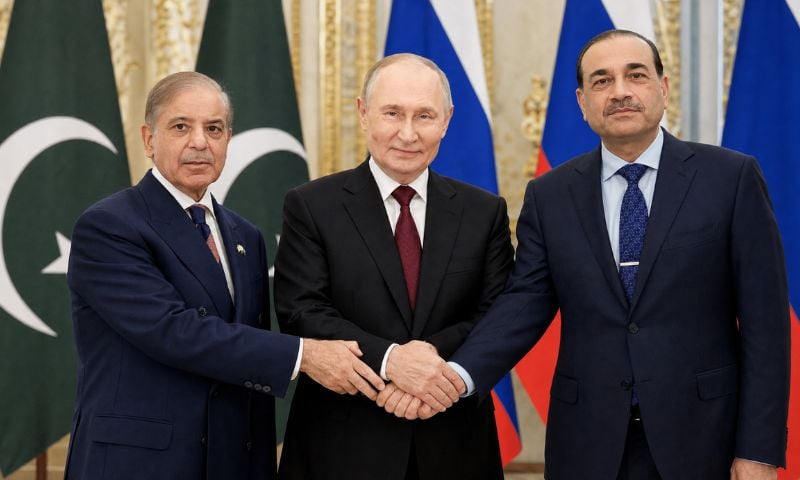
ISLAMABAD: Russian President Vladimir Putin has said Pakistan is a large country with independent foreign policy choices and cannot be described as being under the control of China.
Putin snubbed an Indian journalist who was trying to claim in his question that Pakistan was entirely under China’s influence by saying, “Pakistan is a large country that maintains multi-faceted ties across different regions.
The Russian president rejected the characterisation of Pakistan being solely aligned with Beijing.
The interaction, where an Indian journalist was rendered speechless by Putin, occurred on the sidelines of the 29th St. Petersburg International Economic Forum.
The Indian journalist reportedly raised a question regarding Pakistan’s geopolitical alignment with Beijing during Putin’s interaction with the heads of the international media organisations and news agencies.
According to reports, Putin dismissed the characterisation of Pakistan as being exclusively or structurally dependent on China, instead describing it as a sovereign state maintaining diverse international relationships across multiple regions.
The comments reflected Russia’s diplomatic framing of global affairs, which emphasises multipolarity and the independent and sovereign diplomacy of regional states navigating complex geopolitical environments.
For Pakistan, the remarks add to its narrative of pursuing a multi-vector foreign policy, engaging with China, the United States, Russia, Gulf countries and other partners in areas spanning trade, energy cooperation and strategic dialogue.
Analysts say the exchange at SPIEF reflects shifting global perceptions in which South Asian states are increasingly viewed as balancing multiple power centres rather than aligning rigidly with a single bloc.
The forum remains a key platform for Russian projection of its outlook on the evolving international order and reaffirms its engagement with diverse regional actors amid ongoing global realignments.