


ISLAMABAD: Pakistan’s Ministry of Information and Broadcasting on Tuesday rejected the “delusional” reports by Indian media outlets claiming that the Subhanallah Mosque in Bahawalpur was being reconstructed at the government’s expense after being damaged during last year’s conflict between Pakistan and India.
Several Indian media outlets falsely claimed that the mosque had been nearly restored and made operational again at a cost of Rs250 million funded by the Pakistani government.
“Indian media lives in some delusional world where concocted stories are spewed every now and then, at the behest of their political leadership, to desperately overcome the embarrassment faced through Pakistan’s befitting and just response during Mark-e-Haq, where innocent women, the elderly and children were attacked in a dastardly and illegal operation,” the information ministry said in a statement posted on X.
Pakistan and India engaged in a four-day confrontation after the latter launched strikes targeting the civilian population in various Pakistani cities on May 7, 2025, weeks after the killing of tourists in the Pahalgam area of Indian Illegally Occupied Jammu and Kashmir.
𝐅𝐚𝐜𝐭 𝐂𝐡𝐞𝐜𝐤 | 𝐌𝐢𝐧𝐢𝐬𝐭𝐫𝐲 𝐨𝐟 𝐈𝐧𝐟𝐨𝐫𝐦𝐚𝐭𝐢𝐨𝐧 & 𝐁𝐫𝐨𝐚𝐝𝐜𝐚𝐬𝐭𝐢𝐧𝐠
◼️ Times of India has falsely claimed reconstruction of the Subhanallah Mosque complex in Bahawalpur, with State financing of Rs 250 million, following its damage during India’s botched… pic.twitter.com/CsJFgemI6y
— Fact Checker MoIB (@FactCheckerMoIB) August 25, 2026
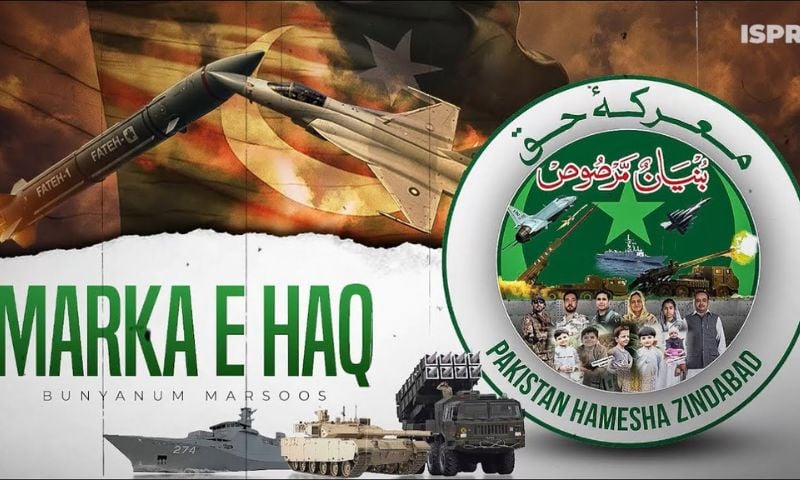
India had codenamed the operation as Operation Sindoor, which Pakistan retaliated by launching Operation Bunyan-un-Marsoos. On May 10, US President Donald Trump announced a ceasefire between the two nuclear-armed neighbours.
India faced humiliation during Operation Sindoor
The ministry added that after the humiliation suffered during Sindoor, following the comprehensive, jaw-dropping, just and memorable retribution from Pakistan, India is repeatedly attempting to retroactively reshape the narrative, which cannot substitute for independently established facts.
It noted that the “pattern is increasingly evident, as also in India’s recent Sindoor documentary, which drew criticism for Bollywood-style reconstruction, selective editing and dramatised presentation rather than a transparent, independently verifiable account”, further stating that the documentary and the recent media story were “neither evidence-based nor supported by any real facts and are rather, more like a belated narrative-building exercise”.
“The repeated recycling of allegations, unsupported intelligence claims and official messaging reflects an attempt to melt the minds of their internal audience through a chain of coordinated narratives in an attempt to offset their humiliating defeat,” the ministry said.
The ministry further noted that the Times of India report fits a familiar state-sponsored terrorism narrative and India’s established playbook, selectively fabricating false pretences, presenting allegations as facts, and then building a predetermined narrative around them.
“This is narrative engineering through distraction, deflection and disinformation, not fact-based journalism. Unverified claims should be scrutinised, not amplified,” the ministry said.
Pakistan military rejects Indian documentary on Operation Sindoor
On August 18, the military’s media wing rejected an Indian documentary on Operation Sindoor, accusing Indian content creators of distorting history and presenting a “highly dramatised, coloured and factually inaccurate” account of the military operation.
ALSO READ: India’s Cinematic Rewrite of Marka-e-Haq Cannot Alter Pakistan’s Battlefield Success
In a statement, the military’s media wing said that more than a year after Marka-e-Haq, India had refused to face what it described as the reality of the conflict and instead sought to portray the outcome in a manner acceptable domestically.
The Inter-Services Public Relations (ISPR) said the documentary featured senior Indian political and military leadership and relied on selectively edited interviews, emotional narration and cinematic, Bollywood-style reconstructions to alter facts and rewrite the operational outcome.
“For its lack of nuance and seriousness, the documentary can be characterised as a tragedy and a comedy at the same time,” the ISPR said.
It said the documentary’s narrative contained “fundamental contradictions” that exposed a belated attempt to manufacture a domestically palatable version of events.