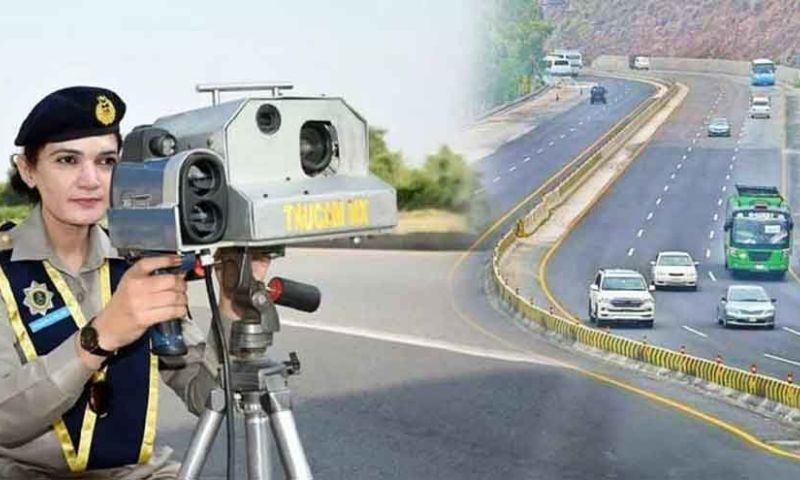
ISLAMABAD: In a major step toward enhancing road safety across Pakistan, motorway authorities have activated a modern point-to-point speed checking system on thee major Motorways, the Peshawar-Islamabad Motorway M-1, the Hakla-Dera Ismail Khan Motorway M-14, and the Hazara Motorway M-15.
The new system effectively ends the old habit of slowing down only in front of cameras, as it now calculates a vehicle’s average speed across entire stretches between checkpoints .
The new technology calculates a vehicle’s average speed between multiple checkpoints, effectively ending the common practice of slowing down only in front of cameras.
With future plans to integrate the system with M-Tag for automated e-challans, Pakistan is modernising its traffic enforcement infrastructure to curb violations and improve safety on its busiest highways.
How the new system works
The newly installed cameras have been placed at intervals of several kilometres along these motorways. The system monitors speed through two distinct methods. First, a vehicle’s real-time speed is checked instantly as it passes under a camera. Second, and more significantly, the system calculates the average speed based on the distance covered and travel time between Checkpoint 1 and Checkpoint 2 .
This dual approach closes a major loophole that frequent motorway travellers had long exploited. Drivers, particularly bus operators, had memorised the locations of traditional speed cameras and would brake suddenly upon spotting them, only to accelerate again afterwards. Under the new point-to-point system, that tactic is rendered useless.
Read Also: Pakistan Considers 20-Year Vehicle Age Limit on Motorways to Boost Road Safety
Calculating average speed
To illustrate, if the distance between two checkpoints is 30 kilometres, it should take 15 minutes to cover that distance at the speed limit of 120 km/h. If a vehicle reaches the second checkpoint in less time, its average speed will be calculated as exceeding the permitted limit, triggering an automatic violation regardless of momentary speed reductions mid-journey .
The official speed limit on three-lane motorways for cars and jeeps is 120 km/h, while public service vehicles are restricted to 110 km/h . Exceeding the limit can result in fines ranging from Rs. 1,000 to Rs. 2,500 for cars, and up to Rs. 4,000 for heavy vehicles .
Future integration with M-Tag
In a significant development for the future of motorway travel, authorities have confirmed plans to integrate the speed checking system with the M-Tag electronic toll collection system. Under this future integration, traffic challans will be processed directly through the M-Tag system, further streamlining enforcement and reducing manual intervention .
The M-Tag system is already mandatory for all motorway travel, with authorities having enforced this requirement since June 2026. Cash reloading at toll plazas is also being phased out, pushing all users toward digital payments.
Read Also: Severe Fog Leads To Motorway Closures Across Pakistan
Safety reminder for travellers
Motorway authorities have issued a strong advisory to all commuters, urging them to strictly observe speed limits, maintain lane discipline, and ensure safe distances between vehicles at all times during their journeys . With the new system now active, compliance throughout the entire stretch of travel is essential to avoid penalties.